
.jpeg)



Big data analytics is the process of examining vast and complex data sets to uncover hidden patterns, unknown correlations and market trends. For SMEs, it is the way to stop making assumptions and start making targeted, data-driven decisions that fuel real growth and provide a competitive advantage.
In a world where 90 percent of all data has been created in the past two years alone, leveraging this information is not a luxury, but essential for survival. This guide will show you what big data analytics means for your business, how it works, and how you can turn raw numbers into your most valuable resource. You will learn how to turn operational data into clear, actionable information that drives efficiency and profitability, without the need for a dedicated team of data scientists.
If you feel overwhelmed by disconnected spreadsheets and reports, you are not alone. Many SMEs collect huge amounts of data but struggle to turn it into real opportunities. That's precisely wherebig data analytics comes in, serving as a powerful translator for your business.
Imagine your data is a warehouse full of unsorted boxes. Finding something is a nightmare. Big data analytics is the modern inventory system that sorts, labels, and organizes every package, turning that chaos into a perfectly managed operation where you can find exactly what you need in an instant. It allows you to understand what's working, what's not working, and where your next big opportunity is.
Fundamentally, "big data" consists of more than just having a large amount of information. They are defined by four key characteristics, known as the "four Vs." Understanding these concepts helps clarify why this data is so diverse and so powerful when you know how to manage it.
Feature (V) What it means to you Example for a PMIVolume The huge amount of data created by every click, transaction and interaction. Tracking daily sales data across multiple online stores and physical outlets. Speed The speed with which new data is collected and must be processed, often in real time. Monitoring live website traffic during a flash sale to manage server load. Variety The data are not just neat rows and columns. It's emails, videos, social media posts, and sensor data. Analysis of customer reviews from your website, Google and social media comments. Veracity The quality and reliability of the data. Inaccurate data leads to incorrect decisions. Cleaning a customer database to remove duplicate entries before a marketing campaign.
These four elements work together. For an e-commerce SME, this means processing daily sales data(Volume) and real-time website traffic(Velocity), while interpreting customer reviews(Variety) to accurately predict inventory needs(Veracity).
In the financial industry, teams use these principles to monitor thousands of transactions per second and detect fraud before it occurs. To have a competitive advantage and achieve transformative results, a deep understanding ofbank data analytics is absolutely essential.
Big data analytics is no longer the exclusive preserve of giants like Amazon and Google. For SMEs, it is a powerful equalizer that provides the information they need to compete, optimize operations and find new sources of revenue, all without an army of data scientists.
This change is why we are seeing massive investment in the industry. The global big data analytics market has been valued at about $277.14 billion and is expected to skyrocket to $1,045.26 billion by 2033. This incredible growth demonstrates how critical this information has become.
Platforms such as Electe, an artificial intelligence-based data analytics platform for SMEs, are designed to make these powerful capabilities accessible. We take care of the heavy lifting behind the scenes, so you can focus on what matters: using clear, reliable information to grow your business.
To fully understandbig data analytics, it is necessary to look under the hood of the engine that makes it all possible. It is a mechanism that takes mountains of raw, chaotic data and makes it understandable with incredible speed. Don't worry, it is not necessary to have a degree in computer science to understand the fundamental concepts.
In its simplest form, data processing comes in two main forms: batch and stream. Choosing the right one depends on how quickly you need your information.
Imagine doing all the week's laundry in one massive load on Sunday. This isbatch processing. It is an efficient way to handle huge volumes of data that do not require immediate response.
Data are collected over a set period of time (an hour, a day, a week) and then processed all at once in a large "batch." This approach is perfect for activities such as:
This is a cost-effective approach and ideal for in-depth and complex analyses in which timing is not the most critical factor.
Now, imagine a smart thermostat that adjusts the temperature of the room the instant you change the setting. This isstreaming processing. It analyzes data the moment it is created, enabling immediate action.
This real-time capability is essential for operations such as:
Stream processing enables your business to be incredibly responsive, turning insights into actions in milliseconds. A solid understanding of fundamental data structures, such as relational databases, is critical to building a processing engine that can handle these demanding workloads.
You probably hear terms like Hadoop and Spark when talking about big data analytics. They might sound like technical terms, but their role is quite simple.
Think of Hadoop as a vast, inexpensive digital warehouse capable of storing every piece of information your company generates. Its importance is hard to overstate: the Hadoop big data analytics market is set to grow from $12.8 billion in 2020 to $23.5 billion by 2025, driven by major IT players.
If Hadoop is the warehouse, then Spark is the super-fast robotic system that finds, processes, and analyzes the exact information you need in a fraction of the time. It is particularly effective at handling both batch and streaming processing, making it an incredibly versatile tool for modern analytics.
The beauty of modern artificial intelligence-based platforms is that they allow you to harness the power of tools like Hadoop and Spark without headaches. They manage complex infrastructure, allowing you to focus entirely on the insights that move your business forward.
These systems are the foundation on which machine learning and statistical models are built. They sift through historical data to find hidden patterns, such as which marketing channels bring in the most profitable customers, and use those patterns to make accurate predictions about the future. Developers who want to integrate these capabilities into their systems can find out more about our verified Postman profile to get a practical view of how systems integration works.
With a platform like Electe, all this complex processing happens behind the scenes. By simply linking your data sources, you get clear and actionable information, turning a huge technical challenge into a simple click.
Having a powerful data processing engine is only half the battle. The real magic ofbig data analytics happens when you turn the raw information your company collects every day into clear, strategic information that can actually be used for decision making. This journey follows a structured path often called the data analytics pipeline.
Think of a professional kitchen. Raw ingredients (your data) arrive from different suppliers. They are washed and prepared (processed), cooked into a final dish (analyzed), and finally arranged elegantly on a plate (displayed). Each step is critical.
This infographic illustrates the two main paths your data can follow during processing.
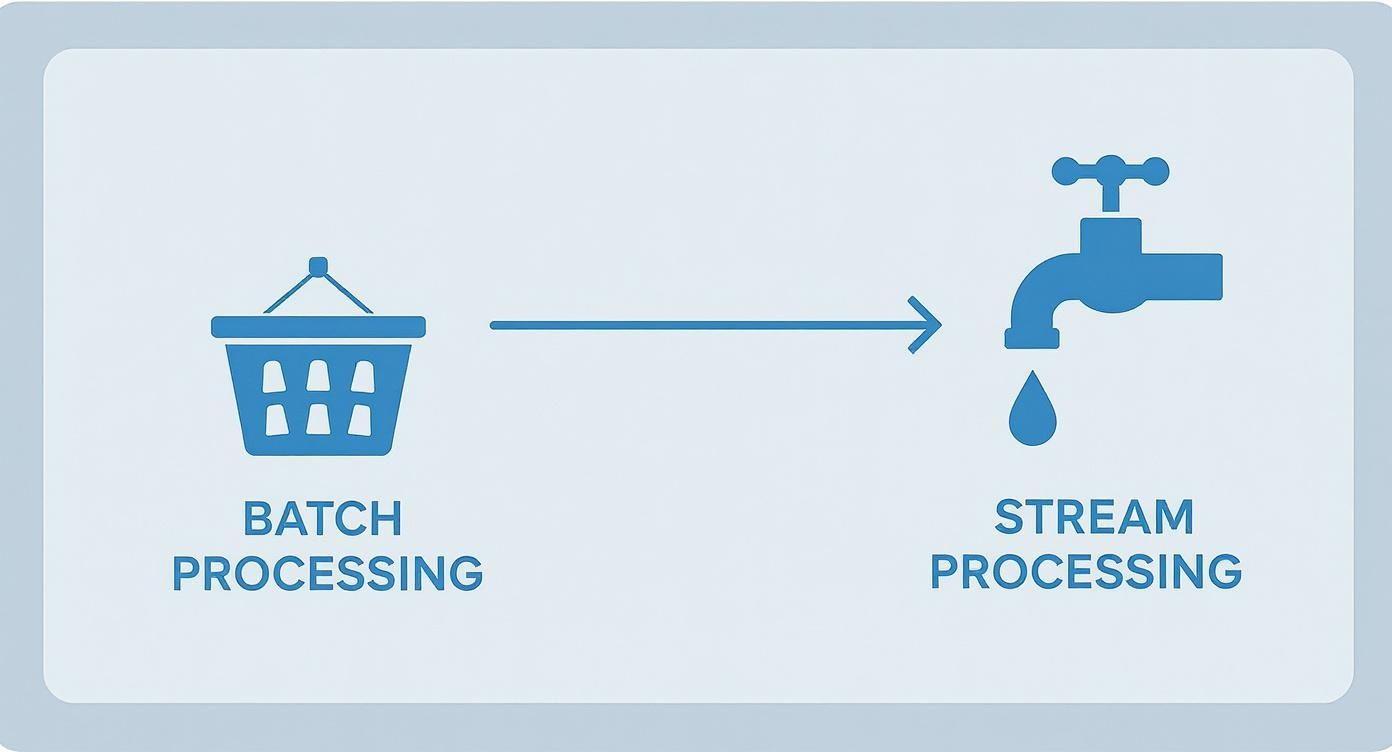
You can see the stark difference between scheduled, high-volume work and the immediate, real-time analysis that modern companies need to remain agile and responsive.
To become a strategic asset, data goes through four distinct stages. Understanding this flow helps to understand how messy numbers can become the engine of confident business growth.
For an SME, this pipeline may seem complex, but its purpose is simple: to bring clarity to complexity. It ensures that the information on which your decisions are based comes from accurate, well-managed data.
Let's look at a concrete example from an e-commerce store.
A customer clicks on your social media ad and comes to your site.Data capture immediately captures that click, tracks their browsing behavior and records what they add to their shopping cart. All of this is piped into your data storage solution.
From there, dataprocessing cleans up the data from this session, perhaps linking it to past purchase history if it is a repeat customer. Finally, at the data analysis and visualization stage, this new information is fed into a sales dashboard.
Suddenly, you can see which ads generate the most sales, which products people often buy together, and where they tend to abandon the cart during checkout. An artificial intelligence-based data analytics platform automates the entire process. To see this last step in action, learn how to create powerful analytics dashboards on Electe. This automation frees you up and allows you to focus on smart moves without getting bogged down in data logistics.

The theory is great, but the real value ofbig data analytics comes from solving your specific business problems. For SMEs, it's not about chasing trendy buzzwords, it's about finding concrete answers to questions that affect your bottom line. How can you reduce waste? Where are your next best customers? What is the most efficient way to operate?
The answers are already in your data. By linking analytics to these daily challenges, you can stop just collecting information and start using it as a strategic resource. Let's examine some scenarios in which analytics offers a clear and measurable return on investment.
The problem: An online retailer is stuck in the classic inventory trap. Either it accumulates stockpiles of items that gather dust, immobilizing capital, or it runs out of the most popular products during peak demand. Customers leave disappointed and sales are lost. Their current forecasting method? A mix of the previous year's sales data and assumptions.
The data-driven solution: usingbig data analytics, the retailer links multiple data sources to gain a much clearer view of the future. The system not only looks at past sales, but analyzes real-time website traffic, social media trends, competitor pricing, and even seasonal patterns. An artificial intelligence-based platform can then run predictive models on this combined data set.
The result: the company now obtains automated and highly accurate demand forecasts. This optimizes inventory levels, reducing inventory costs by 15-20% while ensuring availability of best-selling products. It is a direct path to more revenue, healthier cash flow and more satisfied customers.
The problem: A small financial services company must evaluate loan applications, but its manual process is slow and inconsistent. It relies on a handful of traditional data, making it difficult to identify subtle risk factors or approve a solid applicant who does not fit the traditional profile.
The data-driven solution: the team adopts a data analytics platform to automate risk assessment. Within seconds, the system processes thousands of data points: transaction histories, credit reports, and even nontraditional sources. Machine learning algorithms identify complex patterns related to high and low risk behaviors that a human analyst could easily overlook.
The result: what used to take days now takes minutes. The accuracy of risk forecasting improves, leading to a lower default rate and a more profitable loan portfolio. Your team can now serve more clients, faster and with greater confidence.
"The real power of analytics is its ability to answer your most pressing business questions with hard evidence, not assumptions. It transforms your data from a passive record of the past to an active guide for the future."
The rapid adoption of these data-driven approaches is redefining entire industries. Not surprisingly, the data analytics software segment now controls about 67.80 percent of a market that recently grew to $64.75 billion. This growth is fueled by the urgent need for real-time information as organizations face ever-increasing data complexity. To learn more about this topic, you can find out more about the growth of the data analytics market and find additional information.
The principles are universal, but the applications are specific. Here is how various sectors are using data to achieve tangible results.
Industry Common challenge Big data analytics solution Potential business impact Retail and e-commerce Inaccurate inventory forecasts, generic marketing Predictive demand modeling, behavior-based customer segmentation Reduced stock breakage, increased campaign ROI, increased customer loyalty Finance and banking Slow risk assessment, fraud detection Real-time transaction analytics, algorithmic creditworthiness assessment Reduced default rates, faster loan processing, increased security Healthcare Inefficient operations, personalized patient care Predictive analysis of patient readmissions, electronic medical record analysis Improved patient outcomes, optimized hospital resource allocation Manufacturing Unplanned equipment downtime, supply chain disruptions Predictive equipment maintenance, real-time supply chain monitoring Reduced operating costs, minimized production delays, improved logistics
As you can see, the basic idea is the same across the board: replace assumptions with data-driven decisions. This change enables your company to become more proactive, efficient and responsive.
The problem: The marketing manager of a growing SMB is tired of generic e-mails that do not get the desired result. Engagement rates are low because they send the same message to everyone, failing to pique the interest of different customer groups.
The data-driven solution: usingbig data analytics, the manager delves deeper into customer behavior. The platform segments audiences based on purchase history, products viewed, email interactions and demographic data. It quickly identifies unique customer profiles with different interests and buying habits.
The result: your marketing team can now launch highly targeted campaigns. Instead of a generic sales ad, it can send a special offer on running shoes exclusively to customers who have previously purchased sports equipment. This personalized approach increases open rates, boosts click-throughs, and provides a measurable increase in sales.
Getting started withbig data analytics need not be complicated. Here are some concrete steps you can take today to begin your journey toward data-driven decision making.
The era of gut-based business decisions is over. Today, the most successful SMEs are those that can effectively leverage their data. Big data analytics is no longer a futuristic concept reserved for large companies, but an accessible and powerful growth engine that can help you better understand your customers, optimize your operations, and uncover new revenue opportunities.
By moving from raw data to useful information, you turn a complex and underutilized resource into a clear competitive advantage. The journey begins by asking the right questions and using the right platform to find the answers hidden in your data.
Are you ready to illuminate the future with artificial intelligence? Learn how Electe works and turn your data into your most powerful asset.

.svg)


.svg)
.svg)
.png)