
You have a brilliant idea for using artificial intelligence and data analysis in your company, but how can you convince management to fund it? The answer is a rock-solid business case. Often, the most promising initiatives run aground not because of a lack of potential, but because of an inability to clearly demonstrate return on investment (ROI). An idea without solid numbers is just an expensive hypothesis.
This article is your practical guide to overcoming this obstacle. We won't just give you generic theory, but guide you step by step in building persuasive, data-driven arguments. We'll explore eight detailed business case examples, from retail inventory optimization to sales forecasting, and provide you with a practical template for building your own.
For each example, you will see how:
You will learn how to use platforms such as Electe, an AI-powered data analytics platform for SMEs, to quickly gather the insights you need to strengthen your arguments. Get ready to turn your insights into concrete, approved, and funded projects.
Before diving into the examples, here is a simple and flexible template that you can adapt to any AI and analytics investment project. Use it as a basis for structuring your proposals.
1. Executive Summary
2. Cost-Benefit Analysis
3. Calculation of Return on Investment (ROI)
(Net Investment Income / Investment Cost) x 100(€950 * 12) / (€500 + €250 * 12) * 100 = 11,400 / 3,500 * 100 ≈ 325%€3,500 / €11,400 ≈ 0.3 years (approximately 4 months)(€600 * 12) + €1,500 = 8.700€(€20,000 - €8,700) / €8,700 * 100 ≈ 130%€8,700 / €20,000 ≈ 0.43 years (approximately 5 months)Now, let's apply this logic to other, more complex business case examples.
Accurately forecasting future sales is the foundation of sound business planning. However, many teams still rely on manual estimates or simple linear extrapolations, methods that fail to capture the complexity of the modern market. An approach based on sales pipeline analysis and predictive forecasting is a game changer, allowing you to transform raw data into reliable forecasts.
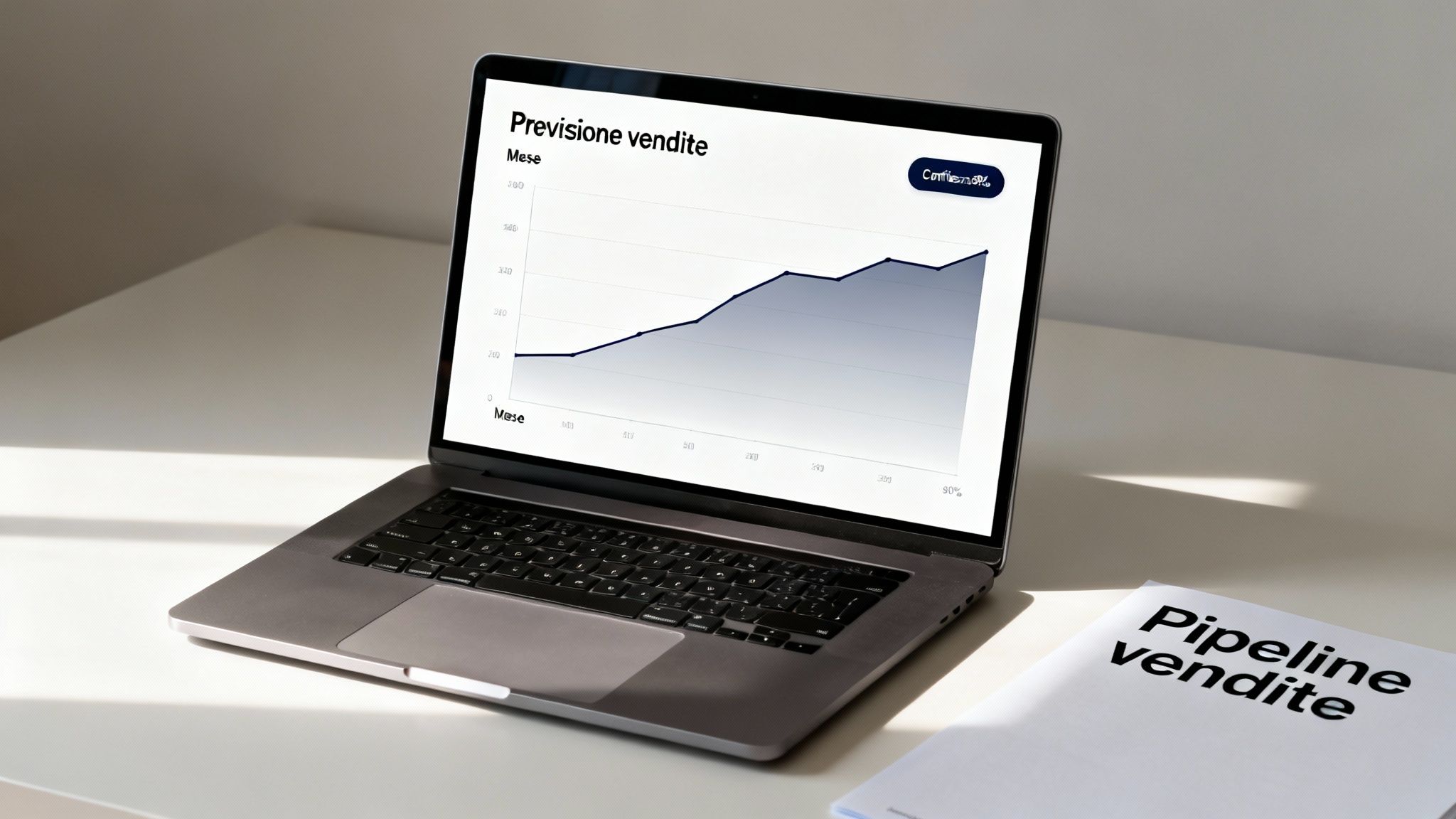
This method uses machine learning algorithms to analyze historical sales data, conversion rates by pipeline stage, deal characteristics, and market conditions. The goal is to identify patterns that lead to success and predict future revenues with a quantifiable level of confidence, supporting strategic decisions on budgets, hiring, and investments.
Primary Objective: Improve the accuracy of quarterly sales forecasts to 90% within 6 months, reducing the gap between projected and actual revenues by 25%.
Working Hypothesis: By implementing an advanced analytics platform such as Electe analyze CRM data, we will be able to identify predictive factors for closing a deal (e.g., deal speed, number of interactions). This will allow us to create dynamic forecasting models, assign probability scores to each opportunity, and focus sales resources where ROI is highest.
Platforms such as Electe directly with CRM systems (e.g., Salesforce, HubSpot) to automate sales data analysis. Instead of requiring complex manual configurations, Electe AI to identify key indicators such as deal velocity and conversion rates by stage.
The platform generates forecasts not only as a single number, but as confidence intervals (e.g., "we forecast revenue between €1.8M and €2.1M with 90% probability"). This probabilistic approach makes the business case more robust and helps leaders make decisions based on weighted scenarios. To learn more about how these tools work, you can find more information on business analytics software and its applications.
Promotional campaigns are an essential tool for retail and e-commerce, but without careful analysis, they can easily erode profit margins. Data-driven optimization transforms promotions from a gamble into a strategic investment by identifying which offers, channels, and customer segments generate the highest return.
This approach analyzes past performance to understand which discounts, bundles, or marketing initiatives drive profitability. The goal is to stop applying generalized discounts and start customizing offers to maximize impact, from the price applied to the communication channel chosen.
Primary Objective: Increase the Return on Investment (ROI) of promotional campaigns by 25% within 6 months, while reducing customer acquisition costs (CPA) by 10%.
Working Hypothesis: By using an advanced analytics platform such as Electe analyze transactional data and customer behavior, we can identify customer segments that are most responsive to specific offers. This will enable us to create hyper-targeted campaigns, increasing conversion and average order value (AOV) while reducing advertising spend on unprofitable segments.
Platforms such as Electe essential for transforming raw data into winning promotional strategies. Electe the analysis of each campaign's performance, correlating sales, discounts applied, channels used, and customer segment behavior.
Instead of complex manual analyses, the platform generates visual reports that clearly show which promotions work, on whom, and why. This allows marketing teams to test predictive scenarios before launch and make quick, evidence-based decisions. This approach is an excellent business case, where advanced analytics directly leads to increased profitability. To learn more about how to calculate the economic benefits, you can read this comprehensive guide on the ROI of AI implementation on Electe.net.
Not all customers are the same. Understanding who the most profitable ones are, who is at risk of churning, and where growth opportunities lie is fundamental to any marketing and sales strategy. Customer segmentation, enhanced by Customer Lifetime Value (CLV) forecasting, allows you to move from a generic approach to a targeted and personalized one.
This method uses behavioral, demographic, and transactional data to group customers into meaningful segments. Machine learning algorithms analyze these clusters to predict the future value of each customer, enabling companies to allocate resources more intelligently and proactively.

Primary Objective: Increase customer retention rate by 10% and average CLV by 15% within 18 months, while optimizing the marketing budget.
Working Hypothesis: By implementing an analytics platform such as Electe dynamic segmentation and CLV forecasting, we will identify high-value customer segments and those at risk of churn. This will allow us to personalize communication campaigns and offers, increasing loyalty and the long-term value of each customer.
Platforms such as Electe advanced segmentation and CLV prediction accessible without the need for a data science team. The platform integrates with CRM and transactional data, automating the creation of segments based on predictive models such as RFM (Recency, Frequency, Monetary) and CLV.
Electe dashboards that clearly display the value of each segment, growth potential, and churn risk. These insights enable marketing teams to quickly and efficiently create hyper-personalized campaigns, transforming a complex business case into measurable results and tangible ROI.
Supply chain resilience has become a critical success factor. Manufacturing and logistics companies must constantly monitor supplier performance, detect inefficiencies, and anticipate potential disruption risks. Proactive analysis transforms a reactive supply chain into a strategic and agile asset.

This approach analyzes data on delivery times, quality metrics, logistics costs, and historical supplier performance. The goal is to optimize procurement decisions, mitigate disruptions, and build a more robust and transparent supply chain, which is essential in an unpredictable global market.
Primary Objective: Reduce delivery delays from Tier-1 suppliers by 20% and mitigate the financial impact of unexpected supply chain disruptions by 30% within 18 months.
Working Hypothesis: By implementing a continuous monitoring platform such as Electe, we will be able to identify early warning signs of risk (e.g., decline in quality, minor delays) 4-6 weeks in advance. This will allow us to activate contingency plans and work with suppliers to resolve issues before they become critical.
Platforms such as Electe and analyze data from different systems (ERP, warehouse management systems, carrier data), creating a unified view of the supply chain. Instead of manual and reactive analysis, Electe the creation of supplier scorecards and risk dashboards.
The platform automatically identifies anomalies and negative trends, sending proactive alerts to supply chain managers. This transforms a complex process into a manageable, action-oriented control system. Creating a solid business case for this investment becomes simple, as the ROI comes directly from reducing costs associated with delays and disruptions.
Understanding which channels, campaigns, and touchpoints drive conversions and revenue is the main challenge for every marketing team. Without a clear view of the customer journey, allocating budget becomes a costly guess. Attribution analysis solves this problem by revealing how different marketing activities interact to influence purchasing decisions.
This approach uses multi-touch attribution models to assign a value to every customer interaction, from the first click on an ad to the last email opened before purchase. The goal is to stop looking only at the last click and gain a holistic view of marketing ROI.
Primary Objective: Improve overall return on ad spend (ROAS) by 25% within 6 months and reduce customer acquisition cost (CAC) by 15% by reallocating budget to higher-performing channels.
Working Hypothesis: By implementing an analytics platform such as Electe, we will be able to apply data-driven attribution models to understand the true contribution of each channel. This analysis will allow us to shift 10% of the budget from underperforming channels (identified by the model) to those that most influence conversions, maximizing spending efficiency.
Platforms such as Electe attribution analysis, a traditionally complex task. Instead of requiring manual configurations and advanced statistical skills, Electe data from multiple sources (Google Analytics, CRM, advertising platforms) into a single environment.
The platform automates the application of different attribution models (linear, time-decay, data-driven) and presents the results in intuitive dashboards. This allows marketing teams to compare scenarios and immediately see the impact of each channel, transforming complex analysis into a strategic lever to demonstrate the value of a business case focused on marketing optimization.
Every company, regardless of industry, manages processes that can hide inefficiencies, bottlenecks, and unnecessary costs. Identifying these areas of waste is critical to improving profitability and competitiveness. Process analytics offers a data-driven approach to mapping, measuring, and optimizing every single step of business operations.
By leveraging operational data, from production to customer service response times, companies can uncover hidden patterns that reveal where time and resources are being wasted. This allows for targeted intervention, delivering measurable results and a rapid ROI.
Primary Objective: Reduce operating costs by 10% and improve cycle times for key processes by 20% within the next 9 months, increasing production capacity without additional hardware investments.
Working Hypothesis: By implementing a process analytics platform such as Electe, we will be able to identify the main causes of inefficiencies (e.g., downtime, manual errors, redundant steps) with 90% accuracy. This visibility will allow us to redesign workflows, automate repetitive tasks, and set new performance standards.
Platforms such as Electe process analytics accessible even to those without advanced technical skills. Instead of requiring complex data mining projects, Electe directly to operating systems (ERP, CRM) and transforms raw data into visual process maps and interactive dashboards.
The tool automatically highlights bottlenecks and deviations from standards, allowing managers to focus on solutions rather than analysis. Creating a business case becomes easier when areas for improvement and potential savings are clearly quantified. To learn more, find out about Business Process Management at electe.net.
Together, we explored eight detailed business case examples, ranging from inventory optimization in retail to financial risk mitigation. Each example followed a logical and replicable structure: defining the objective, formulating clear hypotheses, identifying success metrics (KPIs), analyzing costs and benefits, and finally, calculating the return on investment (ROI). This process demonstrates a fundamental truth: a solid business case is not an academic exercise, but a strategic roadmap that transforms an idea into a financially sustainable and measurable project.
The common thread linking all these scenarios is the transformative power of data. It is no longer a question of navigating by sight based on intuition, but of making informed decisions supported by quantitative analysis and accurate projections. Whether you are trying to convince management to invest in new technology, justify hiring new resources, or launch an innovative marketing campaign, a well-structured business case is your most powerful ally. It provides you with a common language, that of numbers and results, to communicate effectively with every stakeholder.
Let's review the fundamental pillars that emerged from these business case examples:
Strategic turning point: Stop thinking of the business case as a bureaucratic document. Think of it as the first prototype of your project: a dynamic model that helps you test your assumptions, identify risks, and optimize your strategy before you even invest a single dollar.
The real challenge now is not understanding the theory, but taking action. The templates and models we have provided are your starting point. Adapt them to your specific context, populate the sections with your company's data, and start building your argument. You don't have to be an expert financial analyst to get started; you need to have the curiosity to ask the right questions and the discipline to seek data-driven answers.
The ability to create and present effective business case examples is a crucial skill in today's market, a real driver for innovation and sustainable growth. Mastering this skill means becoming an agent of change within your organization, capable of transforming insights into tangible value and guiding your company toward a smarter and more profitable future.
Are you ready to turn your data into an unassailable business case? With Electe , you can accelerate data analysis, generate accurate forecasts, and create the reports you need to support your strategic proposals, all in just a few clicks. Start your free trial and discover how our AI-powered platform simplifies the creation of compelling business cases to guide your decisions.

.svg)


.svg)
.svg)