
Does your company struggle daily with bottlenecks, repetitive tasks that steal valuable time, and a lack of coordination among teams? If the answer is yes, you are not alone. Many SMEs struggle with operational inefficiencies that hold back growth, consuming resources you could be investing in innovation and development. How do you turn this operational chaos into a perfectly orchestrated symphony?
Business Processes management (BPM), or business process management, is the answer. Far from being a technical acronym for large multinational corporations, it is a strategic approach that allows you to analyze, optimize, and automate workflows to achieve your business goals. It is the art of making every activity work smarter, not harder. In this guide, you will discover how BPM, empowered by artificial intelligence and data analytics platforms like Electe, has become the ultimate tool for SMEs that want to eliminate waste, cut costs, and build a lasting competitive advantage.
People often think of BPM as complicated software or a rigid methodology. The reality is much simpler and more accessible. Think of Business Processes Management as the conductor of your company's orchestra. His job is not to play an instrument, but to make sure that each musician-whether a team or an individual employee-plays his or her part in perfect harmony with the others. When marketing, sales, logistics and customer service work in coordination, the result is success for your business.
Without a director, each department would end up following its own score, creating a chaotic performance. BPM provides the score and direction needed to align everyone toward a common goal. It is this approach that allows you to move from reactive management, which chases problems, to proactive management, which anticipates them.
The real goal of Business Processes Management is not just "doing things right," but "doing the right things right" in a repeatable and scalable way. It is the foundation for growth that lasts.
Embracing the logic of BPM means achieving concrete and measurable benefits right away. It is not a revolution to be made overnight, but a path of continuous improvement that leads to tangible results.
Here's what you can expect:
To truly master Business Process Management, it is critical to understand that it is not a project with a beginning and an end, but a continuous cycle of improvement. Imagine building and maintaining a race car: it's not enough to assemble it once; you have to test, monitor and refine it constantly to keep it at peak performance. BPM works exactly like that.
This cycle consists of five logical steps, where each step sets the stage for the next, triggering a virtuous cycle that transforms your company into a proactive and increasingly efficient engine.
This is the diagnostic phase, the starting point. The goal is to take an honest, detailed picture of your current processes, what we call in the jargon "as-is" (as-is). This is the time to map each step, understand who is doing what, with what tools, and in how much time. In this phase, you collect data and, most importantly, talk to teams. Where are bottlenecks created? What are the most common errors or delays? Answering these questions is critical to building a solid foundation.
Once you understand where you are starting from, it is time to look to the future. Here you design the optimized process, the so-called "to-be" (as it should be). Basically, you design the ideal workflow to achieve your business goals. Think of it like designing the new engine for your race car: you decide which components to eliminate, which to upgrade, and how to link it all together to make it more efficient. The goal is not to overhaul everything, but to create a leaner, faster and more reliable model.
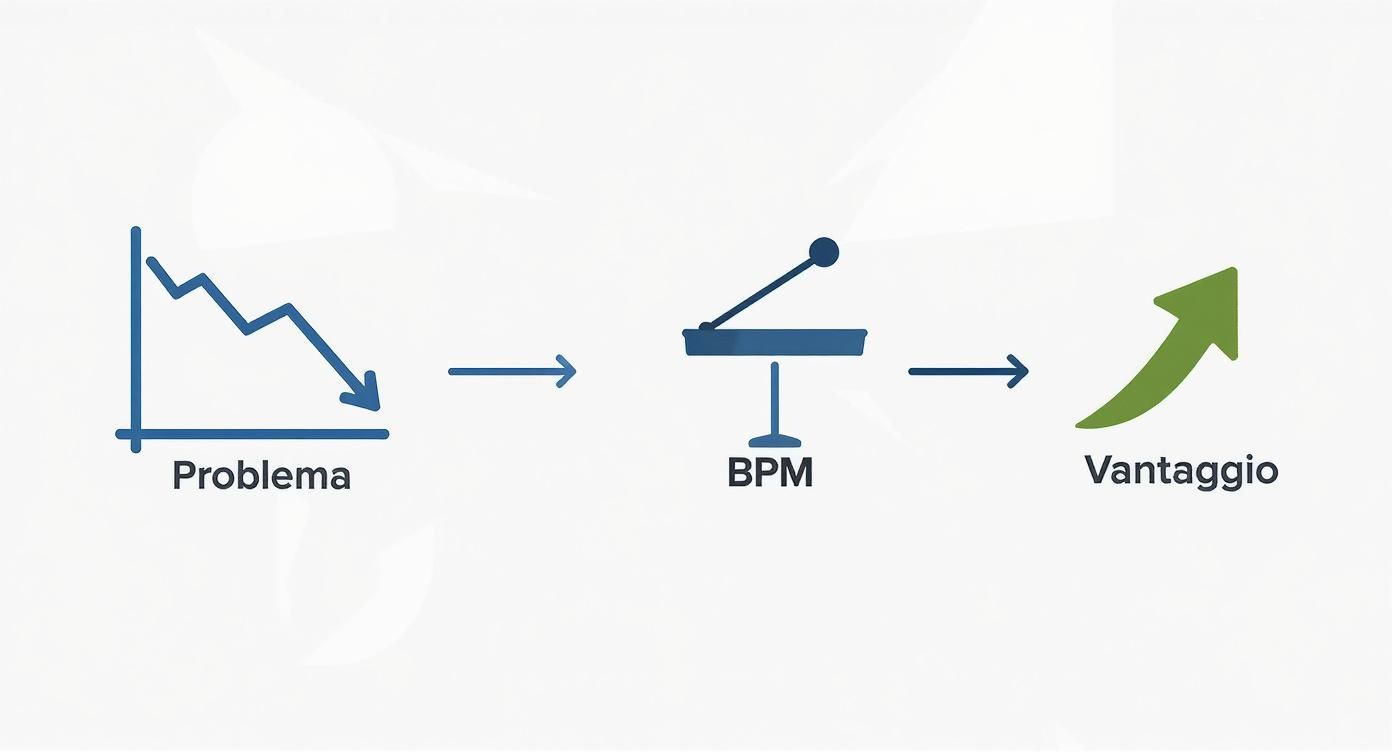
As you see, BPM acts as a catalyst that intervenes on weak points to unlock your company's hidden potential.
With the new model approved, it is time to take action. The execution phase consists of putting the "to-be" process into practice. This may mean introducing new software, standardizing certain procedures, or training employees on the new workflows. The real secret to success here is change management: you must clearly communicate the benefits and actively involve people so that the new procedures are adopted with conviction.
The new process is up and running. But how do you know if it is really working better? The answer is simple: by measuring. At this stage, you collect data and track performance using key performance indicators (KPIs) such as cycle time, cost per process, and error rate. Data analytics platforms such as Electe, an AI-powered data analytics platform for SMEs, become valuable allies here, allowing you to create intuitive dashboards to see these KPIs in real time and turn raw data into actionable insights.
We have reached the last stage, the one that closes the circle and starts a new one. With the data collected during monitoring, you now have a clear idea of where to take action to improve further. Optimization is the beating heart of BPM. If the data tell you that a bottleneck is still there, you go back to the planning stage. If you discover a new technology that can automate a step, you go back to modeling.
The BPM life cycle is not a "one-off" project, but a philosophy of constant improvement. Each optimization becomes the starting point for a new analysis, fueling operational excellence.
PhaseMain ObjectiveKey ActivitiesDesignand AnalysisUnderstandthe current state of processes ("as-is").Map workflows, identify inefficiencies, interview teams.Modeling and DesignDesignthe future optimized process ("to-be").Design the new flow, define rules and standards.Execution and ImplementationPutthe new process into practice.Introduce new software, train staff, update procedures.Monitoring and MeasurementEvaluatethe performance of the new process.Collect KPI data, create dashboards, analyze results.Optimization and ImprovementIdentifyand apply further improvements.Analyze monitoring data, start a new cycle.
There is no universal recipe for Business Process Management. The perfect methodology depends on your company's unique goals, its culture, and the specific challenges it faces. Choosing the right approach is like choosing the right tool for a job: you wouldn't use a hammer to tighten a screw. To help guide you, let's explore the most popular methodologies together.
Lean methodology originated in the manufacturing sector, but its principles are incredibly powerful in any context. Its beating heart is to eliminate anything that does not add value for the end customer, namely waste(muda). It focuses on a few pillars: identify value, map the flow, create a continuous flow, and strive for perfection.
When to use it? It is the ideal choice for optimizing production processes, logistics or any workflow where efficiency and cost reduction are top priorities. Think of an e-commerce business that wants to reduce packaging and shipping time.
If your main goal is to break down defects and bring quality to a near-perfect level, then Six Sigma is the way to go. It is a rigorous approach that thrives on data and statistical analysis to identify and remove the causes of defects. The goal is to achieve a maximum of 3.4 defects per million opportunities.
Six Sigma is not satisfied with "doing better." It wants to achieve near-total reliability, transforming quality from a goal to a measurable and consistent operational standard.
This methodology follows a five-step structured cycle known as DMAIC: Define, Measure, Analyze, Improve, Control.
When to use it. It is perfect for customer service departments that want to reduce ticket resolution time or for software companies that aim to eliminate bugs before release.
Born in the world of software development, Agile methodology is a philosophy that focuses on flexibility, collaboration and the ability to respond quickly to change. Instead of planning everything from the beginning, the Agile approach breaks work down into smaller, more manageable cycles called "sprints." At the end of each sprint, the team produces a concrete result, gathers feedback and adjusts the plan.
When to use it? It is essential for marketing teams, product development, and in any dynamic environment where requirements can change from one day to the next.
Total Quality Management (TQM) is a management philosophy that involves every single person in the organization in a collective commitment to continuous improvement. The basic idea is simple: quality is not the responsibility of one department, but of everyone. Its core principles are customer focus, total staff involvement, and a process-based approach.
When to use it? TQM is a long-term approach to transform corporate culture and build a lasting competitive advantage based on quality.

Once upon a time, business processes management was based on manual analysis and intuition. Today, artificial intelligence and data analytics are changing the game, transforming BPM from a discipline that reacts to problems to one that anticipates and solves them automatically. AI-powered platforms like Electe are putting capabilities in the hands of SMEs that were previously a luxury for large corporations.
Artificial intelligence is not content to just show you a graph. It digs much deeper, analyzing thousands of data points to unearth patterns that a human eye would miss. Basically, it can find the bottlenecks you didn't know you had and predict problems before they explode. Instead of asking you "I wonder why production has slowed down?" the AI alerts you that "based on the data, there's an 85 percent chance of a slowdown next week if we don't take action."
The integration of AI into BPM shifts the focus: it is no longer about correcting yesterday's problems, but anticipating tomorrow's challenges. It is the shift from reactive management to proactive business leadership.
The other big change isIntelligent Process Automation (IPA). We are not talking about the simple automation of a repetitive task, but systems that can "learn" from the context and adapt. According to recent studies, about 41 percent of companies in Italy already use AI to optimize HR procedures, and the figure is estimated to rise to 70 percent by 2025.
Applied to BPM, intelligent automation can:
A concrete example of how technology can streamline processes comes from hospitality, where tools such as an online check-in application are automating tasks that used to take time and staff time.
Perhaps the greatest advantage of this new era of business processes management is democratization. It used to be that to get such deep analysis you needed a team of data scientists. That is no longer the case today. Platforms such as Electe were born to be intuitive and accessible, allowing managers to get insights at the click of a button. The synergy between people and machines is the real key, a topic you can learn more about by reading how to build teams that thrive with AI-enhanced workflows.

Talking about Business Process Management is an investment with a tangible return on investment (ROI), especially for an SME where every resource makes a difference. Let's look together at the key benefits this approach brings to your business.
When processes are clear and automated, your teams stop wasting time on manual tasks. People can finally focus on what really makes a difference: innovating, solving complex problems, and taking care of customers. Automation does not replace people, it amplifies their capabilities. The Electe platform, for example, offers powerful automation tools designed precisely to free teams from low-value-added tasks.
Inefficient processes are a hidden cost that wears down margins. Every mistake, delay, and waste translates into an economic loss. BPM goes straight to the root of these inefficiencies. By mapping workflows, you identify precisely where waste is hiding and can surgically intervene, resulting in a direct and measurable decrease in operating costs.
Standardized processes mean predictable and consistent results. When every activity follows a defined procedure, the risk of human error plummets, translating into significantly higher quality of product or service. For your company, this means fewer complaints, greater customer satisfaction and a reputation for reliability.
A well-managed process is not just faster or cheaper. It is a process that reliably generates value, transforming quality from an occasional goal to a consistent standard.
Today's market is changing at an astonishing speed. The ability to adapt is what distinguishes companies that thrive from those that trudge. Rigid processes are an anchor that holds back innovation. BPM, in contrast, creates a flexible structure. By having a clear understanding of how your organization works, you can change processes quickly and in a controlled manner to respond to new challenges and opportunities.
We are at the end of this guide, but for you the real journey has just begun. Optimizing processes is not an end point, but a path. Here are 3 practical steps to get you started right away:
We have seen how Business Processes Management (BPM) is not an abstract concept, but a practical and powerful approach to making your SME more efficient, agile and competitive. From the BPM lifecycle to different methodologies to the revolutionary role of AI and analytics, you now have a clear map to start your journey. The main benefit is simple: stop chasing problems and start anticipating them, using data as a compass for your strategic decisions. Your operational data hides a tremendous competitive advantage, you just need to know how to read it.
It's time to revolutionize the way your business works. Take the first step today and learn how our platform can support you every step of the way.
Ready to turn your data into better decisions?
Try Electe for free →
To close our guide, we have collected some of the most common questions about Business Process Management to clear up the last doubts.
Automation is the act of using technology to perform a single task without human intervention. It is a tool. BPM, on the other hand, is the overall strategy that analyzes, designs and improves an entire process from start to finish. Simply put: automation is a tactic, while BPM is the strategy that makes sense of it.
Absolutely not. This is perhaps the most common myth. BPM is by its very nature scalable and brings tremendous benefits to even the smallest businesses, helping them build a solid operational foundation from the outset to support growth. For an SME, doing BPM does not have to mean buying complex software, but adopting a mindset of continuous improvement.
Results come in two tracks. On the one hand, there are the "quick wins," quick improvements that you can see after just a few weeks (e.g., eliminating a bottleneck). On the other are the deeper strategic benefits, such as a change in corporate culture or an increase in profitability, which require ongoing commitment over time and turn into a real competitive advantage.

.svg)


.svg)
.svg)
.jpeg)