
Every day, you interact with dozens of intelligent systems, often without even realizing it. Netflix recommends the next series to watch, Google Maps calculates the fastest route to avoid traffic, and your Gmail inbox magically filters out spam. These aren't just tricks, but powerful examples of artificial intelligence in action, based on principles such as pattern recognition and predictive analysis.
But what if you could apply the same logic that personalizes your streaming experience to optimize your e-commerce inventory or predict next quarter's sales? Artificial intelligence is no longer a futuristic technology reserved for large corporations. It is a concrete and accessible tool that can radically transform the way you operate.
In this guide, we'll show you 10 practical examples of AI, explaining not only the technology used but also the measurable impact it can have on your business. We'll analyze how small and medium-sized businesses, just like yours, can leverage these systems to make smarter decisions, reduce costs, and accelerate growth. You'll discover how the mechanisms that already make your daily life easier can become the driving force behind your next winning business strategy.
Predictive sales analytics is one of the most effective examples of artificial intelligence transforming raw data into concrete business strategies. Using machine learning algorithms, this technology analyzes historical data, market trends, and external variables to predict future revenues with surprising accuracy. Instead of relying on manual estimates, companies can identify complex patterns and seasonality, optimizing crucial decisions.

This approach is crucial for the retail and e-commerce sectors. Large chains such as Walmart use it to optimize inventory levels in thousands of stores, reducing waste and stock shortages. Amazon, on the other hand, leverages AI to predict demand during events such as Prime Day, ensuring the availability of the most sought-after products and maximizing sales.
Platforms such as Electe these analyses accessible to SMEs, allowing them to transform complex data into clear forecasts. To learn more about how these technologies work, you can explore predictive analytics features and their impact on business. Find out more about sales forecasting with predictive analytics and how it can help your business.
Automatic anomaly detection is one of the most critical examples of artificial intelligence for financial and operational security. Using machine learning algorithms, this technology establishes a "normal" behavior pattern based on historical data and constantly monitors activities in real time. When an event deviates from this pattern, such as an unusual transaction or access from a suspicious geographic location, the system immediately flags it, enabling rapid intervention.
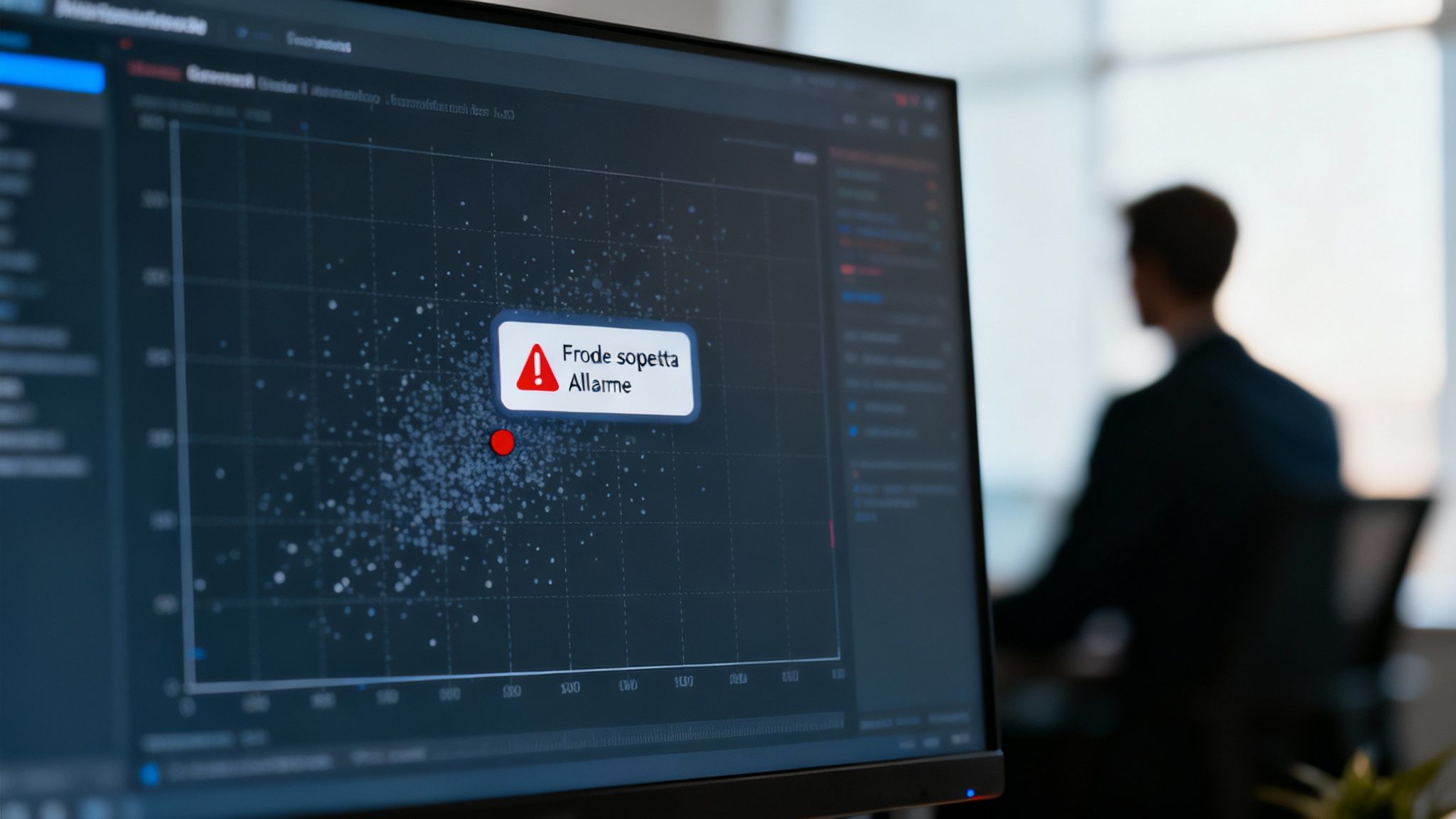
This approach is crucial for the financial sector and e-commerce. PayPal, for example, uses complex AI models to analyze millions of transactions per second, preventing billions of dollars in losses each year. Platforms such as Stripe also integrate AI to identify high-risk purchases and protect sellers from fraud. These systems not only block fraud, but also continuously learn from new attempts, becoming increasingly effective over time.
Customer segmentation is one of the most powerful examples of artificial intelligence for marketing and sales. AI algorithms analyze vast amounts of data, such as purchase history, website interaction, and demographic information, to group customers into homogeneous segments. This allows companies to overcome traditional demographic divisions, creating clusters based on behavior and actual value.
This approach transforms marketing strategies from generic to hyper-personalized. Netflix, for example, segments not only by age or gender, but by "tastes" and "viewing habits," suggesting content with surprising accuracy. In retail, Sephora identifies high-value customers to offer exclusive promotions, increasing loyalty. E-commerce platforms also allow you to create targeted email campaigns based on purchasing patterns, dramatically improving conversion rates.
Intelligent report generation is one example of artificial intelligence democratizing access to data. This technology transforms raw, complex data into visually intuitive reports and dashboards that are understandable even to those without technical expertise. Using natural language processing (NLP) and machine learning, AI systems can create executive summaries and select the most effective visualizations to answer specific business questions. This way, every team member can gain valuable insights without having to rely on a data scientist.
This approach revolutionizes the way companies interact with data. Platforms such as Tableau and Power BI use AI to suggest relevant charts or generate reports based on a simple question asked in natural language, such as "Show me sales by region for the last quarter." Instead of spending hours manually building a report, managers can get immediate answers and focus on strategic decisions.
This technology allows any company to fully exploit the potential of its data. To better understand how to implement these solutions, it is useful to learn more about how Business Intelligence software works and its role in transforming data into strategic decisions.
Dynamic pricing is one of the most powerful examples of artificial intelligence for maximizing profitability in real time. Using machine learning models, this technology instantly analyzes a multitude of factors: market demand, competitor prices, inventory levels, and consumer behavior. Instead of setting static prices, companies can dynamically adjust rates to optimize revenue and profit margins while maintaining strong competitiveness.
This approach has become indispensable not only for retail, but also for the transportation and service sectors. Airlines, pioneers of this strategy, use AI to optimize the price of each individual seat based on variables such as booking time and historical demand. Similarly, Uber adjusts fares with its "surge pricing" during peak hours, balancing supply and demand for available drivers. Even giants like Amazon change millions of prices every hour to maximize sales.
Predictive maintenance is one of the most revolutionary examples of artificial intelligence for industry and operational management. Using machine learning algorithms, this technology analyzes data from sensors, historical maintenance records, and operational patterns to predict machine and infrastructure failures before they occur. Instead of reacting to problems or following a rigid schedule, companies can take proactive action, dramatically reducing downtime and unexpected costs.
This approach is crucial in sectors such as manufacturing and logistics. Companies such as General Electric (GE) use AI to monitor the status of aircraft engines in real time, predicting maintenance needs and increasing flight safety. In manufacturing plants, predictive models anticipate pump and motor failures, preventing costly interruptions in the production chain. Even in data centers, AI monitors server health to avoid catastrophic blackouts.
Inventory optimization is one of the most strategic examples of artificial intelligence for supply chain management. This technology uses machine learning algorithms to analyze historical sales data, seasonality, market trends, and logistical constraints, predicting future demand with high accuracy. This allows you to perfectly balance the risk of stockouts (lost sales) and excess inventory (storage costs), freeing up working capital and improving service levels.
Advanced AI systems allow inventory to be managed not only at an aggregate level, but also by individual location or distribution center. Fast fashion chains such as Zara use AI to quickly allocate collections to the right stores based on local micro-trends. Similarly, Amazon manages inventory in its fulfillment centers globally, placing products closer to customers before they even purchase them, dramatically reducing delivery times.
Understanding what customers think in real time is a crucial challenge, and sentiment analysis is one of the most powerful examples of artificial intelligence for addressing it. Using Natural Language Processing (NLP) algorithms, this technology analyzes reviews, social media mentions, and support tickets to extract opinions, emotions, and emerging issues. Instead of manually reading thousands of comments, AI systems automatically categorize feedback, identify trends, and prioritize customer concerns.

This approach is essential for managing brand reputation and improving products. Banks, for example, monitor sentiment on social media to quickly intercept customer complaints and prevent reputational crises. E-commerce platforms such as Amazon analyze reviews to identify quality defects in products and improve recommendations, while retail chains track satisfaction trends to optimize the in-store experience.
Automatic optimization of business processes is one of the most concrete examples of artificial intelligence being used to increase operational efficiency. This technology employs machine learning algorithms and Robotic Process Automation (RPA) to analyze workflows, identify bottlenecks, and automate repetitive tasks. Instead of manually mapping processes, AI discovers hidden patterns in the way tasks move within the organization, suggesting targeted improvements.
This approach transforms entire departments, reducing operating costs and freeing staff from manual tasks. Insurance companies, for example, automate claims management, from submission to settlement, reducing processing times from days to minutes. In banking, RPA handles account opening and loan processing, while finance teams automate billing and account reconciliation, minimizing human error and speeding up payment cycles.
Adopting these technologies enables companies to become more agile and competitive. To understand how to map and optimize workflows, it is useful to explore process management strategies. Learn more about how Business Process Management can transform your company and prepare it for intelligent automation.
Optimizing the sales cycle is a crucial challenge, and lead scoring is one of the most straightforward examples of artificial intelligence used to address it. This technology uses machine learning models to automatically analyze and classify potential customers (leads) based on their likelihood of conversion. By analyzing behavior, demographics, and engagement signals, AI assigns a score to each contact, allowing sales teams to focus their energy on the highest-potential opportunities.
This approach revolutionizes the efficiency of B2B and B2C teams. Platforms such as Salesforce Einstein and HubSpot use AI to prioritize leads who interact with emails, visit key pages on the website, or match the ideal customer profile. This way, salespeople avoid wasting time on cold leads and can take the right action at the right time, dramatically increasing closing rates and shortening sales cycles.
We have explored numerous examples of artificial intelligence together, demonstrating how this technology is already deeply integrated into your daily life and into the operational fabric of the most innovative companies. From Netflix recommendations to GPS navigation, the basic principles, such as pattern recognition and prediction, are the same ones that today enable a company to optimize its inventory, personalize marketing campaigns, and prevent financial fraud.
The analysis of practical cases, from sales forecasting to dynamic price optimization, has shown us a clear common thread: AI is no longer an abstract concept or a luxury for large corporations. It has become a fundamental strategic lever, a concrete tool for transforming raw data into a measurable competitive advantage. For SMEs, this shift from intuition-based management to data-driven management is not only an opportunity but a necessity to thrive in increasingly complex markets.
"Artificial intelligence does not replace human intelligence, it amplifies it. It provides the clarity needed to make better decisions, faster."
Embracing AI means equipping your organization with an analytical co-pilot, capable of analyzing millions of variables in seconds to illuminate the best path forward. It means freeing your human resources from repetitive, low-value tasks, allowing them to focus on strategy, creativity, and innovation. The crucial question for every leader and analyst today is no longer "whether" to adopt AI, but "how" and "how quickly" to integrate it into daily decision-making processes in order to stay ahead of the curve. The future is not waiting: it is already here, fueled by data and ready to be interpreted.
Are you ready to stop watching others and start building your competitive advantage? The examples of artificial intelligence you have read about are exactly what Electe makes accessible for SMEs like yours. Our platform transforms your business data into predictive insights and automated reports with a single click, allowing you to make smarter decisions right away.
Discover how Electe illuminate the future of your business with a free demo →

.svg)


.svg)
.svg)




.png)