
Is your goal to learn machine learning, but does the idea of writing code hold you back? You’re not alone. The good news is that you don’t have to be a programmer to harness the power of artificial intelligence. You just need to understand how to use your data to predict the future of your business and make smarter, faster decisions. This guide will show you how to turn raw data into a real competitive advantage, without writing a single line of code. You’ll learn the fundamental concepts you need to communicate with technical teams, evaluate the right solutions, and, most importantly, understand when machine learning can truly make a difference for your small business.
Forget the idea that machine learning is an abstract field reserved for a select few. Today, it’s an accessible strategic tool that’s transforming every industry, from finance to retail. Understanding how machines “learn” from data is essential for anyone—like you—who wants to make faster, more informed decisions.
Here, we won’t be focusing on complex algorithms, but on results you can see for yourself.
Imagine an e-commerce manager using machine learning to accurately predict which products will fly off the shelves in the coming quarter. The result? Optimized inventory and no costly overstocking. The ROI is immediate.
Or consider a financial team that, thanks to a predictive model, identifies suspicious transactions 30% more effectively than traditional methods. Fraud is stopped before it even becomes a problem. These aren’t futuristic scenarios, but everyday applications that generate value for the business.
The goal is clear: even if you don’t know how to code, mastering the concepts of machine learning allows you to communicate effectively with technical teams and evaluate AI-powered platforms such as Electe and, above all, turn data into a tangible competitive advantage.
The sector's growth is unstoppable. Globally, the machine learning and AI market is projected to reach between $100 billion and $120 billion in investment by 2026, with annual growth ranging from 16% to 18%.
This growth is driven primarily by two areas: Data Engineering (35%) and Artificial Intelligence (31%). For SMEs, which are often held back by a lack of in-house expertise, data analytics platforms offer a solution to overcome these obstacles. You can read more about the evolution of this market on StartupItalia.

As you can imagine, machine learning isn't a standalone field. It lies at the intersection of statistics, data mining, and artificial intelligence, with the goal of extracting valuable insights from data to improve your decision-making.
Understanding the basics of machine learning enables you to:
Today, familiarizing yourself with the concepts of machine learning is no longer an option. It is a necessity for anyone who wants to lead their company into the future.
Before we dive into the tools and practical applications, we need to make sure we’re all on the same page. Think of this section as a glossary for the world of artificial intelligence—a way to translate complex-sounding concepts into clear ideas that you can immediately apply to your business. Mastering these basics is the first, essential step toward leveraging machine learning in a truly strategic way.

Imagine you want to train a computer to recognize spam emails. To do this, you feed it thousands of examples, each of which has already been labeled by a human as "spam" or "not spam." The algorithm analyzes this "labeled" data and learns on its own to distinguish between the two categories.
There you go—that’ssupervised learning. The model learns from a dataset where the correct answer is already provided. It’s a bit like giving a student a workbook with the answers in the back to help them prepare for an exam.
How does this apply to business?
Consider the need to predict whether a customer will renew their subscription. The model is trained using historical customer data, where the label is "renewed" or "did not renew." The goal is to use what it has learned to predict what current customers will do. If you’d like to learn more, discover how these techniques can turn data into winning decisions in our guide to predictive analytics.
Now, let’s change the scenario. You have a mountain of data on your customers, but this time it’s unlabeled. Your goal is to find out if there are any “natural” groups—customer segments with similar behaviors that you hadn’t noticed before.
This isunsupervised learning. The model explores the data freely, without a "correct answer" to start from, searching for hidden patterns and clusters. It’s like giving a detective a box full of clues and asking them to find the connections.
How does this apply to business?
It’s perfect for market segmentation. A clustering algorithm can identify clusters such as “low-margin loyal customers,” “occasional buyers of premium products,” or “high-potential new users.” These insights are pure gold for personalizing your marketing campaigns.
In short, supervised learning answers specific questions ("Will this customer leave us?"), while unsupervised learning reveals unexpected insights ("What kinds of customers do we actually have?").
How can we be sure that a model has actually learned something and isn’t just “reciting by heart” the answers we gave it? Simple: we split the data into two groups.
This split is a critical step. If the model performs well on the test set as well, it means that it has generalized correctly and that its predictions on completely new data will be reliable.
Overfitting is one of the most common pitfalls in machine learning. It occurs when a model becomes too good at recognizing training data, memorizing even irrelevant details and background "noise." The result? It performs exceptionally well on old data but is completely unable to generalize to new data.
It’s like a student who memorizes the correct answers to practice tests but then fails the actual exam because the questions are phrased slightly differently. They haven’t grasped the concept; they’ve just memorized the examples.
An overfitted model might perfectly predict last year's sales but be terrible at estimating next quarter's sales.
Here's a summary to help clarify things:
The training set is the equivalent of studying from books and exercises: it is used to train the model on historical data.
The test set corresponds to taking the final exam: its purpose is to evaluate the model's performance on new data that it has never seen before.
Overfitting is like memorizing answers: the model performs well on the training data, but becomes unreliable when faced with new situations. Recognizing and preventing it is essential for building reliable predictions.
AI-native platforms like Electe designed to handle these complexities automatically, using specific techniques to prevent overfitting and ensure that the generated models are robust and ready for the real world. For you, the key is to understand these concepts. It allows you to interpret results with a critical eye and use those insights to guide your strategies with full confidence. Knowing the “why” behind a result empowers you to make decisions that are truly data-driven.
To get started in machine learning, you don’t need to be an expert programmer, but understanding what tools are available and what they’re used for will give you a huge strategic advantage. Knowing what goes on “behind the scenes” allows you to choose the right solution for your business and, above all, to communicate effectively with technical teams.
In this section, we’ll explore the landscape of AI tools, starting with code-based solutions and moving on to platforms that are truly democratizing access to AI, making it a practical resource for everyone.
Even if your ultimate goal is to avoid writing code, it’s essential to know the key players. Python is, without a doubt, the king of machine learning programming languages. Its popularity is no accident: it has a clean syntax and a powerful ecosystem of “libraries” that do the heavy lifting for you.
Think of these libraries as highly specialized toolkits:
You don’t need to become an expert in using them, but knowing that they exist and what they’re for will help you understand the technology behind the most modern and intuitive platforms.
The real game-changer for SMEs and non-technical managers came with no-code and low-code platforms. These tools provide intuitive graphical interfaces that allow users to run complex predictive analyses with just a few clicks, hiding all the complexity of the code.
No-code platforms, such as Electe—an AI-powered data analytics platform for SMEs—are designed specifically for business users. You upload your data, define your objective (for example, "predict next month's sales"), and the platform takes care of everything else: from data cleaning to selecting the best algorithm, all the way to presenting insights in a clear and understandable way.
The goal of these tools is not to replace data scientists, but to put the power of AI directly into the hands of those who understand the business: managers, market analysts, and entrepreneurs.
These solutions eliminate technical barriers and entry costs, enabling rapid adoption and an almost immediate return on investment.
The choice of tool depends entirely on your goals and the level of control you want to have over the process. There is no one-size-fits-all answer, but there is certainly a solution to suit every need.
To help you navigate the current landscape, we’ve put together a comparison chart that highlights the key differences between the approaches, guiding you toward the choice that best suits your skill level and business goals.
A guide to choosing the right tool based on your skill level and business goals, from no-code solutions to advanced libraries.
No-code platforms —such as Electe are ideal for managers, business analysts, and entrepreneurs looking for quick insights to guide strategic decisions. They require no programming skills, making them accessible to anyone new to the field. A concrete example is uploading sales data to generate a quarterly revenue forecast in just a few minutes.
Low-code platforms are designed for analysts with some technical expertise who want to customize models without writing all the code from scratch. They require intermediate-level skills, including a basic understanding of SQL or scripting languages. A typical use case is building a customized credit risk model by modifying certain parameters suggested by the platform.
Python libraries —such as Scikit-learn—are designed for data scientists and developers who need complete control to build custom AI solutions. They require advanced-level skills, including a solid background in programming and statistics. A typical example is building a product recommendation system from scratch for an e-commerce site.
As you can see, the path to implementing machine learning is flexible. If your primary goal is to achieve tangible business results without getting bogged down in the technical details, no-code platforms are the most logical and effective starting point. For a more in-depth analysis, you can read our guide to the 7 best AI tools for business growth.
No matter which tool you choose, there are certain analytical skills (not just mathematical ones) that will always make a difference. Technology is a powerful enabler, but critical and strategic thinking remain irreplaceable.
The most important skills to develop are:
In short, choosing the right tool is the first step, but it is the combination of technology and strategic thinking that creates a real competitive advantage.
Well, it’s time to move from theory to practice. So far, we’ve explored concepts and tools, but real learning—the kind that sticks—only begins when you get your hands dirty with a real-world problem. In this section, I’ll walk you through the logic of a machine learning project, but with a twist: we won’t write a single line of code.
We’ll tackle a practical case study—one that’s essential for any small or medium-sized business: customer segmentation. The goal here isn’t technical, but purely strategic. It’s about learning to think like a data scientist to turn data into decisions that, at the end of the day, generate value.
The infographic below shows the simplified process we will follow, starting with the business requirement and ending with practical implementation, which can be achieved using either no-code tools or, of course, coding.
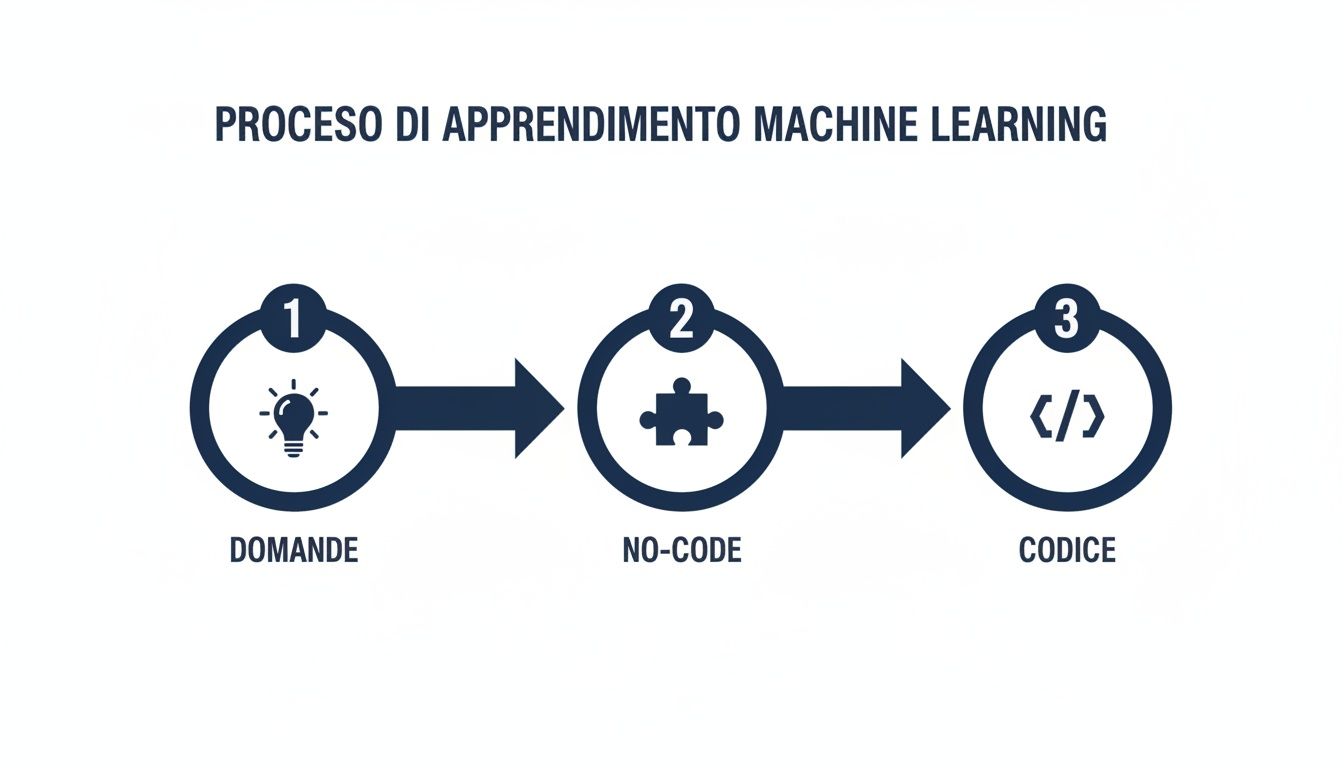
As you can see, it all starts with a well-defined business need. From there, you can proceed with more accessible (no-code) solutions or technical approaches, depending on the resources and goals you have in mind.
The first step in any analytical project is never technical; it’s strategic. We need to ask a clear question. In our case, it’s not enough to say, “I want to segment customers.” The real question is why we want to do it.
A well-defined business objective might sound something like this: "Identify customer groups with similar purchasing behaviors to personalize marketing campaigns and increase the conversion rate by 10% in the next quarter."
Can you see the difference? This definition is powerful because it is specific, measurable, and tied to a tangible business outcome. It gives us a clear direction and a standard for determining whether our project was successful or not.
Once the objective is clearly defined, the next question is: "Okay, what data do we need to answer that?" To segment customers based on their purchasing behavior, we'll need a dataset that contains information such as:
In the real world, this step is often the most time-consuming, but it’s also the one that determines the quality of everything that follows. For this exercise, let’s pretend we already have a nice, clean file with these columns. Platforms like Electe were created precisely for this purpose: they automate much of the process by connecting directly to your data sources and preparing the information for analysis.
With a clear objective and the data ready, it’s time to choose a model. Since our goal is to discover “hidden” groups without relying on predefined labels (such as “top customer” or “lost customer”), we’re dealing withunsupervised learning.
The tool of choice for this task is a clustering algorithm, such as the well-known K-Means algorithm. Don’t let the name intimidate you; its purpose is surprisingly simple. It groups customers into a number of “clusters” that we decide on (let’s say 4), ensuring that the customers within each group are as similar to one another as possible and, at the same time, as different as possible from those in the other groups.
In a no-code environment, you certainly don’t have to implement the algorithm yourself. All you’d need to do is upload the data, select an option like “customer segmentation” or “clustering,” and specify the number of groups you want to identify. The platform would handle the rest.
Here we are at the crucial stage, where technology takes a back seat and makes way for human analysis and business insight. The algorithm will return four clusters, but for now they’re just numbers. Our task is to turn them into “profiles” of real customers, each with a story and specific needs.
By analyzing the average characteristics of each cluster, we might discover profiles like these:
This process transforms numerical analysis into a concrete, actionable marketing strategy. We’ve given the data a name and a face, laying the groundwork for targeted communications that truly resonate with each specific segment. This is the heart of machine learning applied to business: it’s not about algorithms, but about making better decisions.
Okay, you understand the logic behind supervised and unsupervised learning. You know why overfitting is an enemy to avoid. Now, though, let’s talk about the shortcut that lets you use this knowledge to achieve concrete business results—without writing a single line of code. This is where AI-powered data analytics platforms, like Electe, come into play.
Think of these tools as a bridge. On one side are your business skills, and on the other is the power of machine learning. They handle the automation of the most technical and complex tasks, leaving you with the most important job: interpreting insights and making better decisions.
Let’s go back to the examples from earlier. Suppose you want to segment your customers, just like in the theoretical exercise. With a no-code platform, the process becomes radically simpler and faster. You don’t have to worry about choosing the K-Means algorithm or getting bogged down in data preparation.
In practice, the workflow looks like this:
The same applies to sales forecasting. Instead of building a model from scratch, you can upload historical data and ask the platform to generate a forecast for the coming quarter. The tool will handle the split between the training and test sets and implement the appropriate measures to prevent overfitting.
The knowledge you've gained won't go to waste; on the contrary, it will grow. By understanding what overfitting is, you'll be able to evaluate the reliability of predictions with a more critical eye. By understanding the difference between supervised and unsupervised learning, you'll be able to choose the right analysis for the right problem.
This approach is a game-changer, especially for small and medium-sized enterprises. In Italy, SMEs view AI with great interest— 58% say they are curious —but the numbers speak for themselves: only 7% of small businesses and 15% of medium-sized businesses have launched concrete projects. There is enormous, untapped potential that platforms like Electe help unlock by providing accessible tools that don’t require teams of specialized technicians.
With Electe, learning machine learning is no longer a technical programming journey, but a process of strategic application. Your learning curve is no longer tied to code, but to the ability to ask the right questions about your business.
This interface is a prime example: the user selects the variables for a predictive analysis without writing a single line of code.
Simply select the objective, such as "Sales Forecast," and the system will automatically handle the modeling, presenting the results in a clear and visual way.
No-code platforms are making advanced data analysis accessible to everyone. You no longer need a team of data scientists to generate accurate forecasts or uncover hidden customer segments. Managers, marketing analysts, and sales managers can interact directly with the data, test hypotheses, and get answers in near real time.
This not only speeds up the decision-making process but also fosters a truly data-driven corporate culture. Understanding the basics of machine learning empowers you to become a more informed and effective user of these platforms, capable of harnessing their full potential to drive growth. Learn more about how Electe making advanced technology accessible to everyone.
Let’s address some of the most common concerns that hold back those new to machine learning. These answers will help you overcome your initial uncertainties and plan your next steps with greater confidence, focusing on what really matters for your business.
Less than you might think. If your goal is to understand the basics so you can communicate with technicians and use intuitive platforms like Electe, a few weeks of focused study may be all it takes. You don’t need to become a data scientist, but rather a professional capable of using AI strategically.
By dedicating 5–8 hours a week to high-quality content, within a month you’ll be well-equipped to start extracting value from your data. The key is consistency and the ability to focus on business problems, not abstract theory.
Absolutely not. You don’t need a degree in mathematics or statistics to apply machine learning to business problems. Sure, it helps to have a basic understanding of concepts like the mean or correlation, but modern platforms like Electe all the complexity for you.
Your most important skill will always be the one related to your industry: understanding the context, asking the right questions, and interpreting the results to guide decision-making. Technology is just a tool.
Your knowledge of the market is worth far more than any complex formula when it comes to turning analysis into profitable action.
The best project is one that solves a real and urgent problem for your business. Forget about the generic datasets you find online; start with a specific question you ask yourself every day.
A few practical tips:
Use the data you already have and know inside out. Platforms like Electe let Electe upload your files and get answers to these questions in just a few minutes. This makes learning practical, fast, and immediately rewarding.
This is a common concern, but it’s often a false problem. You don’t need terabytes of data to get started. Even medium-sized datasets can reveal incredibly useful patterns, provided you use the right models and techniques. The crucial factor is data quality, not just quantity.
A clean, well-organized file containing data on a thousand loyal customers can be infinitely more valuable than a million disorganized and incomplete records.
Platforms like Electe designed precisely for this purpose: to maximize value even from datasets that aren’t particularly large. They automatically select the most robust statistical approaches to provide you with reliable insights on which to base your strategies, turning even limited data into a competitive advantage. The important thing is to get started.
Now you have a clear roadmap to begin your journey into the world of machine learning. This journey doesn’t require programming skills, but rather curiosity and a strategic approach. Understanding these fundamental concepts has already given you a head start, allowing you to see data not just as a collection of numbers, but as the most valuable resource for illuminating your company’s future.
Are you ready to put this knowledge into action? With Electe, you can apply the power of machine learning to your business in just a few clicks, without writing a single line of code. It’s time to stop guessing and start making decisions with the certainty that only data can provide.

.svg)


.svg)
.svg)