
Imagineyou are the protagonist of a bitter comedy like Pif's "And We As str*ckers Stayed Watching": your company introduces AI, colleagues disappear one by one, and you ... stay there, staring at the screen, while an algorithm suggests you "optimize your existence" (perhaps with a push notification). But you don't want to be a "jerk who stands by and watches," do you? Here's how to turn your story into a successful comedy, not a corporate tragedy.
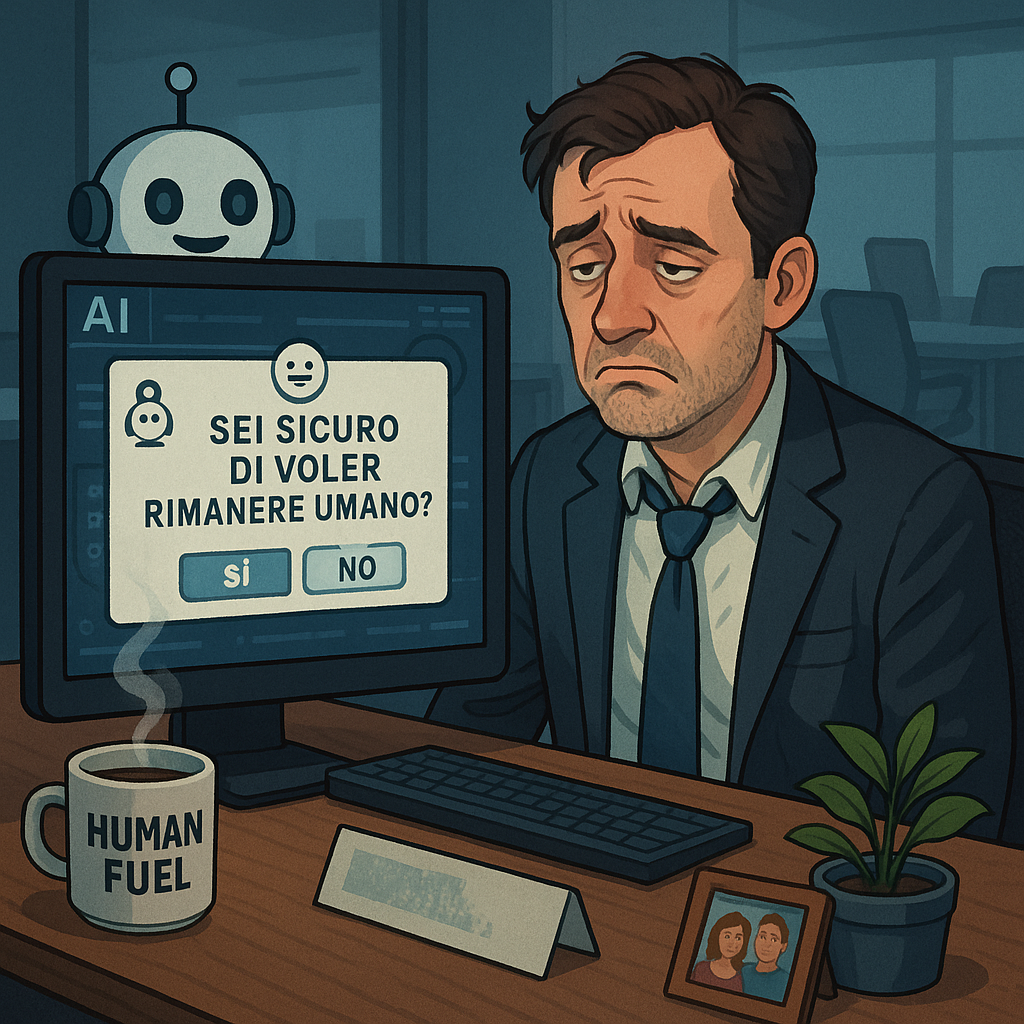
Here's the kicker: this guide is inherently self-deprecating. We're using human intelligence to write a guide on how to survive artificial intelligence, just like the protagonist in the movie who creates the algorithm that replaces him. It's meta-comic, isn't it? But it is precisely this awareness that will save us.
In the film, protagonist Arturo is a victim of the algorithm he himself designed (!) to determine the usefulness of employees in his company-a bitter irony that mirrors the reality of many professionals who introduce technologies that then replace them. In corporate reality, those who wait for "someone to decide" risk being cut without even realizing it.
Tip: Anticipate changes, propose the adoption of AI tools yourself, become the "pioneer" instead of the intended victim.
Nearly 39 percent of current skills will be obsolete or revised between 2025 and 2030, according to the World Economic Forum's Future of Jobs Report 2025. Workers have reached a "silicon ceiling," with only half of them regularly using artificial intelligence tools.
Practical strategy: Don't wait for the company to organize courses. Like Arthur in the movie, you may yourself be the architect of the technology that then replaces you-better to anticipate and control the transformation process than to undergo it.
In the film, satire arises from the contrast between the promise of efficiency and the grotesque reality of a life managed by apps and algorithms.
Tip: Be the first to joke about AI's "absurd decisions," but behind the scenes learn how to use it better than anyone else. Organize "AI roasts" in the company: whoever finds the funniest algorithm error wins a coffee. That way you break down fear and show human leadership.
Over the course of 2024, workers' confidence in GenAI grew. So has their fear of losing their jobs. Employees in organizations going through a complete AI-driven redesign are more concerned about job security (46 percent) than those in less advanced companies (34 percent).
Practical strategy: Become the AI's "emotional translator." Those who can intelligently downplay are remembered, not replaced.
In the film, those who do not understand the language of platforms are left out.
Tip: Become the "translator" between AI and humans: explain to colleagues what the algorithm really does, debunk myths, help those who feel lost. In a world of "assholes watching," you become the guide everyone is looking for.
43% of standard managerial jobs are estimated to be impacted by GenAI. About 19% of these jobs are enhanced, and 24% are automated by GenAI. But without clear guidance, managers struggle to allocate freed-up time to higher-value activities such as strategic planning, talent development, and cross-functional collaboration.
Practical strategy: Position yourself as the bridge between technology and team. Managers bring a nuanced understanding of team dynamics, employee engagement, and organizational culture that AI cannot replicate.
Universal application: This guide is aimed not only at managers, but at all professionals facing digital transformation: from consultant to project manager, from analyst to team leader, from those working in innovative startups to those in large traditional corporations.
In the film, passivity is punished. In reality, those who defend silos are the first to jump.
Tip: You propose the simplifications, but do it with self-deprecation: "Better I say it, before the bot says it!" Like the protagonist who creates the algorithm that fires him, it is better to be active agents of change than passive victims.
Forty percent of employers expect to reduce their workforce where AI can automate tasks. Technology, overall, is projected to be the most disruptive force in the labor market, with trends in AI and information processing technologies expected to create 11 million jobs while simultaneously displacing 9 million.
Practical strategy: Rather than eliminating managers completely, AI shifts the focus from administrative activities to higher-value activities. Anticipate this transition.
In the film, the protagonist's life becomes a tragicomedy.
Tip: Tell the digital transformation as a series of episodes: write short internal newsletter , memes, vignettes about "misadventures with AI." Those who can tell reality with irony are remembered, not replaced.
Eighty percent of C-suite executives believe AI will initiate a cultural shift toward greater innovation. It is important to build a test-and-learn environment to drive innovation and growth. Encourage teams to experiment with AI, share how these tools are useful, and celebrate the successes-and acknowledge the failures-that come with any technological advancement.
In the movie, apps handle everything--except the really human situations.
Tip: Take charge of ambiguous projects, conflicts, team crises-these are the "bugs" that AI can't solve. Become the company's "human debugger."
The contribution of managers to talent development has become more vital than before. As AI redefines job roles and required skills, managers must guide their teams through these transitions, identifying skills gaps and facilitating upskilling and reskilling initiatives.
Practical strategy: Managers will have to supervise 1,000 direct reports. Some are people working in adjacent offices or scattered around the globe, while the rest are artificial intelligence agents who are intelligent, constantly evolving, and work 24/7.
In the film, those who stand by and watch are overwhelmed.
Tip: Propose yourself as an "AI ambassador," organize events, hackathons, discussion moments. Those who lead the culture don't get cut, they get promoted.
Managers are at the heart of successful AI-driven transformations, playing a critical role in bridging the gap between leadership vision and real-world execution. Many organizations underestimate the importance of managers when implementing AI initiatives.
In the film, the protagonist suffers the system.
Tip: If you really have to change roles, do it as a hero: choose your own "exit strategy," perhaps to a hybrid role, a startup, or consulting. Better to be the hero of your own story than someone else's extra.
The top ten roles under consideration include AI Trainer (32 percent), AI Data Specialist (32 percent), AI Security Specialist (31 percent), AI Agent Specialist (30 percent), AI ROI Analyst (29 percent), AI Media & Content Manager (29 percent), AI Finance Strategist (28 percent), AI Customer Success Lead (28 percent), and AI Business Process Consultant (28 percent).
The most recent research confirms which areas where humans remain irreplaceable:
Emotional Intelligence and Leadership: The importance of soft skills such as leadership, empathy and communication is becoming increasingly pronounced. Their ability to mentor junior staff and bridge the gap between operations and senior leadership remains invaluable.
Managing Ambiguity: Managers must be comfortable with ambiguity and uncertainty as the business landscape continues to evolve rapidly.
Practical strategy: Invest in becoming an expert in change management, conflict facilitation, and people development.
The challenge of AI in the workplace is not a technology challenge. It is a business challenge that requires leaders to align teams, address AI headwinds, and reorganize their companies for change.
Practical strategy: It has been less than three years since OpenAI introduced ChatGPT, but the technology has already begun to transform work. Tasks that once consumed much of many employees' days can now be done faster-and in some cases automatically.
Learn how to orchestrate hybrid teams where humans and AI work together. Leaders will need the skills to navigate this transformative era and must master the art of leading teams where AI agents and people collaborate.
The situational leadership framework states that effective leadership depends on the context and maturity of followers. In a world where only 13 percent of employees see AI agents deeply integrated into their daily workflows, the manager must continually adapt his or her style.
Practical strategy: For managers, the need for situational leadership is really crucial given the high volatility in their executive responsibilities and the complexity of internal challenges that may sometimes be greater than product/service/customer challenges.
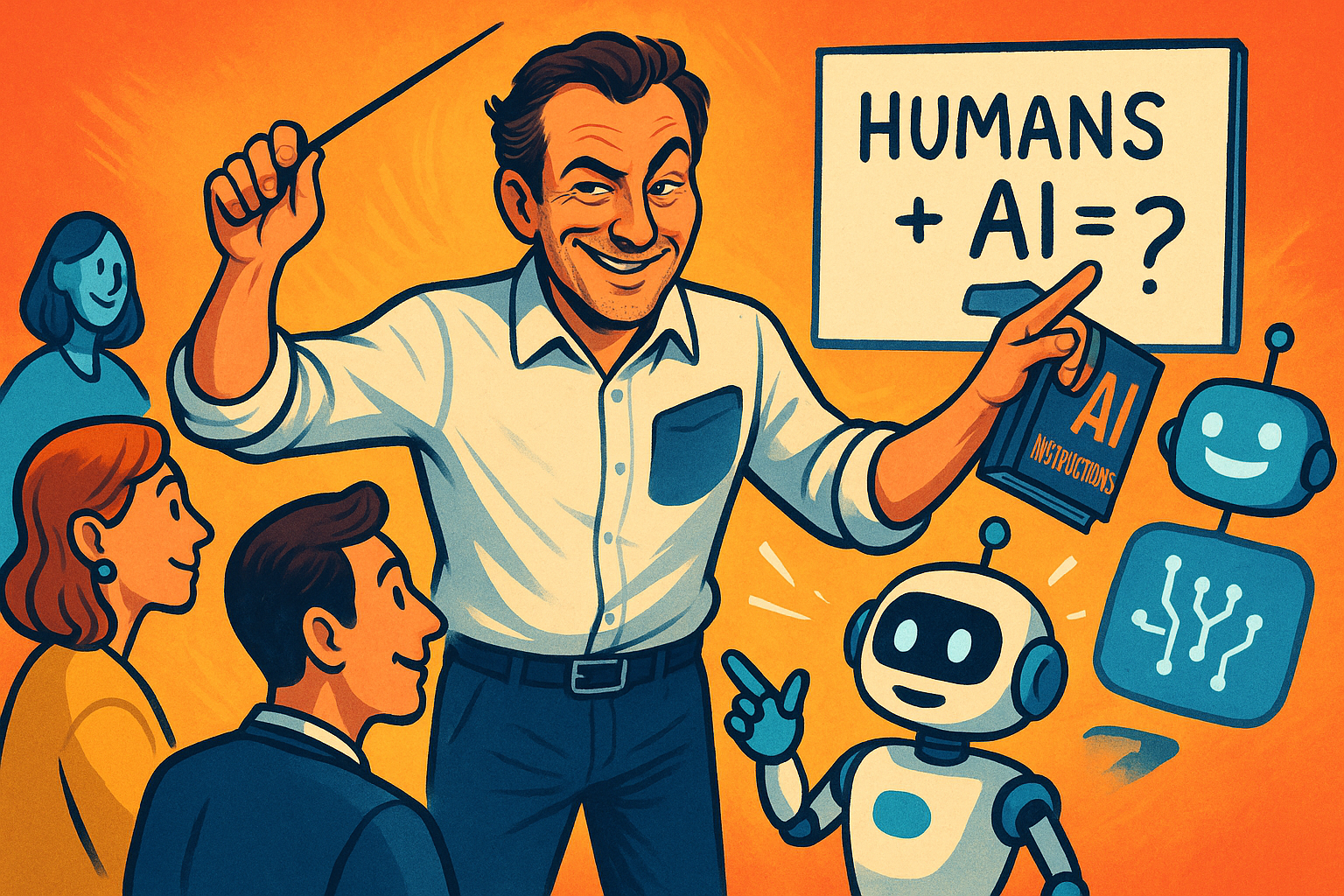
The film is a grotesque satire that should not be taken as an accurate representation of technology, but rather as a critique of modern society in which we risk delegating too much control to algorithms. Above all, it represents a warning about what happens when we remain passive.
The real moral of the film (and of reality): those who stand by and watch are overwhelmed. But those who ironize, act, translate, narrate, and lead...remain protagonists, even in the age of algorithms.
Although predictions about the end of middle management are not new, the proportion of middle managers has actually grown, representing 13 percent of the U.S. workforce in 2022, up from 9.2 percent in 1983. The key is to evolve, not disappear.
Research and Data:
Middle Management Specific Studies:
Film Analysis:
Strategic Resources:
Don't just stand by and watch. Be the protagonist, not the spectator.
AI transformation is inevitable. Your evolution is a choice.

.svg)


.svg)
.svg)