
Are you overwhelmed by spreadsheets that don't add up and orders that get lost along the way? Managing a warehouse manually today is a path that leads straight to costly inventory errors, disappointed customers, and, worse still, many missed opportunities for growth. If this situation sounds familiar, it's time to change your approach.
This article is a practical guide to navigating the world of modern warehouse management software. You will discover why these systems are not just a cost, but a real strategic investment, crucial to the competitiveness of your company. Together, we will look at the essential features, the revolutionary impact of Artificial Intelligence on demand forecasting, and how to choose the perfect platform for your needs, transforming your warehouse from a cost center to a growth engine.
Thinking about digitizing your warehouse is a fundamental step in remaining competitive in a market that demands more and more, faster and faster. The goal is to transform your warehouse from a necessary evil into a driving force for your entire business. It is no longer just a matter of recording income and expenses, but of moving to proactive management, capable of anticipating problems and optimizing every single resource. In concrete terms, this means:
By leveraging smart tools, you can finally make decisions based on data, not gut feelings. And the real game-changer comes when all your systems communicate with each other, giving you a comprehensive overview. If you’d like to learn more, find out how you can integrate ELECTE hundreds of other applications and automate your workflows.
Think of this tool as the conductor of your inventory. Its job is not only to count the products that come in and go out, but to harmonize every single movement: from the arrival of goods from suppliers to the shipment that arrives in the customer's hands. In practice, it is the central nervous system that brings order, precision, and fluidity to all operations.
The leap in quality compared to manual management—consisting of Excel spreadsheets, notes, and memory—is enormous. A dedicated system automates processes, reduces the risk of human error, and, above all, frees up valuable time. Instead of spending hours doing calculations and double-checking, you have a complete and up-to-date picture of the situation in just a few moments.
Although in everyday language they tend to be used as synonyms, it is essential to distinguish between the two main types of warehouse management programs, because they meet different needs:
Fortunately, today many modern platforms do not force you to choose: they combine the features of both, offering a complete and integrated solution.
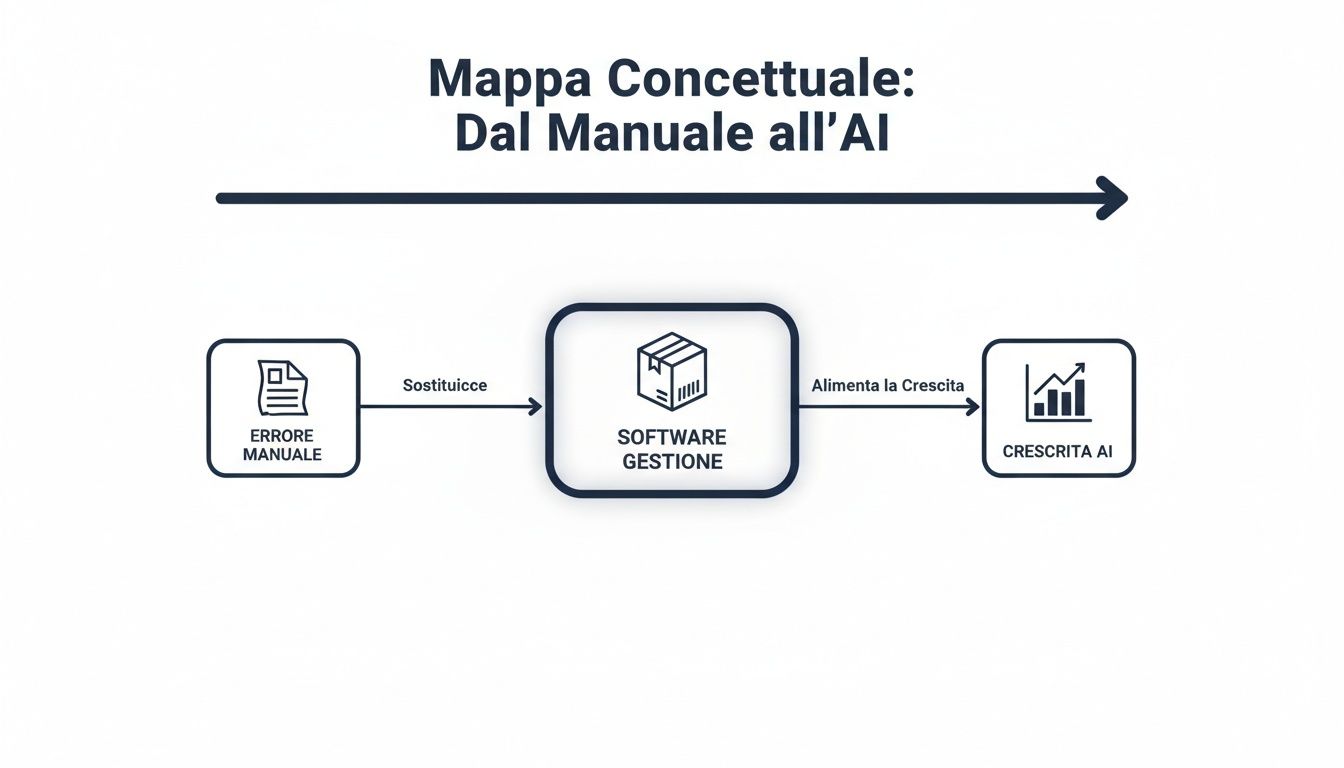
The picture is clear: good management software is the bridge that allows you to move from a fragile and inefficient system to a scalable and intelligent one, where data analysis can become a real driver of growth.
Today, warehouse management software is no longer an isolated system that simply counts products. It is the true beating heart of an interconnected business ecosystem. Its strength lies not only in knowing what is on the shelves, but in its ability to communicate seamlessly with all the other tools you use every day.
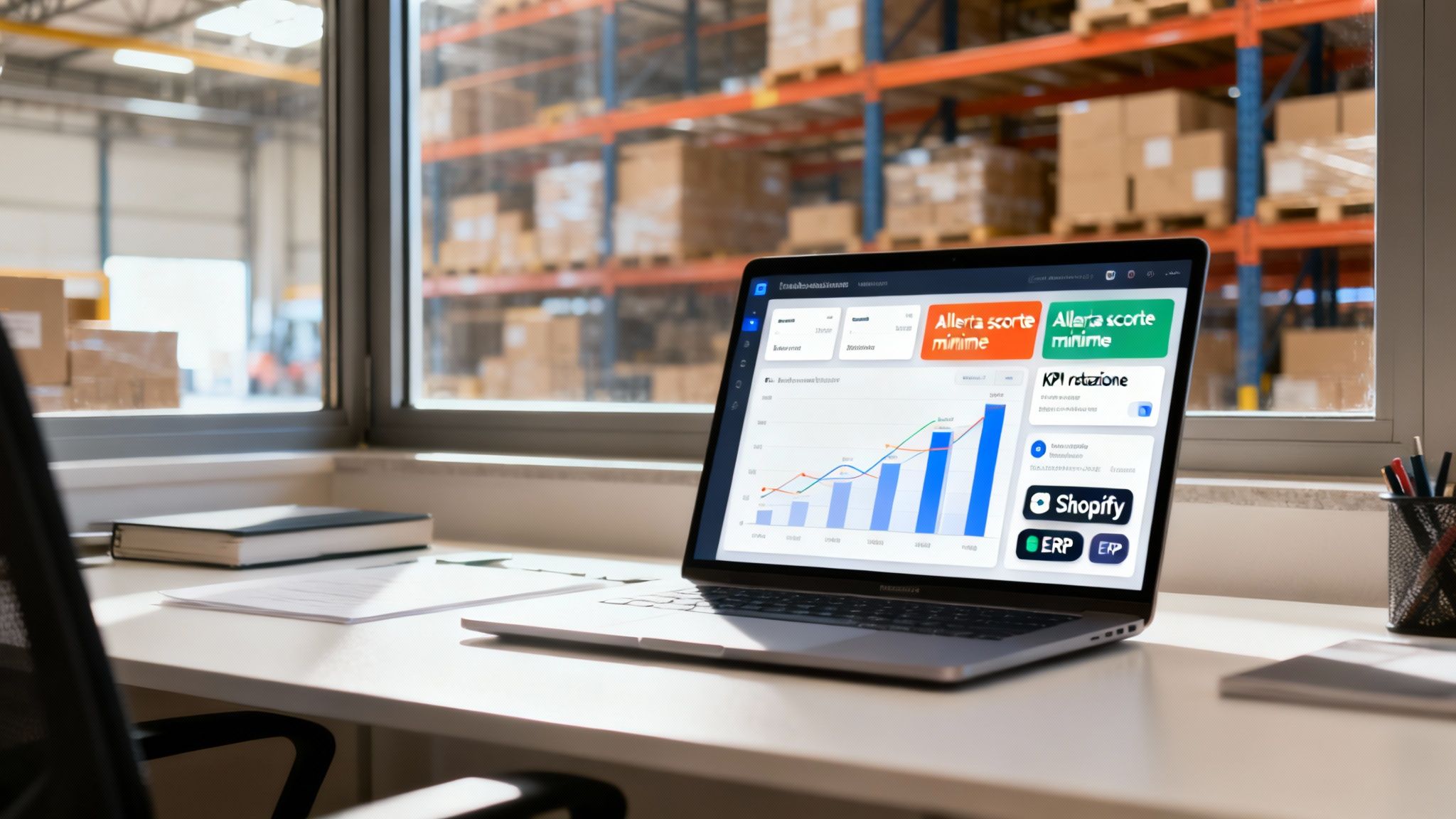
Data synchronization is everything. Modern software must be able to integrate natively with e-commerce platforms such as Shopify, Magento, or WooCommerce, and with corporate ERP systems. But what really makes the difference is integration with AI-powered analytics platforms.
By connecting inventory data to a platform such as ELECTE, you stop looking to the past and start predicting the future. This allows you to transform simple inventory data into strategic insights, anticipating sales trends and optimizing stock levels before a problem arises.
Waiting for a product to run out before reordering it is a reactive strategy that causes you to lose money. The most advanced inventory management programs change the rules of the game with automatic alerts on minimum stock levels.
When the quantity of an item falls below a threshold you have set (the "reorder point"), the system automatically alerts you. This allows you to act in advance, turning what was a potential problem into an opportunity to plan a reorder without rushing. To calculate the ideal reorder point for each of your products, you can use our free reorder point calculator.
An alert is not an alarm, but an assist. It allows you to play offensively, anticipating market needs instead of suffering them.
What really distinguishes an efficient warehouse from one that generates hidden costs? The ability to predict demand. Traditional software relies on sales history, but this is no longer enough. Artificial Intelligence completely changes the game.
An AI-powered system analyzes your sales data and cross-references it with external variables such as seasonality, market trends, and even the impact of your promotional campaigns. The result is an incredibly accurate demand forecast, allowing you to:
This visibility is the first, fundamental step toward optimizing everything. It is no coincidence that Italian logistics trends for 2024-2026 confirm that AI is becoming a decisive competitive advantage.
Artificial intelligence has long ceased to be an abstract concept for large multinationals. Today, it is a concrete tool that can be integrated into warehouse management programs to transform data into a tangible competitive advantage. Put simply, it makes your operations smarter and, above all, more proactive.
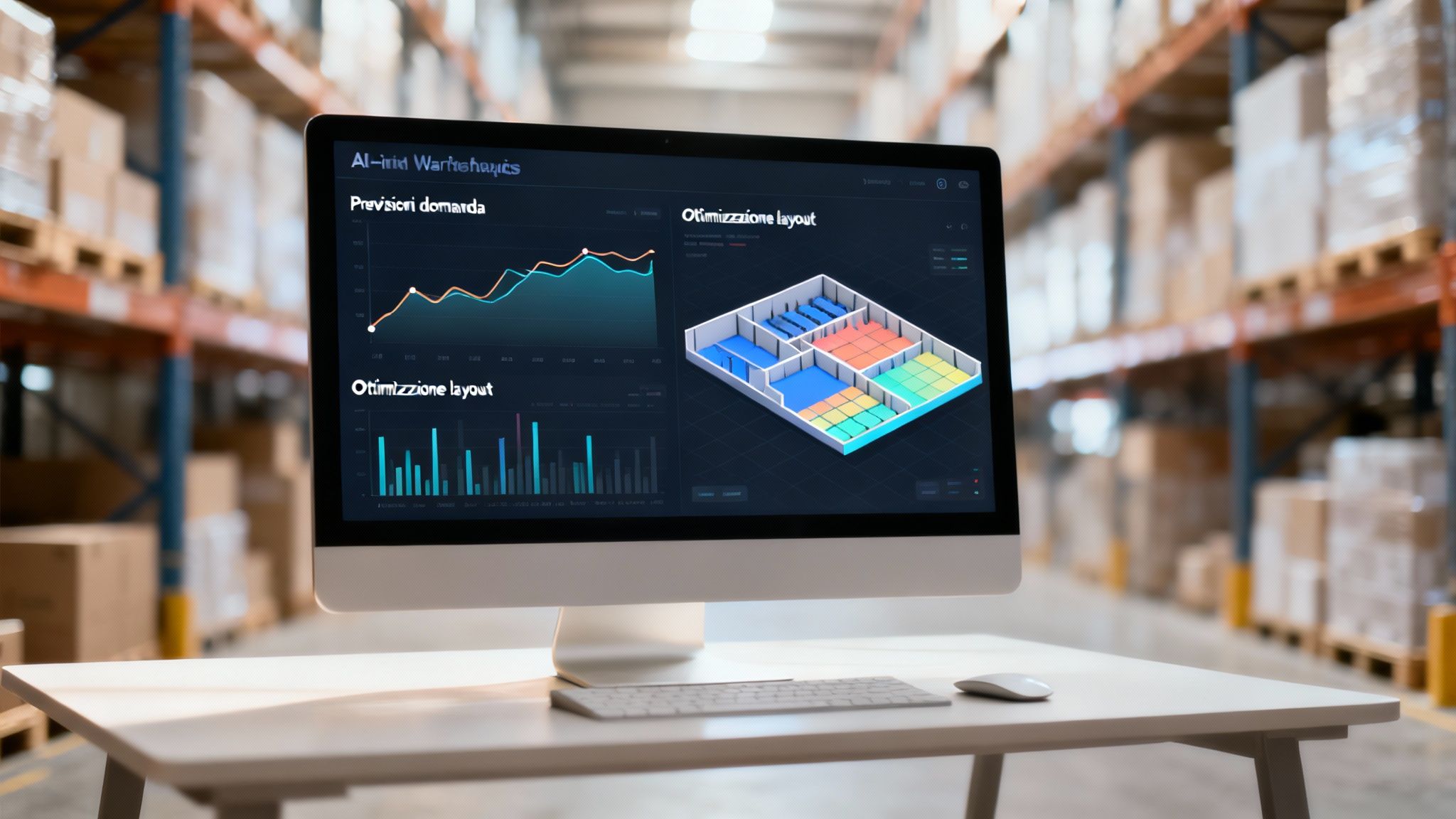
Imagine knowing weeks in advance which products will fly off the shelves on Black Friday or during the Christmas season. Having this information allows you to:
Analytics platforms like ELECTE, an AI-powered data analytics platform for SMEs, connect directly to your accounting software to provide you with these predictive insights. This way, your raw data stops being a dusty archive and becomes the real driving force behind your decisions.
But the impact of AI doesn't stop there. Another hugely valuable application is warehouse layout optimization. By analyzing order frequency and combinations of products purchased together, AI can suggest the optimal physical layout of your merchandise.
The goal of AI in the warehouse is simple: minimize every second wasted. Every step saved by an operator translates into a direct increase in productivity and a reduction in operating costs.
Placingbest-selling items in the most accessible areas closest to the packing zone can drastically reducepicking times. This means faster order fulfillment and greater operational capacity, often without even having to expand your space.
Adopting these technologies is no longer a choice for the few. Estimates suggest that by 2026,80% of Italian logistics companies will adopt systems integrated with Artificial Intelligence, as highlighted by analyses of logistics forecasts and trends up to 2026. Investing in intelligence is no longer a luxury, but a fundamental step to avoid falling behind.
Choosing the right software can seem like a daunting task, but with the right steps, it becomes a manageable process. The winning approach, however, does not start with the software: it starts with you and your company.
The first step, in fact, is an honest and thorough analysis of your real needs. No two companies are alike. What works wonders for an e-commerce clothing retailer could prove disastrous for a manufacturing company.
To start off on the right foot, ask yourself some very specific questions that will help you define your needs. Skipping this step is the best way to end up paying for features you'll never use or, even worse, finding yourself with a tool that no longer meets your needs after a few months.
This is your starting list:
Having clear answers to these questions is like having a map: you know exactly what to look for and what to discard.
Once you have defined the "what," you can move on to the "how." Budget is obviously a key factor, but beware of the list price trap. Always look at the total cost of ownership (TCO), which includes implementation, staff training, and technical support over time.
The real challenge is not finding the cheapest software, but the one with the best return on investment. A system that integrates seamlessly and saves hours of work every day is infinitely more valuable than a low-cost option that only creates obstacles.
Integrations are the second pillar. Your new warehouse management program must "speak" the same language as the other tools you use. Make sure it connects seamlessly to your e-commerce, ERP, and carrier software. An automatic, uninterrupted data flow is what really makes the difference between a warehouse that works and one that struggles.
Finally, never underestimateusability. Request a personalized demo; don't settle for a pre-recorded video. Above all, have the people who will be using the software every day try it out. If your warehouse staff find it complicated, they will never use it to its full potential, and the investment will have been wasted.
We have seen how modern warehouse management programs, especially when enhanced by artificial intelligence, are an essential lever for growth. Here are some practical takeaways for you:
The real leap forward is not just about digitizing processes. It's about changing mindsets. We need to move from reactive management, which chases problems once they have already arisen, to a proactive and predictive approach.
This is the decisive turning point. The point is no longer knowing what is on the shelf today, but anticipating with certainty what will be needed tomorrow. This is how the warehouse ceases to be a simple cost center and becomes a real strategic asset, capable of guiding your business decisions and increasing customer satisfaction.
Integration with AI-powered platforms like ELECTE the bridge that enables you to make this leap. It transforms seemingly mundane data—such as product movements—into a goldmine for business intelligence. Learning to interpret these streams of information is a crucial skill, as we explain in our in-depth article dedicated specifically to business intelligence software.
The future of warehousing is already here, and its language is data. The question is no longer whether to adopt these technologies, but how quickly to do so in order to stay ahead of the curve. Are you ready to turn your data into a competitive advantage?
See ELECTE action with a personalized demo →

.svg)


.svg)
.svg)



.png)