

What is the difference between synchronous and asynchronous? If you are looking to optimize your company's processes, this is not a technical question, but a fundamental strategic choice. The answer lies entirely in timing and the impact this has on your operations.
A synchronous process is like a phone call: you ask a question and wait on the line for an answer before you can continue. Until you get it, everything else is on hold. It's immediate, direct, but blocking. An asynchronous process, on the other hand, is like sending an email: you send it and immediately go back to your activities. The answer will come, but in the meantime, your work hasn't stopped.
In this article, we will guide you through understanding not only the difference between the two approaches, but more importantly, how and when to use them to make your business more efficient, scalable, and responsive. You will learn to recognize situations where immediacy is vital and those where background efficiency is the real key to success.

Imagine you have to make an important decision with your team. You have two options: either call an immediate meeting to discuss it and decide on the spot, or send a detailed email asking everyone to give feedback by the end of the day.
The meeting is a perfect example of synchronous interaction. To work, it requires all participants to be present, connected, and active at the exact same time. Workflow stops, in a sense, until the meeting is over and the decision is made.
Email, on the other hand, is an asynchronous process. Once you've sent it, you can safely move on to other tasks. Your colleagues will reply when they have time, without holding up either your work or theirs. The process will only be complete once all the replies have been collected and analyzed, but in the meantime, the world has moved on.
This analogy, seemingly trivial, is actually at the heart of the difference between synchronous and asynchronous approaches in business. And it is not a purely technical detail, but a real strategic lever that shapes everything: from data management to internal communications, to system architecture.
Understanding this distinction is the first step toward optimizing workflows, choosing the right technologies, and ultimately making more agile and effective decisions.
In the world of computer systems, the logic is exactly the same:
To make the concept even clearer, we have directly compared the two approaches in this table. It helps you quickly see where one approach excels and the other may be less suitable.
As you can see, there is no clear winner. The choice depends entirely on your goal.
There is no single best approach; it all depends on the context and the specific goal you want to achieve. For some activities, the immediacy of synchronous processing is vital. Think of a credit card transaction: you want to know immediately whether it was successful. For others, however, the efficiency and flexibility of asynchronous processing are irreplaceable, such as when you start backing up an entire database.
If you want to see how APIs handle these interactions in practice, you can learn more by reading our guide on Electe APIs, Electe available with a verified Postman profile. There, you will see firsthand how these concepts translate into real solutions.
In the business world, speed isn't an option, it's a competitive advantage. And the synchronous approach to data analysis is just that: getting immediate answers so you can act now, not tomorrow. Forget waiting for the end-of-day report. Here, it's about seeing results as things happen, in real time.
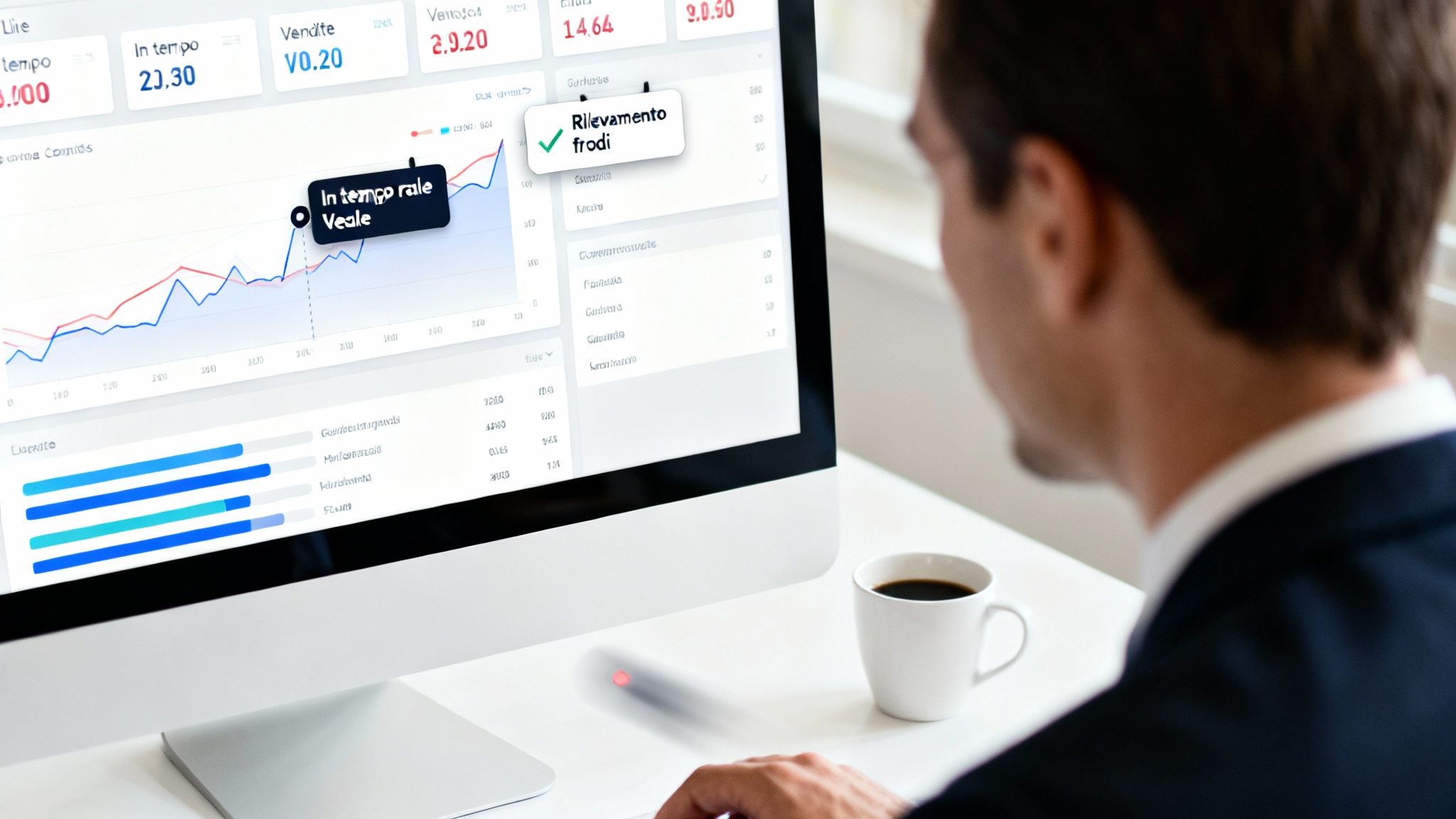
Think of synchronous processing as a navigator that instantly recalculates your route when you take a wrong turn. Every click, every purchase, every single piece of data that enters the system triggers an immediate reaction.
To truly understand the power of a synchronous system, imagine managing the live dashboard of an e-commerce site during Black Friday. With synchronous analysis:
This visibility allows you to capitalize on an unexpected spike in sales or immediately notice a technical issue that is blocking conversions. You don't have to wait for the next day's report to find out that you've lost thousands of dollars. Another critical example is fraud detection: a synchronous system analyzes every payment the moment it occurs and blocks suspicious transactions in a fraction of a second.
The synchronous approach is not about looking at what happened yesterday. It is about influencing what is happening now. It is the key transition from passive analysis to active business management.
Although the winning strategy is often a clever mix of synchronous and asynchronous approaches, the benefits of the former are undeniable when urgency is at its peak.
The advantages speak for themselves:
Of course, this responsiveness comes at a price. It requires a solid technological infrastructure capable of handling a constant flow of requests. Fortunately, platforms such as Electe, an AI-powered data analytics platform for SMEs, have been created for this very purpose: to make real-time insights accessible even to those who do not have an entire IT department at their disposal.
In this way, even SMEs can take advantage of the same decision-making agility that was once a luxury reserved for the few, competing on equal terms in the market.
If the synchronous approach is a sprinter, always ready to dash, the asynchronous approach is a marathon runner. It is the silent hero of efficiency and scalability, allowing your company to grow without collapsing under its own weight. Here, the pace changes completely: the goal is not instant responsiveness, but to reliably complete huge volumes of work without ever disrupting daily operations.
Asynchronous processing, often referred to as "batch," is ideal for non-urgent but intensive tasks.
Consider a classic end-of-day process: generating daily sales reports. Running it asynchronously, perhaps at night, means not overloading the servers during peak hours. The result? Your e-commerce site remains fast and responsive for customers, even while behind the scenes data is being processed to prepare the reports that will be ready for you the next morning.
Its real strength lies in decoupling the moment an activity starts from the moment it ends, freeing up a huge amount of resources in the meantime.
Here are some other examples that we experience every day:
An asynchronous process does not mean "slower" for users. On the contrary, it means "smarter" for the infrastructure, because the workload is managed optimally, ensuring that the system remains stable and performs well for everyone.
For a company, strategically choosing where to use asynchronous processes leads to concrete advantages. In sectors such as retail and finance, data analysis performed asynchronously can cut operating costs by as much as 30-40%. If you are interested in understanding how to optimize these flows, you will find several practical ideas in our article on business process management.
The impact of asynchronous task management goes far beyond simple cost savings. It touches on the pillars that support the growth of a modern company.
The main benefits can be summarized as follows:
Okay, we understand the difference between synchronous and asynchronous. Now comes the fun part: how do we decide which one to use? The right choice is never a matter of preference, but depends 100% on the context and objective of each individual activity.
There are no magic formulas, but there is a strategic approach, a small mental framework that can guide you toward the most efficient solution. Making mistakes here means creating bottlenecks that slow down the company or, worse, wasting valuable resources.
To make it more concrete, think of a series of questions. When faced with a new process or activity to implement, ask yourself these three key questions, in this order.
Does the operation require an immediate response (within a few seconds) in order to proceed?
Would any delay block other critical activities or the user experience?
Does the process need to process a large amount of data or does it require a long calculation time (from a few seconds to several minutes)?
This visual diagram perfectly summarizes a typical asynchronous workflow, where resources are managed intelligently without paralyzing the main system.
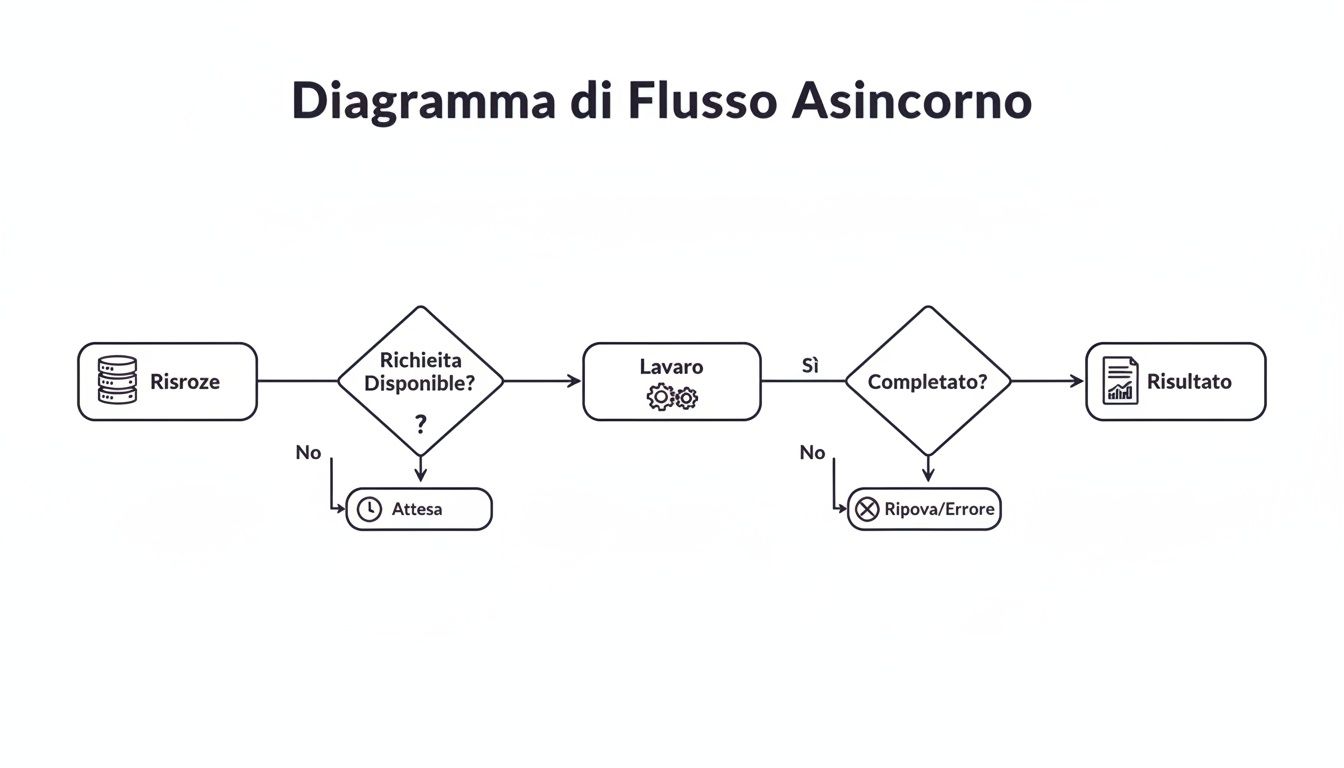
As you can see, the process is queued, processed in the background when resources are available, and the result is only communicated at the end. It's efficiency in practice.
To see this logic applied to the real world, we have put together a table that associates some common business scenarios with the most appropriate approach, explaining why in simple terms.
This same logic also applies at the macroeconomic level. Forecasts for the Italian economy, for example, indicate a strong push for ICT investments by SMEs, with a focus on AI and cybersecurity. This trend, as emerges from the outlook for the Italian economy until 2026, highlights the need for hybrid systems: synchronous for security (threat detection must be instantaneous) and asynchronous for large-scale data analysis (strategic planning).
Choosing the right approach is not a technical decision, but a strategic one that directly impacts operational efficiency, costs, and customer experience.
Using this framework allows you to build more robust, scalable, and intelligent processes. In practice, it transforms every single operation into a small engine of efficiency for your company.
The real challenge today is not choosing between synchronous and asynchronous, but learning how to make them communicate intelligently. It is not a matter of choosing sides. On the contrary, the most robust and efficient systems are those that orchestrate both approaches, getting the most out of every situation. The key lies in creating a hybrid workflow, in which each mode does exactly what it was designed to do.
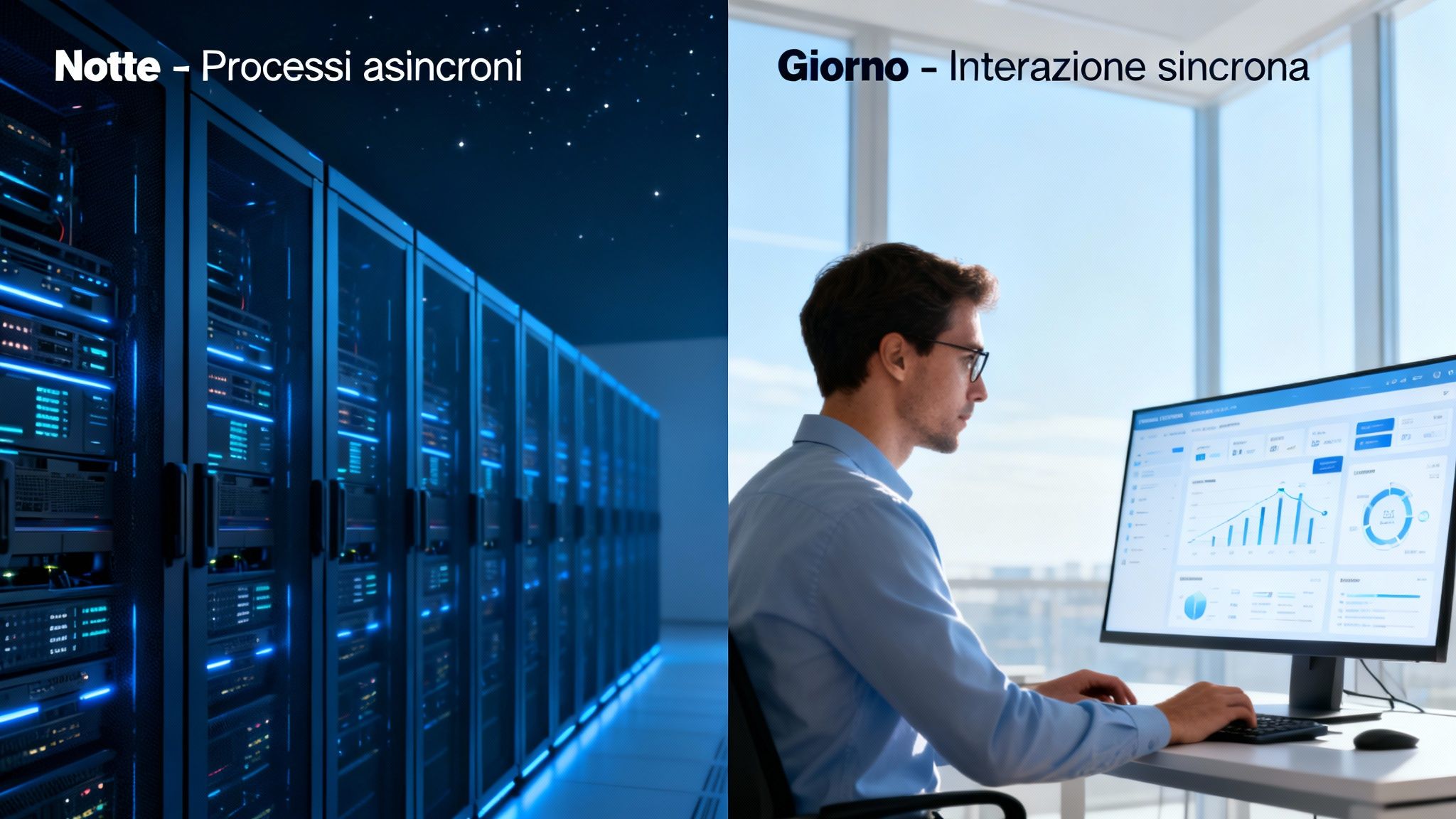
A modern data analytics platform such as Electe the perfect example of this hybrid model. The system is designed to give you the best of both worlds, handling all the complexity behind the scenes.
At night, or during quiet periods, the platform works asynchronously. It grinds, aggregates, and cleans up huge volumes of data coming from dozens of different sources: your CRM, management software, advertising platforms. This massive process, which you don't even see, prepares the ground and ensures that data is always ready and system performance is at its best.
During the day, however, when you open your dashboard, interaction becomes synchronous. Every filter you apply, every chart you explore, every insight you request is updated instantly. You get the answers you need in real time, so you can act immediately, without frustrating delays. It's an approach that combines the power of asynchronous with the responsiveness of synchronous.
This balance between synchronous and asynchronous is what allows Electe offer "enterprise-level analytics without enterprise-level complexity," making a data architecture that would otherwise be out of reach accessible to SMEs. In practice, for us, the hybrid model translates into asynchronous analytics to optimize retail inventory (with stock reductions of up to 20%) and synchronous analytics to ensure real-time compliance in the financial sector.
The strategic combination of synchronous and asynchronous transforms data from a simple archive into a dynamic tool for making better decisions faster.
This flexibility is essential to meet the needs of a market where, according to recent studies,86% of large companies are involved in Open Innovation initiatives that require extreme agility. To better understand how integrations promote this agility, you can read our article on AI orchestration according to Zapier and Electe more than 450 integrations. Knowing how to integrate different workflows, some immediate and others working in the background, is the secret to building a truly data-driven company.
We have reached the end of this guide. Understanding the difference between synchronous and asynchronous is the first step, but the real value lies in using these concepts to improve your company's processes. Here are the key points to take away with you.
Okay, now that we have the basics covered, let's get down to business and answer some of the most common questions. These are the points that often cause confusion when moving from theory to practice.
Of course. In fact, the smartest and most modern workflows are almost always a mix of the two.
Think about when you buy something online. The system must immediately check whether the product is available and whether your credit card works. These operations are synchronous because you need an immediate response: "order confirmed" or "order failed."
But a moment later, everything else—sending the summary email, updating the warehouse systems, notifying the courier—starts asynchronously. There's no need to keep you waiting for operations that can easily take place behind the scenes.
For the end user? Almost never. In fact, it's quite the opposite.
Imagine you need to generate a complex report that requires 10 seconds of computation. A synchronous approach would force you to stare at a loading screen, blocking everything else. A terrible user experience.
With an asynchronous flow, on the other hand, the user clicks "generate report" and can immediately go back to doing something else. When the document is ready, they will receive a notification. The perceived wait time is zero, and the system appears much more responsive and fluid.
True speed is not measured by the time it takes for an operation to complete, but by how little it interrupts the work of those using it. And in this respect, asynchronous processing is unrivaled.
Here, the difference is clear. Synchronous processes usually cost more in terms of infrastructure. They require powerful servers that are always active, ready to respond instantly to any request. This means keeping resources "hot" 24/7, even when they are not needed.
Asynchronous processes, on the other hand, are masters at optimizing resources. They allow you to manage work peaks by queuing them, distributing the load over time, and using servers much more efficiently, perhaps during off-peak hours. This approach almost always translates into significant savings in operating costs.
Optimizing your processes means making smarter, faster decisions. The choice between synchronous and asynchronous is at the heart of this transformation. Understanding when to leverage real-time responsiveness and when to rely on the efficiency of background processes allows you to build a more agile and scalable business. That's how you illuminate the future of your business.
Ready to transform your data? Discover how Electe works Electe

.svg)


.svg)
.svg)