
Agile IT project management is not just a methodology, but a change in mindset that transforms the way your company approaches innovation. Have you ever wondered why so many IT projects, especially those related to AI and analytics, fall behind schedule or, worse, fail to achieve their goals? Often, the fault lies with a rigid approach that leaves no room for adaptation. This agile approach, on the other hand, allows your team to deliver value to customers more quickly, flexibly, and with fewer unexpected events.
In this guide, you will discover why traditional methods no longer work for innovative projects and how the Agile approach can make your SME more competitive. Together, we will look at the fundamental principles, the most effective frameworks such as Scrum and Kanban, and a practical case study that demonstrates how to implement an analytics project in four weeks instead of six months. Are you ready to make your projects faster, more efficient, and more aligned with the real needs of the market?
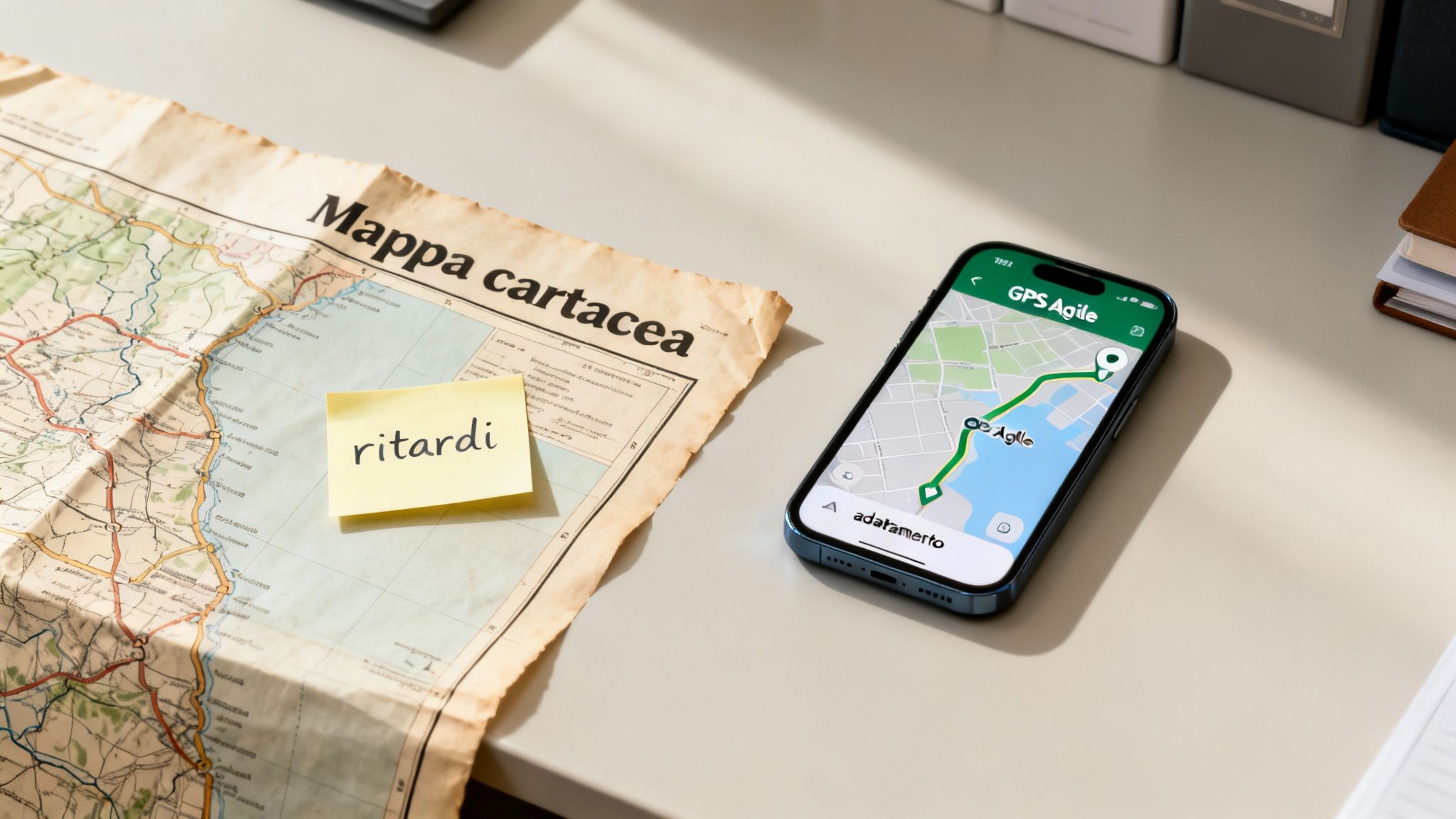
Many small and medium-sized businesses, perhaps even yours, struggle daily with the rigidity of traditional project management methods, such as the waterfall model. It works a bit like an old road map: you plan the entire route at the beginning, and woe betide you if you stray from it. Each stage must be completed before moving on to the next, creating a slow and unresponsive process.
This system becomes a huge obstacle, especially when it comes to AI and analytics projects. In these fields, exploration and adaptation are not the exception, but the rule of the game.
What happens when the market suddenly changes or a customer requests a change midway through the project? The Waterfall model shows all its flaws. Any deviation from the original plan means significant delays and rising costs, because it forces you to go back and dismantle entire phases of the project that have already been "closed."
In a market that changes at lightning speed, following an outdated plan is much riskier than adapting. The traditional approach forces you to stare at the map while the road ahead is already completely different.
Agile IT project management was created precisely to resolve this paradox. It is not a magic formula, but a different way of thinking that can transform the way your company approaches innovation.
Embracing the Agile mindset brings tangible benefits that go far beyond simple task management. For an SME, this translates into:
Think of Agile as a GPS navigator that recalculates your route every time you encounter traffic or a road closure. Not only does it save you time and resources, but it also makes your company stronger and more competitive. It transforms every project into an opportunity to learn and continuously improve.
To truly enter the worldof agile IT project management, the first thing to do is to understand its soul, its beating heart. I am talking about the four fundamental values written in black and white in the Agile Manifesto.
Don't think of them as rules set in stone. They are more like a compass, guiding principles that shift the focus: from rigid procedures to people, from immutable plans to results that work. Each value is based on a simple preference: while recognizing that what is on the right has its importance, we choose to prioritize what is on the left.
This is the starting point. People are the real driving force behind any successful project. Of course, sophisticated tools and detailed procedures can help, but they will never replace the spark of creativity, intuition, and that magic that is created when team members talk to each other, exchange ideas, and solve problems face to face.
It's a bit like assembling a complex piece of furniture. You can have the best instruction manual in the world and the most high-tech tools, but if those working on it don't communicate and help each other, the result will almost certainly be a disaster. Agile bets everything on this: on the ability of a close-knit team to find better solutions faster than any predefined procedure.
The goal of an IT project is one and only one: to create something that works and brings value. Documentation has its purpose, but it becomes a huge waste of time and resources when its drafting ends up taking precedence over the actual development.
Imagine a restaurant: a detailed, beautifully written menu is nice, but customers come back for the quality of the food, not for how the dishes are described. Similarly, a customer judges a project by the software they can use, not by hundreds of pages of technical specifications that, let's face it, no one will ever read from start to finish. Agile aims to deliver concrete, tangible, usable value.
In traditional models, the relationship with the customer is often locked into a rigid contract, negotiated at the outset and almost impossible to change. This approach almost immediately creates an "us versus them" dynamic, where every request for change turns into a legal battle.
Agile completely overturns this perspective: the customer is not a counterpart, but a strategic partner. Constantly involving them in the development process is not a nuisance, but the surest way to build exactly the product they need.
This ongoing dialogue ensures that the final result is aligned with the real needs of the market, not those we had hypothesized months earlier in a meeting room. And it is no coincidence that Agile projects have a much higher probability of success.
The market waits for no one. New competitors, technologies that appear out of nowhere, changing consumer tastes: this is the norm. Blindly following a plan established a year earlier is the perfect recipe for delivering a product that is already outdated at the time of launch.
Being agile doesn't mean not having a plan. It means having the intelligence to adapt it when necessary. Think of an experienced sailor: they don't go straight ahead, but constantly adjust their sails to make the most of changing winds. It is this flexibility that allows them to seize new opportunities and correct their course based on feedback, maximizing their chances of success.
The data speaks for itself. According to the Standish Group's Chaos Report, only 9% of Agile projects fail. This is an impressive result when compared to traditional (Waterfall) projects, where the failure rate jumps to 29%. If you want to learn more, take a look at these statistics on the Agile world and how they can make a difference for you too.
Embracing the Agile mindset is the first, fundamental step. But immediately after that comes the operational choice: what is the right tool for your team? There is no such thing as a perfect framework, but there is one that is perfect for the project you are working on.Agile IT project management offers several "toolboxes," and the most proven are undoubtedly Scrum, Kanban, and their hybrid, Scrumban.
The choice depends entirely on the nature of the work to be managed. Are you building a completely new product from scratch? Or are you managing a continuous flow of requests, such as maintenance and support? The answer to this question is key to guiding you.
Scrum is the most widely used Agile framework, employed by approximately 63% of Agile teams. It is a structured approach based on fixed-time work cycles called Sprints, typically lasting one to four weeks. Each Sprint is a sort of mini-project: the work is planned, developed, tested, and, at the end, a piece of the product is delivered that is functional and ready to use.
This rhythmic pace makes it ideal for complex projects, where the goal is clear but the path to get there is yet to be discovered. Think about developing new software or implementing an analytics platform from scratch. Scrum introduces specific roles (Product Owner, Scrum Master, Development Team) and "ceremonies" (Sprint Planning, Daily Scrum, Sprint Review, Sprint Retrospective) that create a predictable structure and encourage collaboration.
In summary, if your project requires building something new, exploring solutions, and receiving constant feedback to adjust your approach, Scrum provides you with the discipline you need to never lose sight of the goal.
Unlike the rhythmic structure of Scrum, Kanban is a visual and incredibly flexible system, designed to manage a continuous workflow. Its beating heart is the Kanban board, a board (physical or digital) that displays activities in columns representing the various stages of the process (e.g., "To Do," "In Progress," "Done").
The key principle of Kanban is as simple as it is powerful: limit Work In Progress (WIP). This means placing a cap on the number of tasks the team can work on simultaneously at any given stage. This small measure prevents bottlenecks, improves focus, and optimizes delivery speed.
Kanban is perfect for teams that handle continuous and often unpredictable requests, such as:
If your priority is not to build a product from scratch but to optimize an existing process with maximum flexibility, Kanban is the right way to go.
What if your team needs both the structure of Scrum and the flexibility of Kanban? That's where Scrumban comes in, a hybrid approach that takes the best elements of both worlds.
From Scrum, Scrumban takes ceremonies and roles (such as retrospectives and daily stand-ups) to ensure constant communication and continuous improvement. From Kanban, on the other hand, it adopts the board and the WIP limit to manage workflow in a visual and flexible way, without the rigidity of fixed-time Sprints.
This model is the ideal solution for teams working on mature products, where the development of new features (perfect for Scrum) alternates with the management of bugs and maintenance requests (perfect for Kanban). It offers a balance that allows for long-term planning while remaining responsive to daily emergencies.
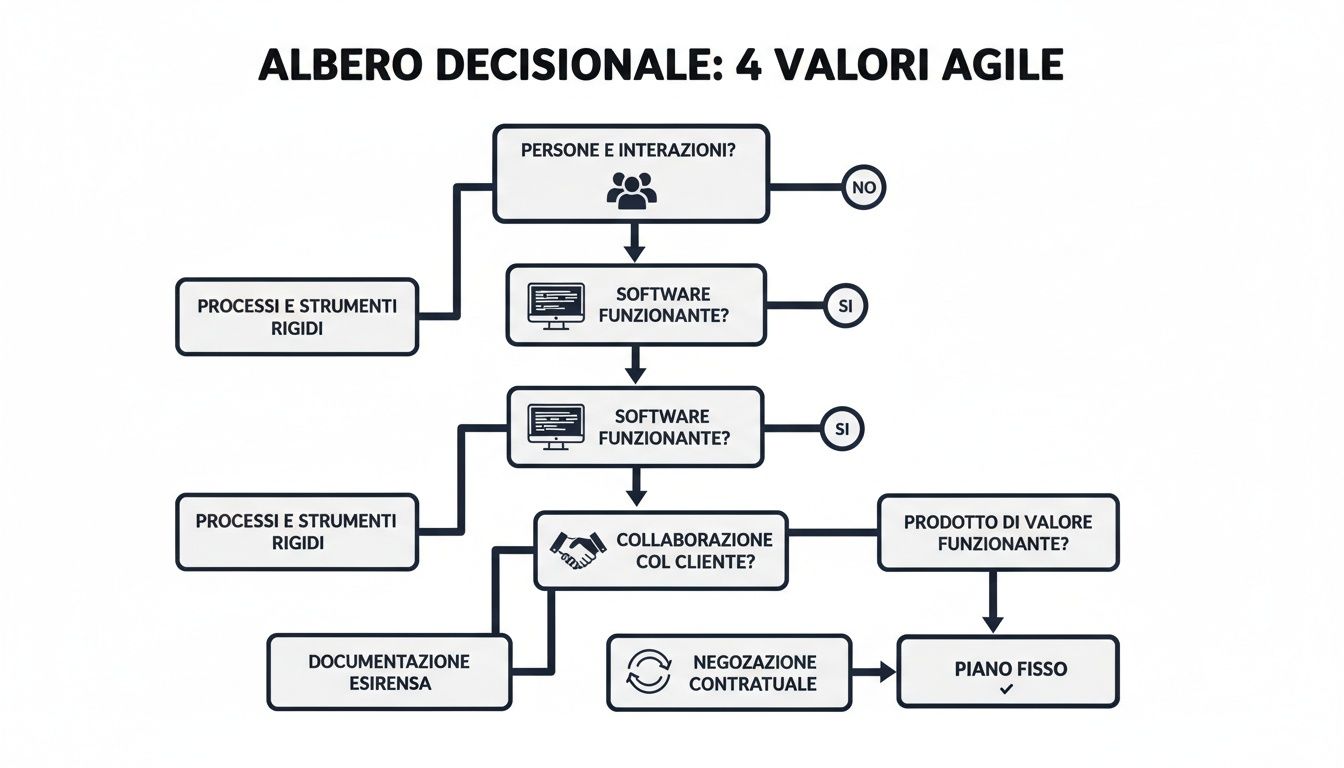
The visualization shows how the right choice always starts with fundamental principles: valuing people and direct interactions, focusing on delivering working software, collaborating closely with the customer, and, above all, embracing change as an opportunity.
Choosing a framework is not a final decision. The essence of agility lies in trying, measuring, and adapting. Start with what seems most suitable and don't be afraid to modify it or switch to another one if the needs of your team or project change.
Choosing the right framework is the first step toward transforming the way your team works. The important thing is to get started, observe the results, and have the courage to adapt the process to find the winning formula.
Theory is one thing, but it's in the field that you see the real difference. To get a feel for the powerof agile IT project management, let's imagine an SME in the e-commerce sector. The goal? To launch a predictive analytics project to optimize inventory by forecasting sales to say goodbye to stock shortages or excess inventory.
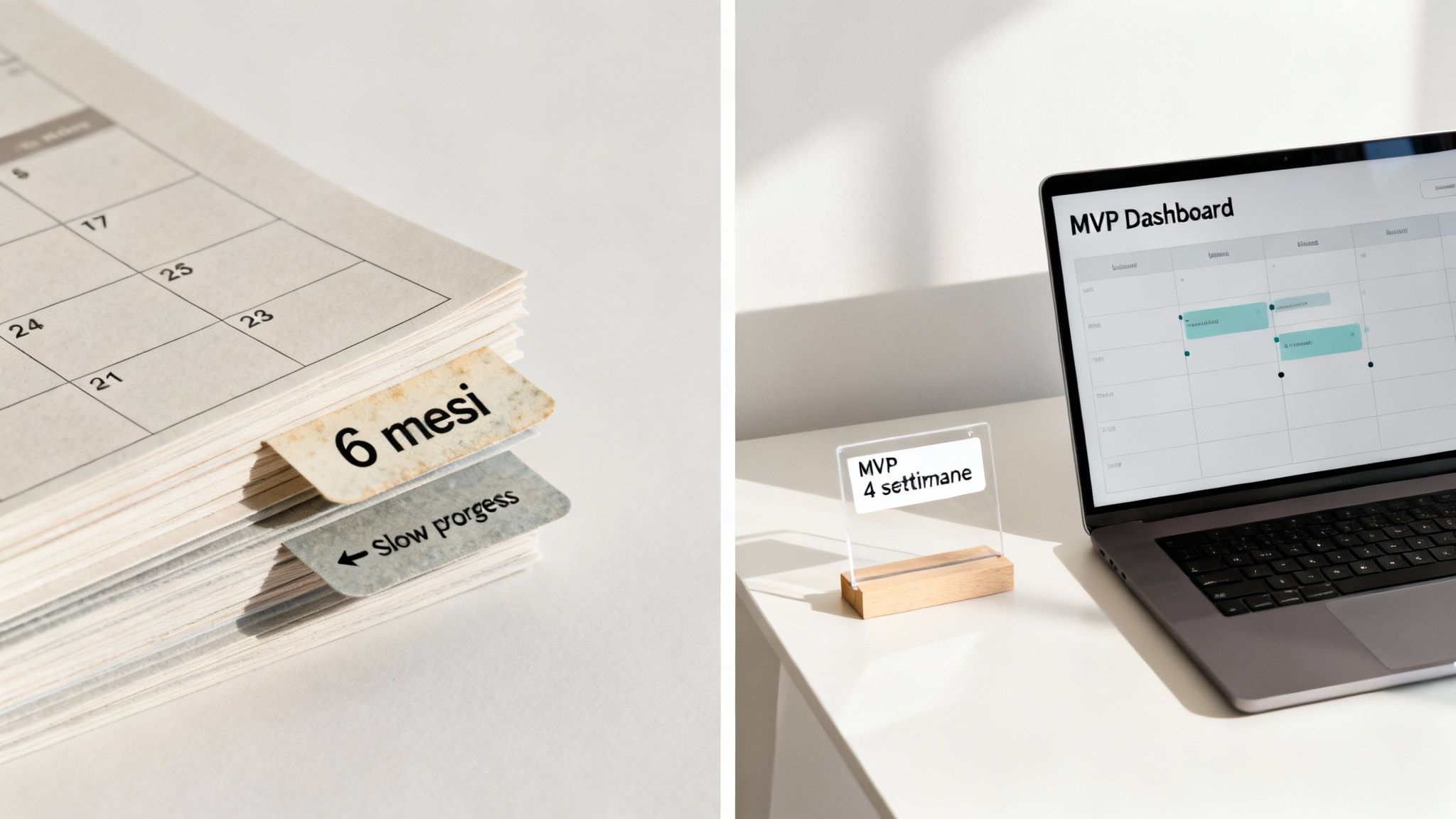
With a classic approach, the project would unfold in rigid phases, one after the other. A marathon.
The result? After six long months, the team presents a complex platform. Unfortunately, in the meantime, the market has changed and management realizes that the insights they need are missing. A technically successful project, but practically a flop.
Now, let's start again with an Agile approach based on Scrum. The goal changes radically: not to build everything right away, but to release a Minimum Viable Product (MVP) —a first working version that brings immediate value—in just four weeks.
An MVP is not an incomplete product, but the simplest version that solves a real problem for those who will use it. In Agile, the focus shifts from delivering a "finished" product to delivering value on an ongoing basis.
The work is broken down into weekly sprints.
After four weeks, the company doesn't have a pile of documents, but a tool that the manager is already using to make better decisions. Value was delivered immediately, the risk of failure was reduced, and the final product will be infinitely more useful. Platforms such as Electe, an AI-powered data analytics platform for SMEs, accelerate this process by providing ready-to-use insights and guiding priority selection in each sprint. To learn more, check out our comprehensive guide to big data analytics.
In the worldof agile IT project management, it is not tools or processes that make the real difference, but people. The success of an Agile project depends 100% on the quality of collaboration and the clarity of roles within the team. And in an SME, where responsibilities are often more fluid, defining who does what is even more critical.

A well-structured Agile team, even if small, moves as a single, cohesive, and focused unit. Let's take a look at the three key roles that are absolutely essential.
Think of the Product Owner as the guardian of the product vision. Their mission is singular: to maximize the value of what the team is building. They are not a traditional project manager; they are the strategic reference point, the compass that points the way.
His responsibilities are crucial:
In an SME, this role can be filled by the founder themselves, a product manager, or a line manager. The important thing is that they have the authority to make quick decisions and a deep understanding of the market.
The Scrum Master is not a boss, but a servant-leader. Their goal is not to assign tasks, but to remove any obstacles that might slow down the team. Think of them as a coach who ensures that the team plays to the best of their ability, respecting the rules of Agile.
Here's what it does in practice:
An effective Scrum Master is an excellent communicator and a problem-solving wizard. They are the oil that keeps the Agile machine running smoothly and efficiently.
The Development Team is the beating heart of the project. It is a multifunctional, self-organizing group of professionals with all the skills necessary to transform ideas from the backlog into a working product.
The team does not receive orders on "how" to do the work, but organizes itself independently to achieve the objectives defined by the Product Owner. This autonomy is the secret to unlocking creativity and a sense of responsibility.
And keep in mind, this team isn't just made up of programmers. It can include analysts, UX/UI designers, marketing experts, and anyone else who is essential to getting the job done.
It is precisely the synergy between these three roles that creates an ecosystem of shared responsibility and transparent communication, the essential ingredient for success. For further insight, discover how to build teams that thrive with artificial intelligence and optimized workflows.
Here are the key points to remember in order to successfully implementagile IT project management in your SME and start seeing concrete results in no time:
Movingto agile IT project management is one of the most strategic decisions an SME can make today. It allows you to abandon the rigidity of traditional models and embrace a dynamic approach that focuses on the customer, collaboration, and rapid delivery of value.
We have seen how Agile principles, frameworks such as Scrum and Kanban, and a well-structured team can transform a six-month project into a four-week success. Adopting this mindset not only reduces risk and optimizes resources, but also makes your company more resilient and ready to seize opportunities in an ever-changing market. Innovation doesn't wait: with the right approach, you can drive it.
Ready to transform your IT projects? See Electe action with a personalized demo →

.svg)


.svg)
.svg)



.png)