
Imagine being able to teach a computer to find hidden business opportunities in your data, much like teaching a child to recognize shapes. Machine learning algorithms are exactly that: "smart instructions" that allow computer systems to learn from data without being explicitly programmed for each individual task. In practice, they transform a sea of information into accurate predictions and strategic decisions that can grow your business.
You're in the right place to understand how this technology, once reserved for a few large companies, is now an accessible and essential tool for SMEs that want to compete and win in the market. In this guide, you'll discover not only what these algorithms are, but how you can use them in practice to optimize sales, improve efficiency, and make decisions based on concrete evidence.

Today, data is the fuel of every business. But without the right tools, it remains just numbers on a spreadsheet. This is where machine learning algorithms come in, the real engine of modern artificial intelligence. They transform raw data into a real competitive advantage.
These mathematical models don't just look at the past; they learn from it to predict the future. They identify patterns, correlations, and anomalies that a human being could never detect, providing clear insights to guide your business strategy.
For SMEs, integrating machine learning is no longer an option, but a necessity to remain competitive. The goal is not to turn you into a statistics expert, but to give you concrete answers to questions that are fundamental to your business.
The advantages are tangible:
This technology is already changing the game. In Italy, the Artificial Intelligence market has reached €1.8 billion, with 50% growth in just one year. Machine learning alone accounts for 54% of this . This is a clear sign that more and more companies are using algorithms to analyze data and improve their performance. If you want to learn more, read further details on how AI is transforming Italian businesses.
In simple terms, machine learning algorithms are the bridge that connects your data to your decisions. They allow you to move from "what happened?" to "what will happen?" and, most importantly, to "what should you do?"
AI-powered platforms such as Electe, an AI-powered data analytics platform for SMEs, are created precisely for this reason: to make such powerful technology accessible. You don't need a team of data scientists to start extracting value from your data. Our platform takes care of the technical complexity, leaving you free to focus on what really matters: growing your business.
To navigate the world of machine learning, the first thing to understand is that not all algorithms are created equal. They are divided into three broad approaches, three "families," each with a different learning method, designed to solve completely different business problems.
The easiest way to grasp the concept is to imagine them as three types of students: one who learns with a teacher (supervised), another who discovers things on their own by analyzing data (unsupervised), and a third who learns by trial and error (reinforcement). Understanding this distinction is the first step in choosing the right tool for your needs.
Supervised learning is the most common and intuitive approach. It works exactly like a student learning from a teacher by following examples that have already been worked out. These algorithms are provided with "labeled" data, i.e., a set of information where the correct answer is already known.
Imagine you want to teach an algorithm to recognize spam emails. You will give it thousands of emails that have already been manually classified as "spam" or "not spam." The algorithm will analyze them, learn to recognize the characteristics that distinguish the two categories, and, once trained, will be able to classify new emails on its own.
There are two main objectives:
Unlike supervised learning, unsupervised learning works without guidance. It is like a detective who has to find patterns and connections between the evidence available to them on their own. The algorithm freely explores unlabeled data to discover hidden structures within it.
A classic application is customer segmentation. You could feed the algorithm your customers' purchase data, and it would autonomously group them into "clusters" based on similar behaviors, revealing market segments you had never thought of before.
Unsupervised learning excels at answering questions you didn't even know you needed to ask, revealing hidden opportunities in your data.
Finally, reinforcement learning is based on a system of rewards and punishments. The algorithm, which we call an "agent," learns by performing actions in an environment to maximize a reward. No one tells it what to do, but it discovers which actions lead to the best results through continuous trial and error.
Consider an artificial intelligence that learns to play chess. If a move puts it in an advantageous position, it receives a "reward." If the move is counterproductive, it receives a "punishment." After millions of games, it learns winning strategies. This approach is perfect for optimizing complex and dynamic processes, such as real-time inventory management.
This section summarizes the key differences between the three approaches.
Supervised learning requires labeled data and has the primary goal of making predictions or classifications. A concrete business example is customer churn prediction.
Unsupervised learning, on the other hand, works with unlabeled data and aims to discover hidden patterns and structures. In business, a typical application is the segmentation of customers into groups based on purchasing behavior.
Reinforcement learning is based on interaction data and aims to optimize decision-making processes. A practical example is the dynamic optimization of prices for an e-commerce product.
Understanding these three families is the first, fundamental step in harnessing the power of machine learning algorithms. With a platform like Electe, you don't need to be an expert to apply them: our system guides you in choosing the best model for your data and business objectives, turning complexity into a competitive advantage.
When it comes to machine learning in business, supervised learning algorithms are almost always the protagonists. The reason is simple: they offer direct answers to crucial business questions. Imagine you want to predict next quarter's revenue based on historical sales data. That's their bread and butter. Supervised machine learning algorithms are designed precisely to transform past data into concrete predictions about the future.
The mechanism is quite intuitive. You "train" the model by providing it with a series of "labeled" examples, where the result you are interested in is already known. The algorithm analyzes this data, learns to recognize the relationships between input characteristics (e.g., seasonality, promotions) and the final result (revenue), and thus becomes capable of applying this knowledge to new data. It is the beating heart of any serious predictive analytics activity.
This concept map shows the three major families of algorithms, highlighting the central role of supervised learning in guiding your business decisions.
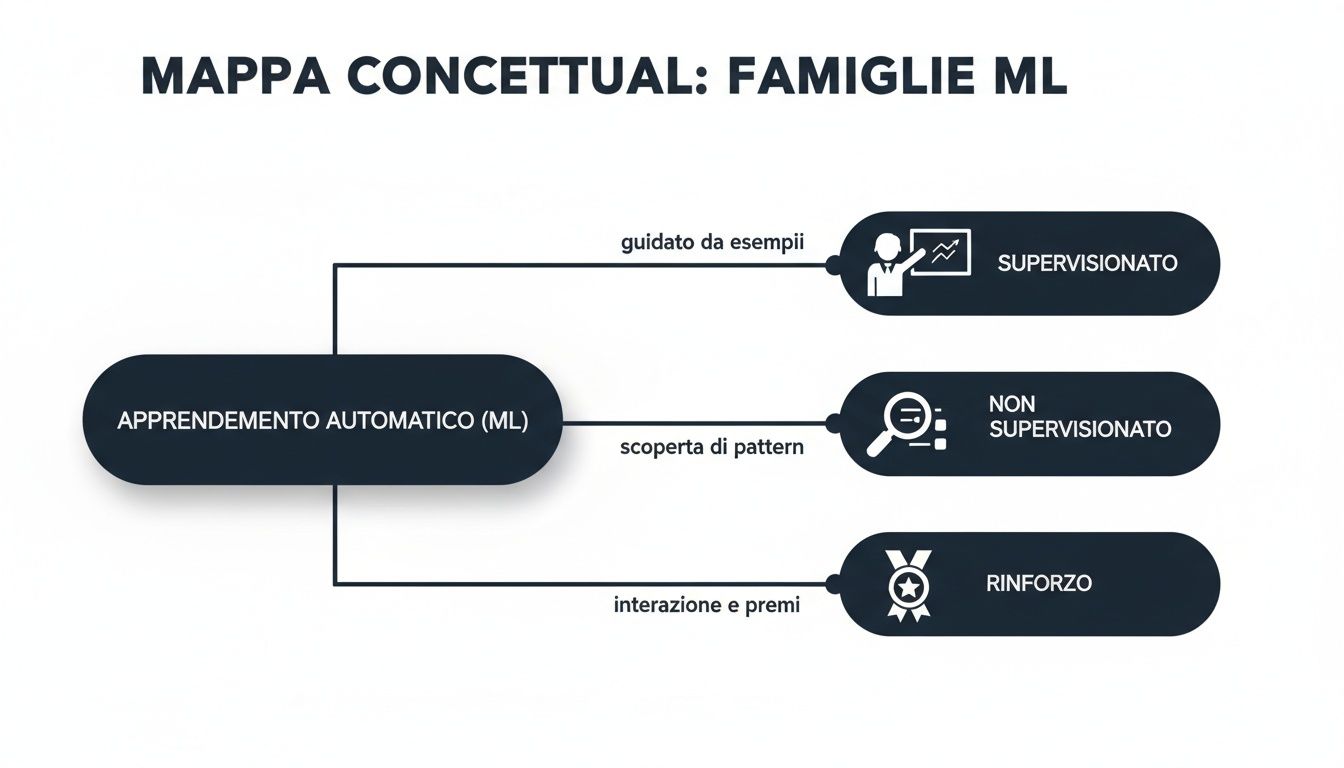
As you can see, each approach has its own battlefield, but it is the supervised approach that answers the predictive questions that every manager asks themselves every day.
Classification is one of the two fundamental techniques of supervised learning. Its purpose is not to predict a number, but to assign a label or category. In practice, it answers questions such as "yes or no?" or "which group does it belong to?"
Consider the everyday challenges in your company:
In every scenario, the impact on business is direct and measurable: costs are reduced, risks are mitigated, and efficiency is increased.
Classification not only tells you what is happening, but also helps you decide where to intervene first. It is a tool that brings order to chaos and transforms data into priorities.
If classification answers the question "which category?", regression answers the question "how much?". This technique is used when your goal is to predict a continuous numerical value. It is the tool par excellence for planning and strategy.
Its strength lies in transforming complex data into quantitative forecasts, which form the basis for more robust and informed decisions. If you want to learn more, discover howpredictive analytics transforms data into winning decisions and how you can implement it in your company right away.
Let's look at some concrete examples:
AI-powered platforms such as Electe created to make these algorithms accessible to everyone. You no longer need to be a data scientist to create reliable forecasts. The platform automates the selection and training of the best model for your data, so you can focus on interpreting insights and planning your next strategic moves.
What if your data concealed opportunities you didn't even know you were looking for? Unlike supervised algorithms, which need a "teacher" to learn, unsupervised algorithms are like autonomous detectives. They dive into raw, unlabeled data and hunt for hidden structures and connections.
This family of machine learning algorithms is designed to answer questions you didn't know you needed to ask, transforming apparent chaos of information into clear and profitable business strategies.

Clustering is one of the most powerful techniques in unsupervised learning. The goal is simple but highly effective: to group similar data into "clusters," or homogeneous segments. In the business world, this almost always translates into effective customer segmentation.
Instead of dividing customers by age or geographical area—criteria that are often too generic—an algorithm such as K-Means analyzes their actual purchasing behavior: what they buy, how often, and how much they spend.
The result? Customer groups based on concrete habits. This allows you to:
The impact of these optimizations is significant. For SMEs, which represent 18% of the Italian AI market, it is estimated that operating costs could be reduced by up to 25% thanks to this type of analysis. An analyst using a platform such as Electe can achieve sales forecasts with an accuracyof 85-90%, freeing themselves from repetitive tasks. You can learn more about the growth of the AI market in Italy and its applications for SMEs.
Clustering transforms your customer database from a simple list of names into a strategic map of opportunities, showing you exactly where to focus your resources.
Another fundamental technique is association analysis, which became famous with "Market Basket Analysis." This method discovers which products are frequently purchased together, revealing often surprising correlations.
The classic example is that of a supermarket that discovers that customers who buy diapers also tend to buy beer. This information may seem bizarre, but it guides very concrete strategic decisions.
Here's how you can use association analysis in your business:
These machine learning algorithms don't just tell you what you sell most, they explain how your customers make their purchases. With a data analytics platform like Electe, you can perform these analyses on your sales data with just a few clicks, transforming simple transactions into an inexhaustible source of insights.
Choosing from the many machine learning algorithms available may seem like a task for a data scientist. In reality, it is a logical process guided by the goals you want to achieve. The real question is not "which algorithm is the most complex?", but "which business problem do I want to solve?".
To clarify, just start with a few key questions. The answers will naturally lead you to the family of algorithms that best suits your needs, transforming a technical dilemma into a strategic decision.
Before looking at the data, let's focus on your goal. Answering these three questions will drastically narrow down the field.
Once these points have been clarified, the path becomes much simpler.
Use these guiding questions as a practical reference to help you choose the most suitable algorithm.
If your data already has labels or a known outcome, lean toward supervised algorithms such as regression and classification. Otherwise, consider unsupervised algorithms such as clustering or association.
If your goal is to predict a continuous numerical value, regression algorithms—such as Linear Regression—are the natural choice. If, on the other hand, you want to predict a category, switch to classification algorithms.
If you want to group data into non-predefined clusters, algorithms such as K-Means are recommended. If the groups are already known a priori, return to the classification algorithms.
If model transparency is a fundamental requirement, favor interpretable models such as Decision Trees or Regression. When performance is the priority and transparency is less critical, you can use "black box" models such as Neural Networks or Gradient Boosting.
Finally, if you have a large amount of data and need maximum accuracy, complex models such as Neural Networks or Ensemble Methods are the most suitable choice. With smaller datasets or when training speed is required, simpler models are often the best solution.
This checklist is a great starting point for understanding what you really need to turn your data into business decisions.
The good news? You don't have to face this choice alone. The evolution of data analytics platforms has made the process infinitely easier.
Today, the goal is no longer to become statistics experts, but to obtain reliable forecasts to guide the business. Technology takes care of the complexity, so you can focus on strategy.
AI-powered platforms such as Electe created precisely to break down this barrier. The process is disarmingly simple:
In this way, predictive analytics becomes democratic. It is no longer the exclusive domain of data scientists, but a handy tool for managers, business analysts, and entrepreneurs who want to make data-driven decisions without writing a single line of code.
The theory is fascinating, but it's the practical application that brings results. So far, we've explored what the main machine learning algorithms are and how they work. Now, however, it's time to see how you can turn this knowledge into a concrete competitive advantage, without writing a single line of code.
Once upon a time, access to these technologies was a privilege reserved for a few large companies. Today, thanks to AI-powered data analytics platforms such as Electe, this power is finally within reach of every SME.
Forget complex programming. The process of implementing machine learning has become incredibly straightforward and consists of just a few steps, designed with business users in mind.
Here's how it works:
The focus of this approach is not on technology, but on the return on investment (ROI) it can generate. When predictive analytics becomes accessible, the impact spreads throughout the organization.
The goal is not to turn managers into data scientists. It is to give managers the tools to make better and faster decisions based on reliable forecasts rather than intuition alone.
Your marketing team can segment customers with unprecedented precision. The sales department can focus on leads with the highest probability of conversion. Operations managers can optimize inventory to reduce waste and costs. Every decision is empowered by data, transforming a simple database into an engine for growth.
Here's what you should remember from this guide:
You have seen how machine learning algorithms are no longer an abstract concept, but a concrete strategic asset for growing your business. From sales forecasting to marketing campaign optimization, the opportunities to turn data into profit are immense and, above all, within your reach. The era when only large corporations could afford advanced analytics is over.
With tools like Electe, you can finally stop flying blind and start making decisions based on accurate predictions. You don't need to invest in a team of data scientists or complex IT projects. All you need is the willingness to look at your data in a new way to illuminate the future of your business.
Ready to take the first step?

.svg)


.svg)
.svg)




.png)