
Imagine being able to predict which customers are about to leave you, or which products will literally fly off the shelves next month. It's not magic, it's predictive analytics. A discipline that uses today's and yesterday's data to understand what will happen tomorrow, turning uncertainty into a concrete competitive advantage for your company.

In this guide, we will show you step by step what predictive analytics is and how you can use it to transform the data you already have into strategic forecasts you can act on. You will see why it is no longer a luxury for multinationals, but an accessible and decisive tool for SMEs like yours.
This change is possible thanks to the growing digital maturity of Italian companies: according to recent studies, 71% of large companies have already adopted at least one advanced technology. If you want to learn more, you can find interesting data in the 2025 report on digital technology in Italy.
We will explore how it works, the technologies such as machine learning that make it possible, and, with practical examples, we will show you how it can revolutionize the way you:
The goal is clear: transform your data into a real driver for growth by integrating artificial intelligence into your decision support systems so that nothing is left to chance.
Predictive analytics is not a crystal ball. It is a scientific method that transforms historical data into strategic forecasts, much like a detective using clues from the past to figure out what will happen next. Instead of just looking in the rearview mirror, it answers a crucial question for every business: "What is most likely to happen in the future?"
This approach allows you to move from reactive to proactive management, transforming your company from reactive to proactive. While other analyses tell you where you have been, predictive analytics help you decide where to go.
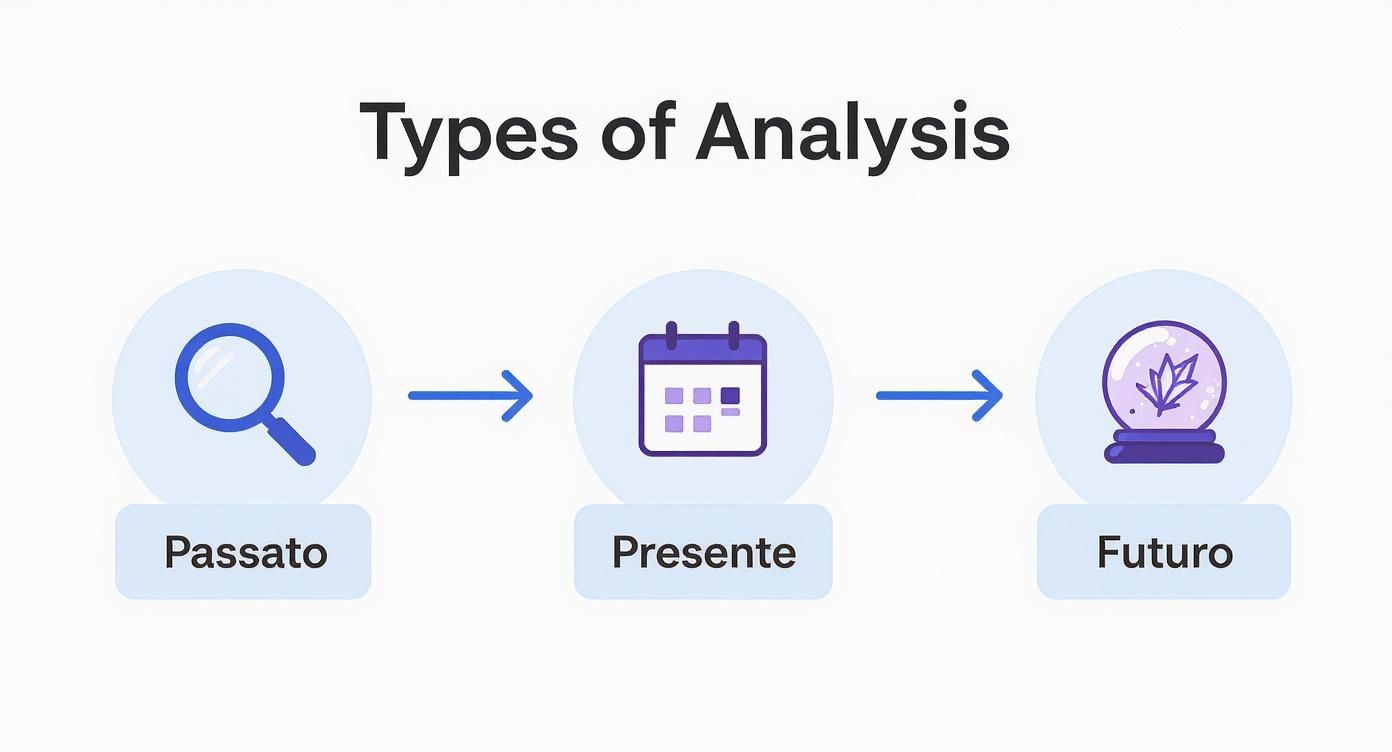
To understand the value of predictive analytics, imagine it as the top step of a ladder. Each level of analysis answers a different question, building an increasingly comprehensive and powerful view of your business. First, let's see how it compares to its simpler "sisters," which you probably already use without realizing it.
If predictive analytics is the car, machine learning is its AI-powered engine.
Consider weather forecasts. Meteorologists don't just look at the sky; they use complex models that process enormous amounts of historical data (temperature, pressure, humidity) to reliably predict tomorrow's weather.
Similarly, machine learning algorithms analyze your business data, such as past sales or customer behavior. They don't follow fixed rules, but "learn" from the data, identifying hidden patterns that a human being would not be able to detect. The more data you provide, the more intelligent and reliable the system becomes over time.
This capacity for continuous learning is its superpower. It is no coincidence that the adoption of artificial intelligence in Italian companies is accelerating. Although only8.2% of companies with at least 10 employees had adopted AI technologies, the trend is growing exponentially. You can learn more about AI trends in Italy here.
Essentially, what is predictive analytics if not teaching a system to recognize the past in order to anticipate the future? This is the quantum leap that allows SMEs to compete on equal terms with large companies.
Implementing a predictive analytics system is not a one-time operation, but a well-defined cyclical process. Don't see it as a technical obstacle, but as a strategic recipe for transforming raw data into better decisions. Each step is crucial to ensuring that forecasts are not only accurate, but also truly useful for your business objectives.
It all starts with a question. A good predictive model does not come from technology, but from a crystal-clear business objective. The most common mistake is to start with the data without knowing what you are looking for.
The key question is: which decision do you want to improve?
A precise question is like a compass: it defines the goal and guides the rest of the journey.
Here we are at the stage that, realistically, takes up the most time and attention, about80% of the totalwork. Raw data is almost always messy: incomplete, full of errors, duplicates, or inconsistent.
This process of "cleaning and tidying up," known as preprocessing, includes fundamental activities such as:
Solid data preparation is the foundation on which the entire model rests. If you want to learn more, we have created a guide that explains the process from raw data to useful information.
Once the data is ready, you enter the heart of the process. It's time to choose a machine learning algorithm (for example, a regression or classification model) and "train" it using a portion of the historical data.
Think of training as a student learning from textbooks (your historical data) to prepare for an exam (predicting future results).
But how do you know if the model has "studied well"? Through validation. In practice, another portion of data that the model has never seen is used to verify the accuracy of its predictions. This step is crucial to avoid creating a model that is very good at explaining the past but useless for predicting the future.
Having a validated model is not the end goal. The final step is implementation (or deployment), i.e., integrating the model into your daily business processes. It could, for example, feed a dashboard, send automatic alerts, or customize offers on your e-commerce site in real time.
Finally, there is continuous monitoring, an essential activity. The world changes and data becomes outdated. Checking the model's performance over time ensures that its predictions remain reliable and relevant, guaranteeing a lasting return on investment.
At the heart of every predictive analysis are models, or algorithms that transform your historical data into forecasts. You don't need to be a data scientist to understand how they work. Think of them as specialists, each with a specific talent.
Your task is to choose the right specialist for the problem you want to solve. The two main families of models you need to know about are regression models and classification models.
If your goal is to predict a precise numerical value, regression is the tool for you. These models are perfect for answering questions such as:
Imagine you have a graph showing sales over the last two years. A regression model plots the line that best describes past trends and then extends it to predict where it will go in the future. It is a powerful method for financial planning and inventory management.
This approach helps you understand not only whether you will grow, but above all by how much.
If, on the other hand, you need to predict which category or group a certain element will belong to, then you need a classification model. Here, the result is not a number, but a label, a definitive answer.
These models are ideal for answering questions of this type:
A common example is thedecision tree, which functions like a flowchart that asks a series of questions about data to arrive at a conclusion. For example: "Has the customer made a purchase in the last 6 months? If not, have they opened the latest emails? If not, then they are at risk of churning."
To help you quickly understand which model is right for you, this table summarizes the key differences and shows how they can be applied to your SME.
Model TypeObjectiveBusiness QuestionPractical Example (SME)RegressionPredicta numerical value"How many visits will the site receive next week?"An e-commerce business can predict web traffic to optimize server capacity during sales.Classification Assignto a category "Will this lead turn into a paying customer?" A B2B company can classify leads to focus the sales team's efforts only on the most promising ones.
As you can see, the choice depends entirely on the question you want to answer.
The good news? Platforms such as Electe, an AI-powered data analytics platform, automate much of this process. Based on your data and your goal, the platform suggests the most suitable model, finally making predictive analytics accessible even without a dedicated technical team.
Theory is a great starting point, but the true value of predictive analytics is seen when it is put into action. Often, the best way to truly understand what predictive analytics is is to watch it solve real-world problems, turning everyday challenges into measurable growth opportunities.
Let's take a look at how companies in very different sectors are already reaping tangible benefits.

In the retail world, every unsold product is a cost, and every sold-out product is a missed sale. Predictive analytics helps you find the perfect balance between supply and demand.
The real competitive advantage today is not having a mountain of data, but using it to anticipate customer needs. Predictive analytics turns this vision into an operational reality.
Your sales team's time is a valuable resource. Predictive analytics helps focus energy where it really matters. In Italy, it is no coincidence that its use for marketing and sales already accounts for 35.7% of use cases.
Predictive Lead Scoring Insteadof treating all contacts the same, a predictive model assigns each one a score based on the likelihood of conversion. The system analyzes the characteristics of customers who have already purchased and uses them as a benchmark. This allows the sales team to focus only on "hot" leads, becoming more efficient. This change in approach is linked to how Big Data Analytics are reshaping business strategies.
Churn PredictionAcquiring a new customer costs much more than retaining an existing one. Predictive analytics identifies signs that a customer is about to leave (e.g., decline in interactions). This allows you to take proactive action—with a special offer or dedicated support—before it's too late.
For SMEs operating in financial services, risk management is at the heart of the business. Predictive analytics offers powerful tools for making more confident decisions.
The idea of bringing predictive analytics into your business can be intimidating, but it doesn't have to be. With the right strategy and tools, even SMEs can see tangible results in a short time. The secret? Start small to prove its value.
The journey always starts with a clear and measurable business question. Forget vague phrases like "we want to increase sales." Be specific: "we want to increase the conversion rate of our email campaigns by 15% over the next six months." This precision is the compass that will guide every choice.
Once you have defined your goal, the second step is to look inward. Take an honest look at the data you already have: is it sufficient? What is its quality? CRM data or sales history are often an excellent starting point.
Here is a simple roadmap for launching your first project:
For most SMEs, the second option makes the most sense. Relying on a platform such as Electe the need for specialized technical skills, lowers initial costs, and reduces implementation time from months to a few days.
This choice is crucial in the Italian context:89% of Italian SMEs have already carried out some kind of analysis on their data, but are struggling to internalize the skills needed to make the leap in quality. You can learn more about this trend by reading the full analysis by Osservatori Digital Innovation.
Here we have compiled the most common questions about predictive analytics to clarify and help you understand how it can benefit your business.
Imagine machine learning as a powerful engine capable of learning from data.Predictive analytics, on the other hand, is the car that uses that engine to make concrete predictions. In practice, predictive analytics is the practical application that uses machine learning algorithms to tell you what is most likely to happen in the future.
Once upon a time, the answer would have been "yes." Today, fortunately, things have changed. New-generation platforms such as Electe have been designed for managers, analysts, and entrepreneurs. They automate all the technical aspects, allowing you to focus solely on business decisions, without the need to write code.
The good news is that you probably already have everything you need. Sales history, customer data in your CRM, website traffic statistics... these are all excellent starting points. The important thing is to have a good-quality historical database that describes the phenomenon you want to predict.
While building an internal data science team remains a significant investment, cloud-based platforms (SaaS, Software-as-a-Service) have broken down barriers. They operate on flexible and affordable subscriptions, eliminating the need for huge upfront costs. This makes predictive analytics a tangible resource that is within reach of any company.
Are you ready to turn your data into decisions that make a difference? With Electe, you can start doing predictive analytics in just a few clicks, without the need for a technical team. Illuminate the future of your business with artificial intelligence.
Discover how Electe works Electe start your free trial →

.svg)


.svg)
.svg)