
Think about all the repetitive tasks that take up precious time from you and your team every day: manual data entry, weekly reporting, email follow-ups. Low-value tasks that stunt growth. Now, imagine being able to put all of this on autopilot. That's business automation , in a nutshell.
We're not talking about complex and inaccessible technologies, but about intelligently using modern software to ensure processes run smoothly, without the need for constant manual intervention. In this guide, you'll discover which processes to automate first, which no-code tools you can use right away, and how to calculate the ROI of these initiatives. We'll look at concrete case studies, such as one of a company that reduced a manual task from 20 hours a week to just 2 hours.

Business automation is simply using technology to manage repetitive tasks, following precise rules. Think of all the times someone on your team had to copy and paste data from a spreadsheet into a CRM, send follow-up emails one by one, or fill out weekly reports by hand.
These operations aren't just tedious. They're a minefield of human error, inefficiencies, and bottlenecks. Automation comes into play here, creating a digital workflow where information flows seamlessly from one application to another, without anyone having to act as a "receptionist."
To better understand the difference, here is a practical comparison that shows how everyday activities change.
Daily Activities Manual Approach (The 'Before') Automated Approach (The 'After') New Contact Data Entry A salesperson manually enters the lead data into the CRM, then into a mailing list, and finally into a spreadsheet. Average time: 10 min. The contact is acquired from an online form, and the system automatically enters it into the CRM and mailing list. Average time: 0 min. Supplier Invoice Management The invoice arrives via email, is downloaded, the data is manually entered into the management system, and queued for approval. Risk of errors: high. Software reads the invoice, extracts the data, enters it into the management system, and sends a notification to the manager for approval with one click. Risk of errors: almost zero. Weekly Sales Reporting An analyst exports the data from three different systems, combines them into an Excel spreadsheet, creates graphs, and sends the report via email. Average time: 3-4 hours. A dashboard updates in real time. The report with key KPIs is automatically generated and sent every Monday morning. Average time: 0.
As you can see, it's not just about saving time. It's about freeing people to focus on what really matters: thinking, creating strategies, and talking to customers.
Embracing automation isn't just about optimization, but a powerful strategic lever for growth. The benefits are immediately visible and directly impact the health of your company.
The global market has already figured out which way the wind is blowing. Automation is at the heart of the economic transformation, with forecasts predicting the market will grow to $474.51 billion by 2035. In Italy, too, companies investing in it are seeing operating costs reduced and productivity improved, with domestic demand for machines and robots growing by 20.5% . You can delve deeper into the growth of the Italian machine tool industry to gain a clearer picture.
The goal of automation is never to replace people. It's to empower them. It's to give your talent the tools to focus on what they do best: thinking, creating, and innovating.
Ultimately, for an SMB that wants not only to survive but to thrive, automation is no longer a choice. It's a necessity. It allows you to operate with the efficiency of a large corporation, while retaining the agility that is your true strength.
Launching a business automation project can feel like standing at the foot of a mountain. The question is always the same: where do I begin? The answer is simpler than you think: start with the low-hanging fruit, that is, those processes that, once automated, guarantee a near-instant return on investment (ROI).
The secret lies in hunting down tasks that meet three fundamental criteria: they are repetitive , rely on precise rules , and, above all, consume a huge amount of manual time . Putting these tasks on autopilot not only frees up precious hours, but also dramatically reduces the risk of human error. The impact on productivity and operating costs is immediate.
Here are the 3 ideal candidates to start with in your SME.
Manual data entry is probably the lowest-value and most error-prone task in any company. Automating it is a surefire win.
How many hours does your team waste each week collecting data from different sources, collating it into a spreadsheet, and creating graphs? Automation turns this process from hours to minutes.
Sending follow-up emails is crucial, but doing it manually is unsustainable. Automation allows you to maintain constant and personalized contact with customers and leads effortlessly.
To see the impact firsthand, consider an SME in the retail sector. The marketing team spent nearly 20 hours a week on a single task: creating the weekly sales report. The process was a manual nightmare: exporting data from Shopify, Google Analytics, and email marketing software, dumping everything into a mile-long Excel spreadsheet, and finally creating the management graphs by hand.
They implemented a simple automation that connected these sources to a dashboard that updated itself in real time. The report is now automatically generated and emailed every Monday morning.
The result? Time spent has dropped from 20 to less than 2 hours a week . And those two hours are now dedicated to strategic data analysis, not data compilation. This is a perfect example of immediate ROI: a net saving of 18 hours a week that the team has been able to reinvest in creative activities to grow the business. This is the true power of business automation .
Introducing business automation may seem like a daunting undertaking, but with a clear plan, it becomes a manageable journey. In fact, it's rewarding. There's no need to overturn everything overnight. Instead, the best approach is gradual: one step at a time, minimizing risks and ensuring every single action generates real value for your SME.
This roadmap will guide you through the essential steps, transforming a seemingly huge project into a series of concrete, measurable actions.
Before you can automate anything, you need to have a clear picture of how things work now . The first step, therefore, is to analyze your current processes to uncover the real "bottlenecks": those slow, error-prone, manual tasks that hold up the entire system.
Ask yourself some honest questions: Where is the most time wasted? Which tasks are just boring copy-and-paste that no one wants to do? Involve your team in this phase. They, in the field, know the daily frustrations and hidden inefficiencies best. An honest and thorough analysis will give you a clear map of priorities. For more detailed guidance on this point, you can learn more about business process management .
Once you've nailed it—the process you're starting from—you need to determine what you want to achieve. Vague goals like "improve efficiency" aren't helpful. You need to be specific and set goals you can measure with numbers.
Here are some examples of SMART (Specific, Measurable, Attainable, Relevant, Time-bound) goals that really work:
The good news? You don't need an army of developers. The market today is full of no-code automation platforms, designed specifically for those like you who don't have specific technical skills. These tools use visual interfaces, allowing you to build workflows by simply dragging and dropping the applications you already use every day.
The choice will depend on the process you want to automate: it could be a CRM with automation features, an email marketing tool, or a more general workflow platform. The important thing is to start with something simple, but one that can grow with you.
Starting with a pilot project on a single process is the smartest move. Achieving a quick win, even a small one, builds trust, demonstrates the value of the investment, and gives the entire team the impetus to embrace the change.
This infographic clearly shows how automation impacts ROI across various areas, from administration to marketing.
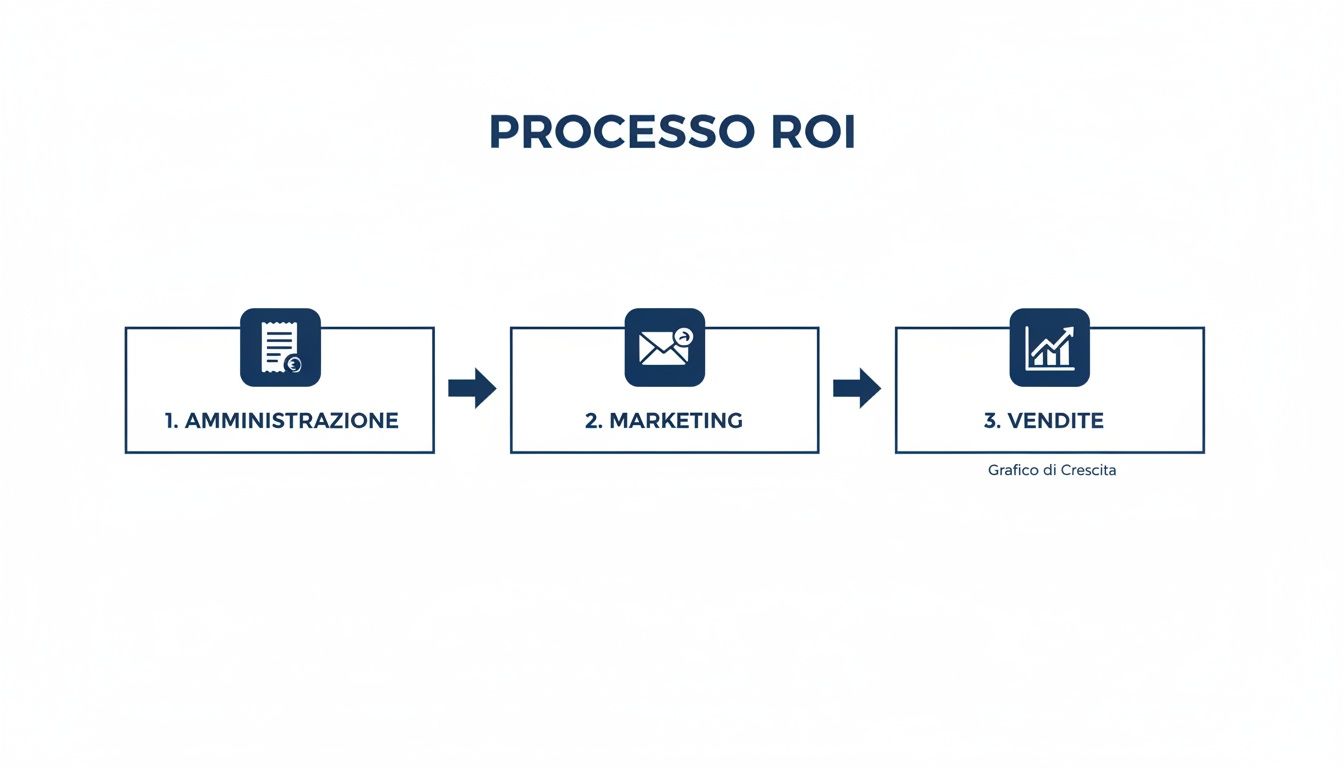
As you can see, each area benefits specifically, and the sum of these benefits leads to a tangible overall ROI.
Once your pilot project has started, the work isn't over. In fact, the most exciting part begins. It's time to measure the results, comparing them to the goals you set at the beginning. Data is your best ally here.
But don't forget the human factor. Gather feedback from your team: what's working well? What could be improved? Use this information to refine your workflow and prepare for the next step.
This isn't a passing fad. It's estimated that by 2026, approximately 88% of global companies will have adopted some form of automation. Perhaps most interestingly, 60% of companies already using AI in at least one area saw a positive ROI within the first 12 months.
After the success of the first project, the game gets easier. You can begin extending automation to other departments, following exactly the same approach. The initial victory will have given you a proven model and the confidence to tackle increasingly complex processes, building a more agile, efficient company that's ready for real growth.

The idea that business automation is a luxury for the few, reserved only for large companies with armies of developers, is a thing of the past. Today, anyone can design and implement automated workflows without having to write a single line of code. The credit for this? No-code platforms.
These tools have literally democratized technology. Imagine being able to connect all the apps you use every day—your CRM, your invoicing software, your email—by simply dragging and dropping icons onto a screen. This is the principle of drag-and-drop : you define rules, create connections, and the apps start talking to each other.
For an SME, this isn't just an improvement. It's a paradigm shift. It means being able to launch sophisticated solutions in record time, at extremely low costs, and without relying on external consultants. Automation is finally becoming something concrete, tangible, and within every entrepreneur's reach.
Think of these tools as digital Swiss Army knives. They're the glue that holds your software ecosystem together, allowing you to create a seamless flow of information between thousands of different applications. They act as a bridge, passing data from one system to another based on triggers and actions you decide.
Let's see some practical examples:
The true power of platforms like Zapier lies in orchestrating processes that cross multiple departments, transforming a series of disconnected tools into a seamlessly integrated digital system.
On that note, if you want to see how to make the most of these connections, read our article on how to integrate Electe with hundreds of apps using Zapier .
Modern CRMs have long since ceased to be simple contact repositories. Today, many of these systems include powerful automation engines, specifically designed to smoothly grease the wheels of sales and marketing processes.
Thanks to these features, you can build nurturing paths that "warm up" contacts over time, manage follow-ups scientifically and be sure that no business opportunity is left behind.
Beyond the large platforms that do a bit of everything, there is a universe of no-code tools focused on a single task, which offer "out-of-the-box" automations for vertical needs.
Below is a table grouping some of these tools by function, with practical examples to guide your choice and understand where to start.
Examples of no-code tools to automate your SMB
For email marketing , tools like Mailchimp and ActiveCampaign allow you to create welcome sequences, recover abandoned carts, or send personalized emails based on user behavior.
For document management , PandaDoc allows you to automate the creation of a quote starting from CRM data, send it for electronic signature and automatically archive it once signed.
For social media management , platforms like Sprout Social and Buffer allow you to schedule posts months in advance across all channels and analyze performance in a single dashboard, saving hours every week.
For accounting and invoicing , tools like QuickBooks and Cloud Invoices let you send automatic payment reminders for overdue invoices or generate recurring financial reports without any manual input.
For project management , Airtable and Notion allow you to create automatic notifications when a task changes status or assign tasks based on specific triggers.
Choosing the right tool depends solely on the problem you want to solve first. The best approach is almost always the same: start with a single process, the most repetitive and "painful," use the most suitable platform to fix it, and only then expand the scope.

Implementing business automation isn't just about doing things faster. Its deeper value, the one that really makes the difference, is another: it allows you to do things more intelligently . Every single process you put on autopilot becomes a goldmine for your company, a constant source of clean, structured, and, above all, reliable data.
While no-code tools take care of the tasks, a new, far more strategic question arises: how do we transform this flood of data into decisions that truly drive growth? This is where automation takes the next level.
Thinking that automation stops at the execution of a single task is like buying a race car to use only in city traffic. The true potential is unlocked when you also automate the next step: analyzing that data.
It is in this scenario that comes into play Electe , our AI-powered data analytics platform designed for SMBs. Electe It plugs into your ecosystem of tools, takes the data generated by your automated processes and transforms it into strategic insights, often with just a single click.
While other tools focus on "doing", Electe It focuses on "understanding." It gives you the big picture to drive your business, without requiring a team of data scientists.
This approach closes the loop. Not only do you free your team from repetitive tasks, but you also equip them with the tools to make better decisions, faster.
Imagine being able to answer complex questions about your business without having to spend days poring over spreadsheets. That's exactly what automated analytics makes possible.
Here are some practical examples of how Electe Leverage data from your automated workflows:
This analytical capability not only improves efficiency, but also shifts the entire company's focus toward a future driven by digital skills. Projections for the Italian labor market indicate a need for between 3.3 and 3.7 million workers between 2025 and 2029, with technological skills becoming increasingly crucial. For more information, you can read the 2026 labor market forecast.
In practice, the combination of process automation and intelligent data analysis creates a powerful virtuous cycle: efficient processes generate high-quality data, and analyzing this data leads to decisions that make processes even more effective. This is how an SME today can compete and grow sustainably.
We've seen how business automation can transform your SMB, but theory isn't enough. Here are 4 practical steps you can take today to get started.
Implementing business automation isn't just about streamlining processes; it's about radically changing the way your SMB operates. By automating tasks like data entry, reporting, and follow-ups, you're not just saving time; you're unleashing your team's human potential, allowing them to focus on innovation, strategy, and customer relationships.
No-code tools have made this transformation accessible to everyone, without requiring advanced technical skills or large budgets. As we've seen, the average ROI is often rapid and tangible, with case studies demonstrating drastic reductions in manual labor. The real leap in quality, however, comes when you combine the efficiency of automation with the intelligence of data analysis. It's this combination that transforms raw data into strategic decisions that drive sustainable growth.
Are you ready to stop chasing processes and start driving them with data-driven decisions?

.svg)


.svg)
.svg)