
In today's market, making a decision is no longer just a matter of gut feeling. It means evolving from assumptions based on intuition to certainties built on data. For SMEs aiming for solid, measurable growth, relying solely on instinct has become too risky a gamble.
The feeling of being stuck between a mountain of incomprehensible data and a total lack of clear information is a common experience for many managers. This guide is designed for you, who are ready to turn data into a powerful strategic ally.
We will guide you through a practical process, starting with defining the problem and ending with analyzing the right information to solve it. You will discover how AI-powered analytics platforms such as Electe, a data analytics platform for SMEs, make this process accessible, automating complex analyses and transforming them into immediate insights. The goal? To provide you with a solid working method for making strategic decisions with the confidence that only facts can give.
This infographic summarizes the flow that transforms raw data into effective strategic decisions.
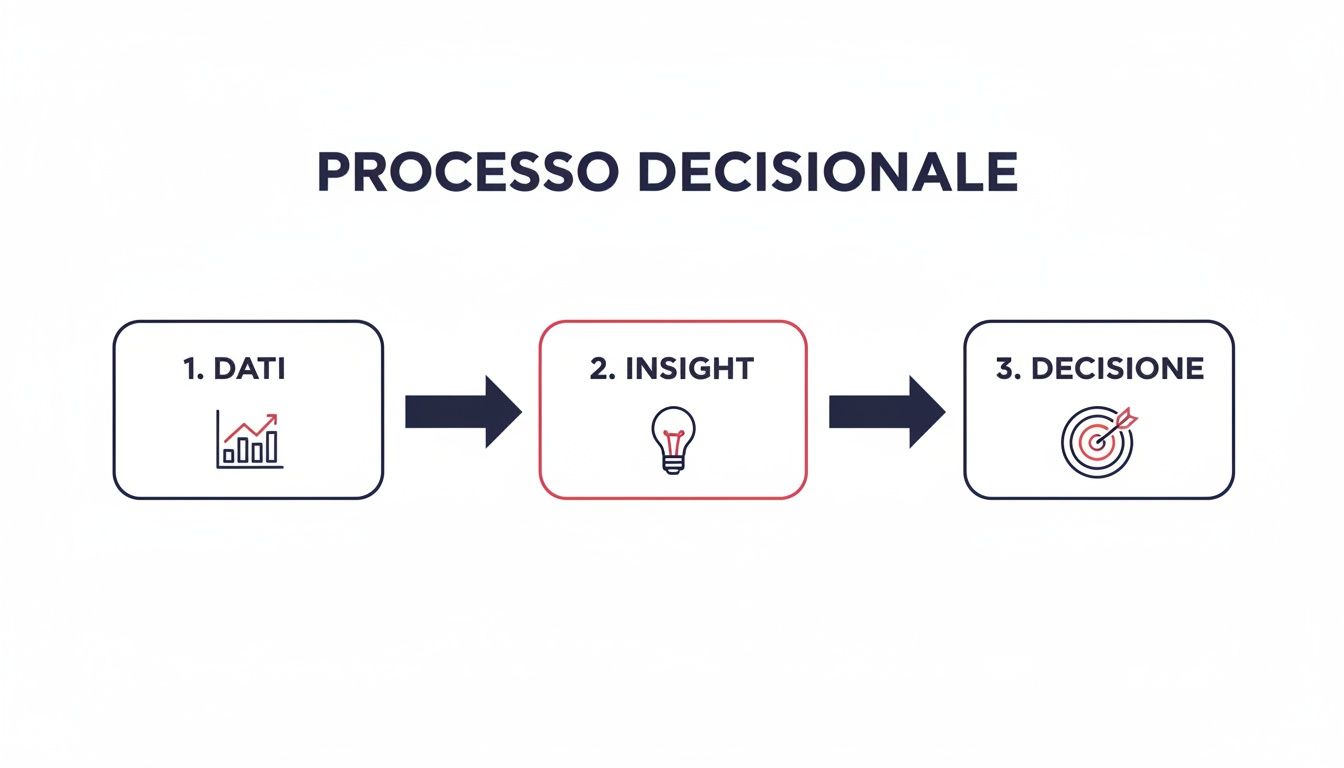
As you can see from the diagram, it all starts with solid data. This is then transformed into understandable insights that ultimately drive action. It's a logical process that eliminates guesswork.
Every effective decision starts not with a fact, but with a question. And not just any question, but the right one, precise and well-formulated. If you simply ask, "How can we increase sales?", the answers will be vague and difficult to put into practice.
To make a decision that will have a real impact, you need to take a step back. Break down your business objectives into specific questions that can be answered clearly by the data.
Imagine you really want to boost sales. Instead of staying vague, try asking yourself, "Which of our advertising campaigns has generated the highest customer lifetime value over the last six months?" See the difference? Not only is this a clearer question, but it also directs your analysis toward concrete metrics and targeted actions.
The SMART framework is an incredibly powerful tool for turning abstract goals into measurable questions. Let's see how it works in practice and how it helps you define the Key Performance Indicators (KPIs) that really matter.
Here's how to turn a generic goal into a SMART question:
This new question is all you need to get off on the right foot. It is Specific (reduce the churn rate), Measurable (by 15%), Achievable (requires concrete action), Relevant (directly impacts growth), and Time-bound (in the next quarter).
"The quality of your insights depends directly on the quality of your questions. Asking 'why did sales drop in May?' is much more useful than 'how can we sell more?'. The first question leads you to look for a cause, the second to look for opinions."
Defining clear questions and objectives acts as a compass for the entire analysis that follows. It ensures that every effort is focused on what really matters for your growth. This approach saves you from "analysis paralysis," that frustrating situation where you find yourself overwhelmed by a sea of data without knowing what to do with it. With platforms such as Electe, you can set up dashboards that monitor exactly the KPIs derived from your SMART questions, keeping track of your progress toward your goal.
Once you have focused on the right question, it's time to fill up your decision-making engine with fuel: data. Often, the data you need is already in your company.
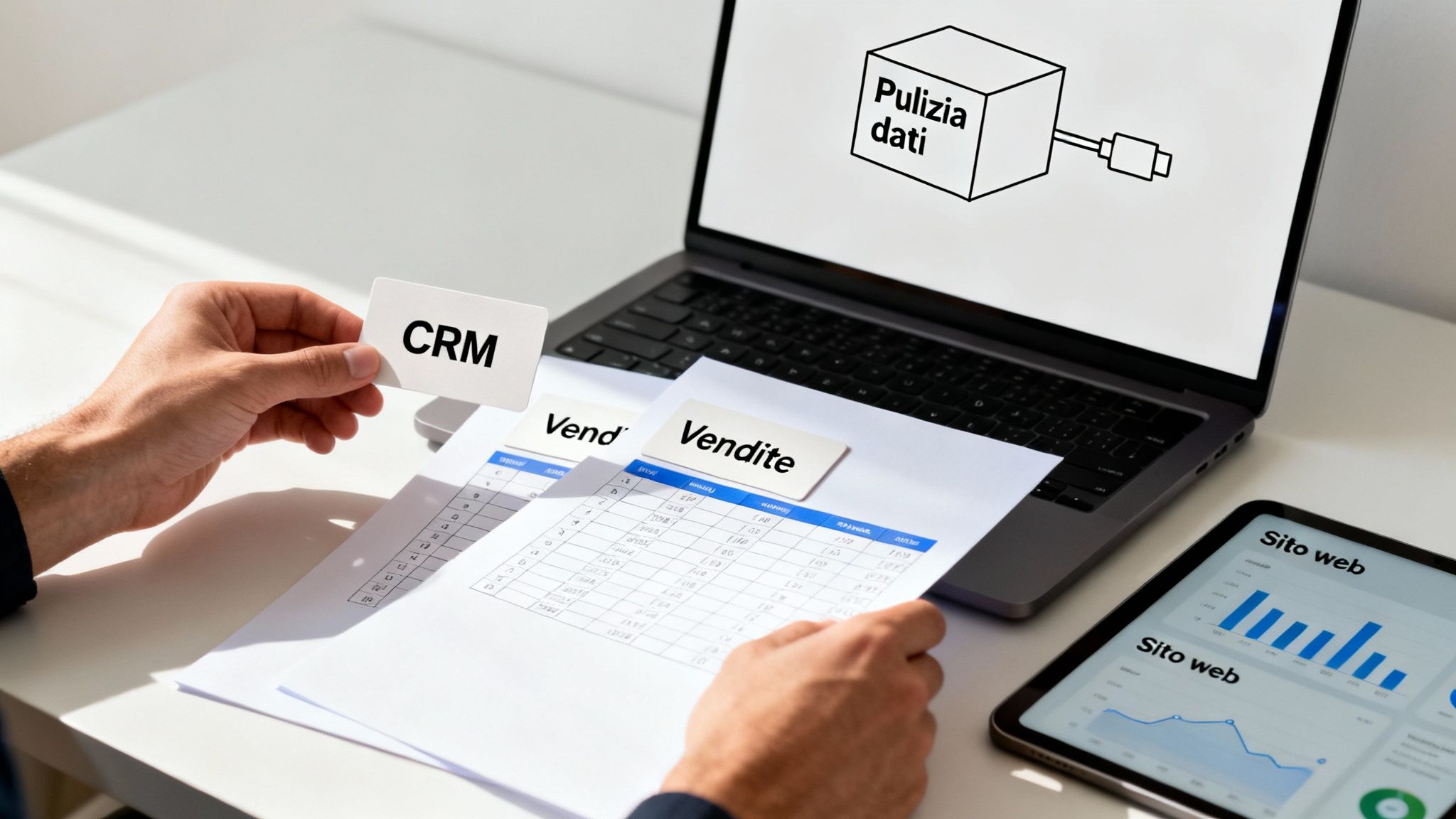
The starting point is internal sources. Think about your CRM, sales records, website analytics, or finance department spreadsheets. These are veritable gold mines. By putting this data together, you will begin to see patterns that would otherwise remain invisible.
Before diving into analysis, there is one step you absolutely cannot skip:data cleaning. Raw data almost always contains errors, duplicates, or missing information. Basing your strategies on this foundation is like building a house on unstable ground.
The cleansing process ensures that you are working with accurate and consistent information. Not only does it improve the reliability of your insights, but it also protects you from drawing the wrong conclusions that could cost your company dearly.
Making a decision based on "dirty" data is not a data-driven decision. It's just a more complicated guess. The quality of the data determines the quality of the final choice.
Platforms such as Electe been created to automate much of this work. Instead of spending hours manually correcting files, you can connect your data sources and let artificial intelligence do the heavy lifting. Our system identifies and corrects anomalies, unifies formats, and prepares data for immediate analysis. This allows your team to focus on what really matters: interpreting the results. If you want to learn more about how to manage large volumes of information, you can read our guide on Big Data Analytics.
Internal data is key, but to get the full picture, you need to look outside. Enriching your analysis with external information allows you to contextualize your decisions. This may include:
To give you a concrete example, economic policy decisions for 2025 are based on moderate growth estimates. Istat forecasts a 0.5% increase in national GDP in 2025 and 0.8% in 2026, driven mainly by domestic demand. Figures such as these, which guide investment at national level, are invaluable for calibrating your sales forecasts. To find out more, you can consult the outlook for the Italian economy published by Istat.
Looking at past data is useful, but the real competitive advantage comes when you start anticipating the future. That's wherepredictive analytics comes in.
Until recently a luxury for multinationals, predictive analytics is now a tool within the reach of SMEs. In practice, it uses machine learning algorithms to uncover patterns and correlations hidden in your historical data. Instead of just telling you what happened, it builds projections of what might happen. It is the crucial shift from a reactive to a proactive approach, the basis for making truly informed decisions.
You manage an e-commerce business and need to plan your inventory for the next quarter. The traditional approach? Look at last year's sales and cross your fingers.
With predictive analytics, on the other hand, the system cross-references past sales with market trends, the performance of your marketing campaigns, and even seasonal weather forecasts if you sell climate-related products. The result is a more reliable estimate of which products will fly off the shelves, allowing you to optimize your inventory and maximize profits.
Another powerful application is customer loyalty. A predictive model can analyze your customers' behavior—purchase frequency, average receipt amount, interactions with customer service—to identify the subtle signs that precede churn. At that point, you can intervene with a tailored offer before the customer leaves.
Predictive analytics transforms data from a rearview mirror into binoculars focused on the future. It gives you the ability to see what's coming and prepare accordingly.
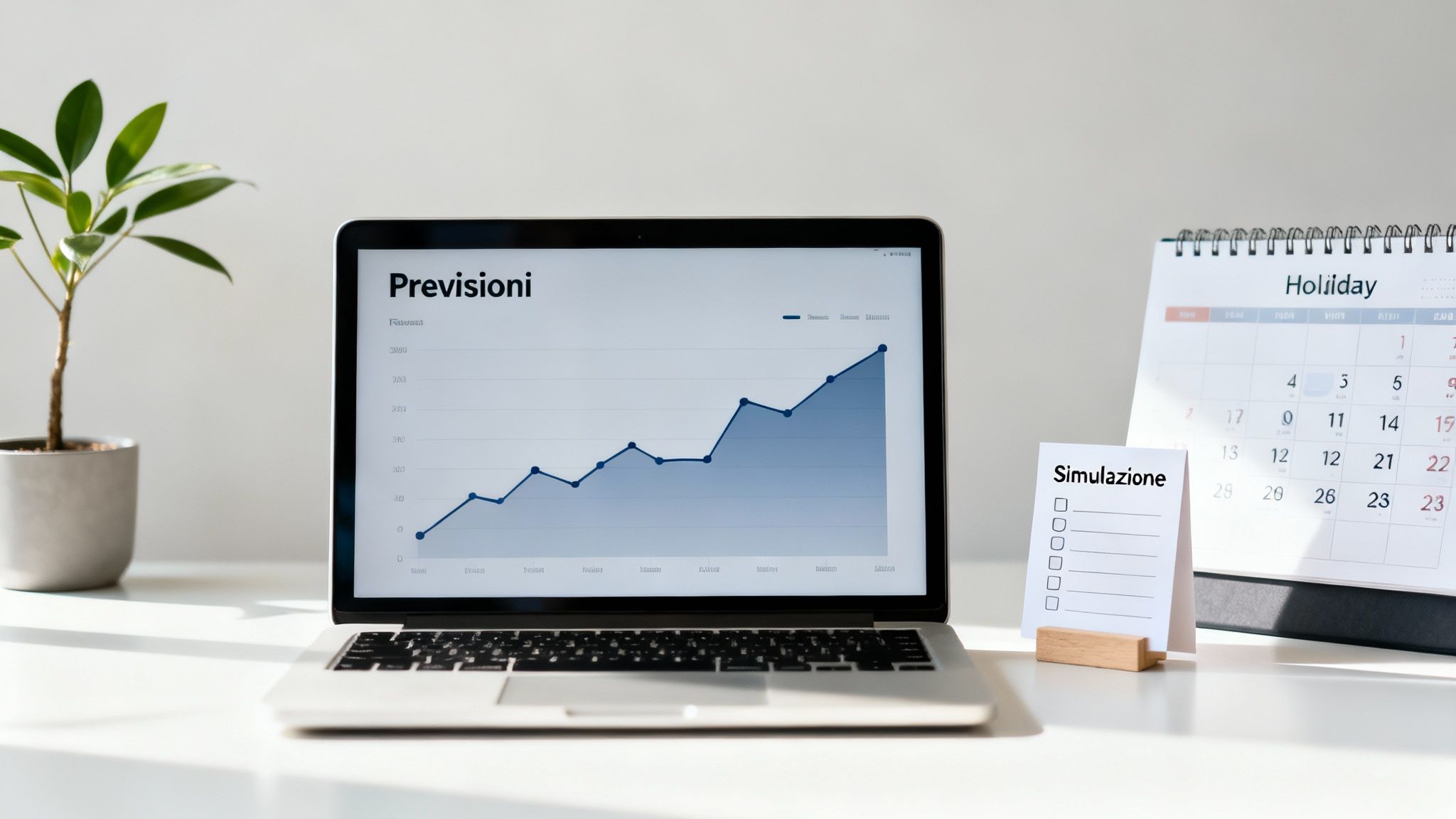
Perhaps the most powerful tool in predictive analytics is "what-if" simulation. In simple terms, you can test the potential impact of different strategies before investing a single euro.
It allows you to answer questions such as:
Platforms such as ours, Electe, integrate these features to make them readily available. You don't need to be a data scientist to run simulations. You can explore different scenarios, evaluate risks and opportunities with data at hand, and ultimately make a decision with a completely different level of confidence. If you want to get an idea of how it works, take a look at how to use our prediction feature with Electe.
This approach becomes vital in an uncertain economic climate. According to the Eurispes 2025 report, around 36.7% of Italians expect their economic situation to worsen, showing great caution in their consumption. For companies, anticipating these trends is essential in order to avoid being caught unprepared.
Data analysis will not give you a single answer, but will shed light on a range of plausible options, each with its own pros, cons, and unknowns. This is where decision-making moves from pure analysis to strategic evaluation, where human experience once again takes center stage.
The first step is to translate insights into an objective comparison. Each alternative must be weighed not only for its potential gain, but also for the resources it requires. The goal? To go beyond personal preferences and anchor the choice to a clear and shared business logic.
To compare options fairly, you need a structured approach. Two tools can guide you through this phase.
Cost-benefit analysis is the starting point. For each scenario, put the following down on paper:
Next, the risk assessment matrix comes into play, forcing you to prepare for the unexpected. For each option, ask yourself: what is the probability that something will go wrong? And if it does, what will be the impact on the business? This forces you to think of a plan B before you even need it.
This balance between ambition and caution is crucial. Just consider the Italian defense sector: the 2025-2027 Multi-Year Program Document allocates a budget of over €31 billion for investments. Yet economic constraints make it difficult to achieve strategic objectives. This demonstrates how even large-scale decisions must balance strategic potential and financial risks. For those who wish to learn more, the analyses in the Defense Programmatic Document on Start Insight.
No single department within a company possesses the absolute truth. A decision that seems brilliant for marketing could turn into a logistical nightmare for the warehouse. That's why decision-making must be a dialogue, not a monologue.
Involving different teams is not about finding a compromise, but about building a stronger decision that takes into account all aspects of the business.
It is in this context that tools such as Electe interactive dashboards Electe a valuable ally. They allow different departments—from sales to finance—to view the same data and explore it from their own perspective. This transforms analysis into a strategic conversation, where the common goal is to bring together different perspectives on the best choice for the company.
Choosing the right path is only half the battle. The success of an initiative is measured in the field. Without a clear action plan, even the most data-driven decision risks remaining a dead letter.
The implementation phase begins by assigning specific responsibilities and setting realistic deadlines. Who does what? By when? Answering these questions prevents inertia and ensures that every team member knows exactly which piece of the puzzle they need to complete.
A classic mistake? Rushing into things and only then wondering how to measure success. Key Performance Indicators (KPIs) must be defined before taking the first step. They will give you an objective, real-time picture of whether your choice is working.
Let's say the decision was to launch a new marketing campaign to increase conversions. Your KPIs could include:
This initial clarity allows you to immediately understand whether you are on the right track or whether you need to make adjustments.
Implementation is not the end goal, but the beginning of a cycle of continuous learning. Measuring impact allows you to optimize, adapt, and improve.
With Electe customizable dashboards, you can track these key metrics in real time, without having to wait for weekly or monthly reports. This immediate visibility enables you to take an agile approach: if a KPI is not performing as expected, you can analyze the data to understand why and make quick changes.
This cycle of execution, measurement, and optimization transforms the decision-making process from a single event into a strategic skill that is refined over time. Every choice becomes an opportunity to learn. To get a broader picture of the tools available, you may find our overview of business analytics software.
Here are the key points to remember to transform your approach to decision-making:
Absolutely not. This is the most widespread myth. You don't need terabytes of data; you need the right data. Even a small business has a wealth of information about sales, customers, and web traffic. The point is to extract value even from a limited data set. Modern platforms such as Electe were created for this very purpose: to make analysis accessible and enable you to make better decisions with the resources you already have.
Recognizing traps is the first step to avoiding them. Here are the most common ones:
It depends. Some benefits, such as understanding why a marketing campaign isn't working, can be almost immediate. The real value, however, is built over time. Adopting a data-driven approach is not a short-term project, but the beginning of a cultural transformation. As data becomes the foundation for every decision, the impact on growth becomes exponential.
Are you ready to turn your data into smarter decisions? With Electe, you can start discovering valuable insights in minutes and illuminate the future of your business.
Discover how Electe works Electe a personalized demo →

.svg)


.svg)
.svg)




.png)