
In the business world, effectiveness and efficiency are two words you hear all the time. They are often used interchangeably, but confusing them can cost you dearly, leading to ineffective strategies and a waste of resources. It's time to clarify.
In simple terms, effectiveness means doing the right things, i.e., achieving the goal you have set for yourself.Efficiency, on the other hand, means doing things the right way, i.e., achieving that goal using as few resources as possible, whether time, money, or energy. Understanding the difference between effectiveness and efficiency is the first step in turning your data into a driver of sustainable growth. In this guide, we'll look at how to measure both with the right KPIs and how an analytics dashboard can help you monitor them to make better decisions.
Imagine you need to travel from Rome to Milan. If you charter a private jet, you'll be extremely efficient: you'll reach your destination in a flash. But from a cost perspective, the operation is a disaster. Incredibly inefficient.
If, on the other hand, you take a high-speed train, you are both effective (you still get to Milan) and efficient, because you optimize time and money. This simple analogy perfectly captures the difference between effectiveness and efficiency, a concept that, once understood, can change the way you run your business.

Many managers make the mistake of focusing on only one of these two aspects. You may have a super-efficient team that completes unnecessary tasks in record time (efficient but not effective), or another team that works chaotically to achieve an important goal, wasting a lot of resources (effective but inefficient). In both cases, there is a problem to be solved.
To provide an even clearer picture, we have summarized the key differences in a table. Understanding these points will help you evaluate your company's performance much more clearly.
This table provides an overview so that you will never confuse the two concepts again.
As you can see, it's not about choosing one or the other, but about finding the right balance.
Operational excellence does not come from choosing between effectiveness and efficiency, but from combining the two. A company thrives when it achieves the right goals (effectiveness) with the least waste of resources (efficiency).
The real secret lies in understanding when to prioritize one over the other and how to make them work together. Now that we have the basics, let's see how to measure both concretely with the right KPIs and how data analysis can become your best ally.
Without data, any discussion about the difference between effectiveness and efficiency remains purely theoretical. To transform these concepts into growth drivers for your company, you need to translate them into measurable indicators: Key Performance Indicators (KPIs).
KPIs are not all the same. To get a complete picture, it is essential to distinguish between two categories that answer different but complementary questions.
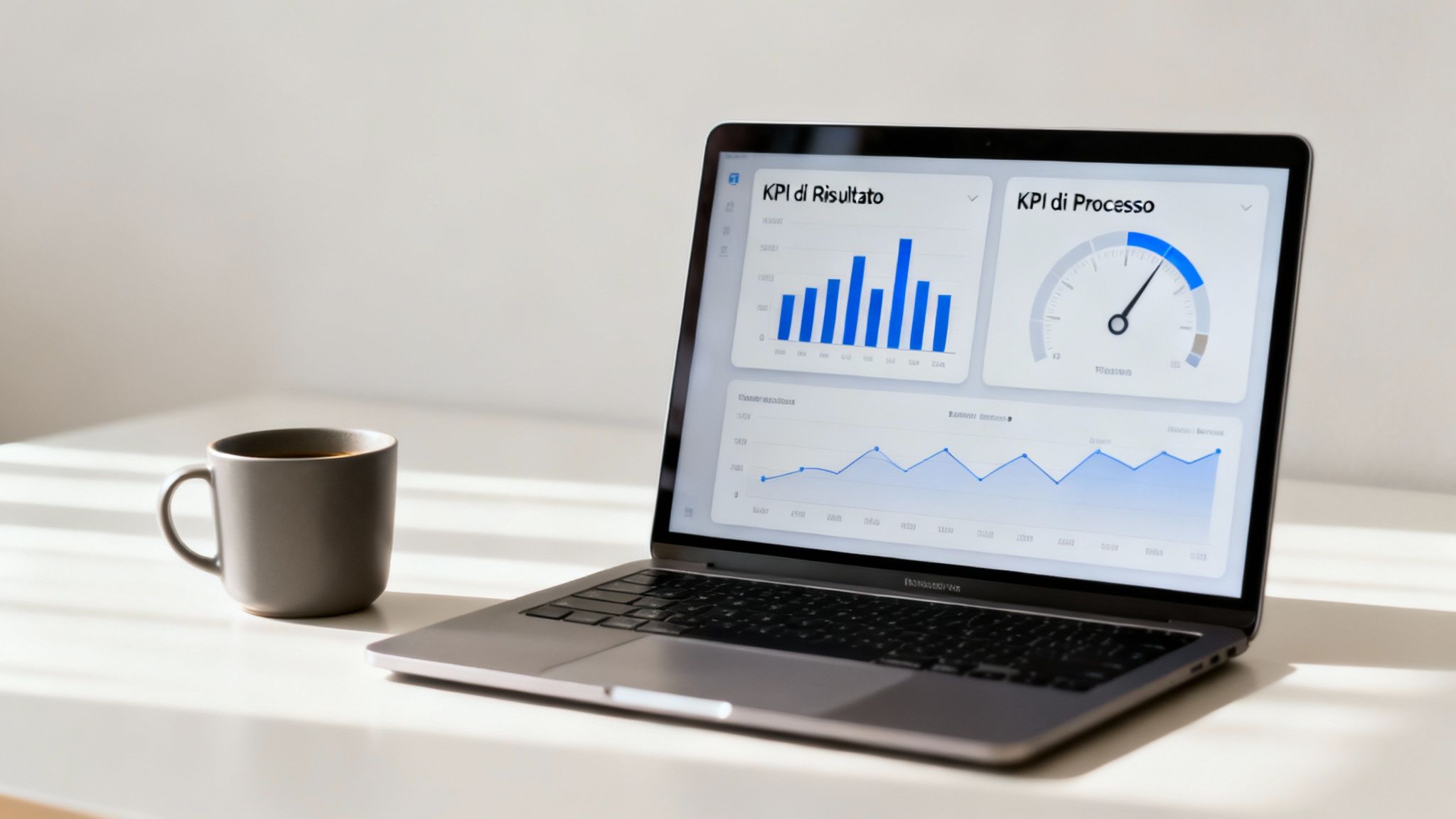
Outcome KPIs measure the achievement of final objectives. They answer the question: "Are we doing the right things?" They are tangible proof that your strategies are bearing the desired fruit. These are the indicators to monitor:
On the other hand, process KPIs measure how resources are used to achieve objectives. They answer the question: "Are we doing things the right way?" They focus on optimizing time, costs, and energy. Here are some examples:
The real power lies in monitoring both types of KPIs simultaneously. High effectiveness with low efficiency can lead to cash-burning growth. Conversely, high efficiency without effectiveness means becoming very good at doing things that don't lead to any results.
A modern data analytics dashboard, such as those you can build with Electe, allows you to view and correlate these indicators in real time. At a glance, you can see whether a surge in sales (effectiveness) is coming at too high a cost (inefficiency), enabling you to make informed and balanced decisions.
If you want to learn more, you can consult our guide on Key Performance Indicators with 10 practical examples for growing your business.
The concept of measurement is not confined to the corporate world. For an example of how efficiency is regulated in regulatory contexts, read the article on motor vehicle efficiency.
Theory is one thing, but the daily grind of a company is another. That's where the difference between effectiveness and efficiency ceases to be an academic concept and becomes a concrete lever for success. Let's look at some examples.
Consider a digital marketing campaign aimed at generating qualified leads. After a month, the results look great: 1,000 new leads. On paper, the campaign has been very effective: goal achieved.
But then you analyze the costs and discover that each lead cost €150, a price that makes it almost impossible to turn a profit. This is a perfect example of inefficiency: you reached the finish line, but the race cost you so much that it negated your victory.
Now let's flip the script. Imagine a customer support team that closes every ticket in less than 15 minutes. An incredibly efficient process.
It's a shame that, in order to maintain this speed, operators use standard responses that don't solve the real problem. Satisfaction surveys are a disaster. The company is extremely efficient at closing tickets, but totally ineffective in its main purpose: to have happy customers.
One issue that affects almost every SME is digitization. Adopting new technologies is a necessary step. According to recent statistics, Italy has reached 90.7% of the European target for the adoption of cloud computing by SMEs.
But effectiveness does not guarantee efficiency. Buying a new CRM is an effective move for centralizing data. But if the team is not trained, if the software does not communicate with other tools, or if processes are not redesigned, that investment becomes a waste of resources. To better understand this, it is useful to read stories of those who have managed to figure out how to improve an outdated and inefficient system.
Recognizing these dynamics is the first step. The second is to dig into the data to understand where inefficiencies lie and why your strategies, while effective, are not generating the profit you expect.
Only by linking outcome data (effectiveness) with operational data (efficiency) can you gain a comprehensive overview. To do this, it is crucial to have a clear understanding of workflows, something you can learn more about by reading our guide to business process mapping.
In the real world, absolute perfection—maximum effectiveness and efficiency—is a utopia. Day-to-day management involves compromises that depend on the situation your company is currently experiencing.
The real skill lies in understanding when to step on the accelerator of effectiveness and when, instead, to pull the brake of efficiency. The difference between effectiveness and efficiency becomes very clear at certain key moments in the life of a business.
A startup must focus entirelyon effectiveness. The only goal is to win over the first customers and validate the idea. Processes may be disordered and resources wasted, but if the goal of creating a customer base is achieved, that initial inefficiency is the price to pay for survival.
A mature company in a crowded market, on the other hand, must makeefficiency a matter of life and death. The goal is not just to sell, but to do so profitably. Optimizing costs and automating processes become priorities in order to defend profitability.
To get a clearer picture, we can use a simple matrix. By cross-referencing effectiveness and efficiency, we obtain a snapshot of your company's health.
This concept map is an excellent example: it visually shows how different combinations of effectiveness and efficiency lead to opposite results, from acquiring dissatisfied leads (low effectiveness) to closing tickets at very high costs (low efficiency).
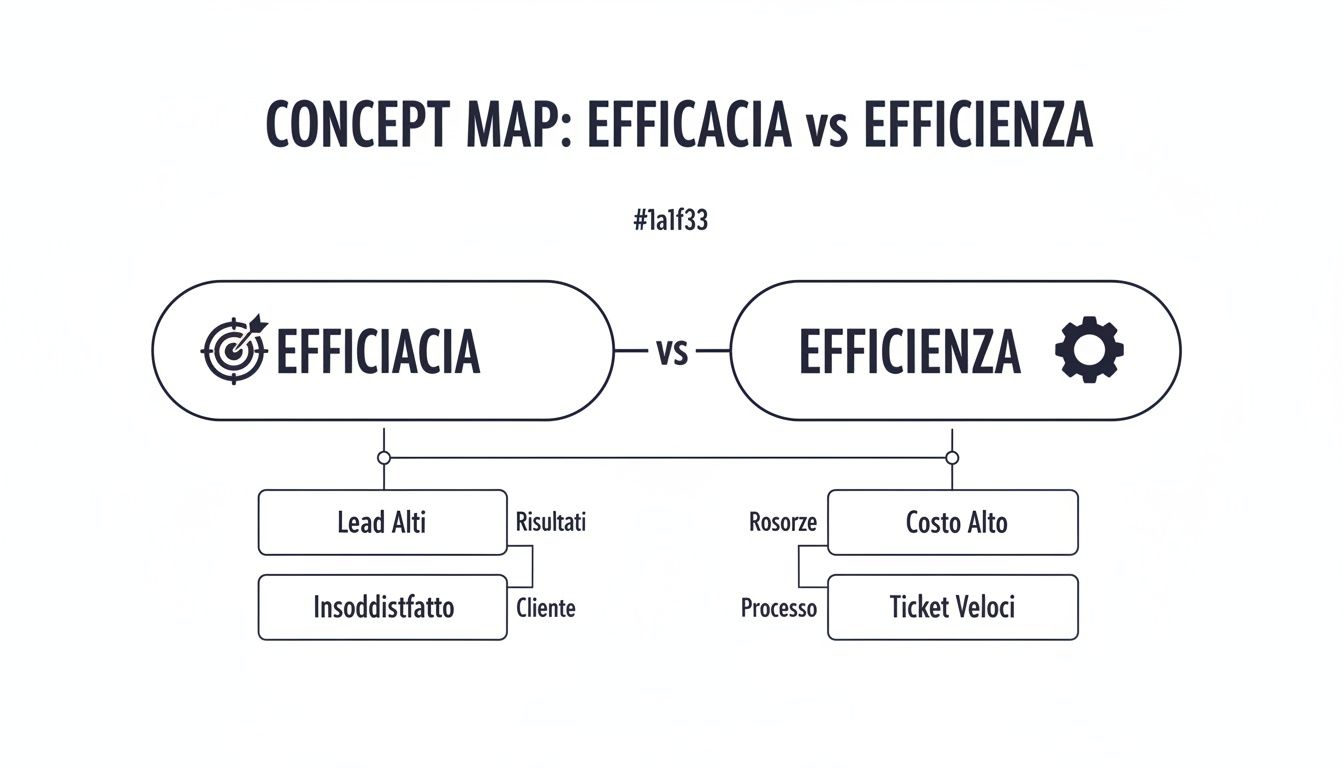
The infographic highlights a crucial point: focusing on only one aspect while ignoring the other creates dangerous imbalances. Let's analyze the four quadrants you might find yourself in:
High Effectiveness, Low Efficiency (Explosive Growth): The typical scenario for startups. Amazing results are achieved, but cash is "burned" at an impressive rate. The focus must be on structuring processes without stifling innovation.
High Effectiveness, High Efficiency (The Ideal Zone): The goal every company aspires to. The right goals are achieved by using resources in the best possible way. It is a position of strength that must be maintained through constant monitoring of KPIs.
Low Effectiveness, Low Efficiency (Imminent Crisis): The quadrant to escape from. Goals are not being achieved and the few available resources are being wasted. Drastic and immediate action is required.
Low Effectiveness, High Efficiency (The Optimization Trap): Doing the wrong things, but doing them perfectly. Well-oiled processes to sell a product that the market does not want. We need to go back to the strategy table and redefine our objectives.
Understanding which quadrant you are in today is the first step in deciding where to invest your time and money.
Okay, we understand the difference between effectiveness and efficiency. But how can we turn this awareness into concrete actions? This is where artificial intelligence and data analytics come into play. It's no longer about looking at the past, but about lighting the way ahead.
AI-powered platforms, such as Electe, are the driving force behind this optimization. They don't just collect data; they put it to work for you, driving both effectiveness (achieving the right goals) and efficiency (doing so with as little waste as possible).
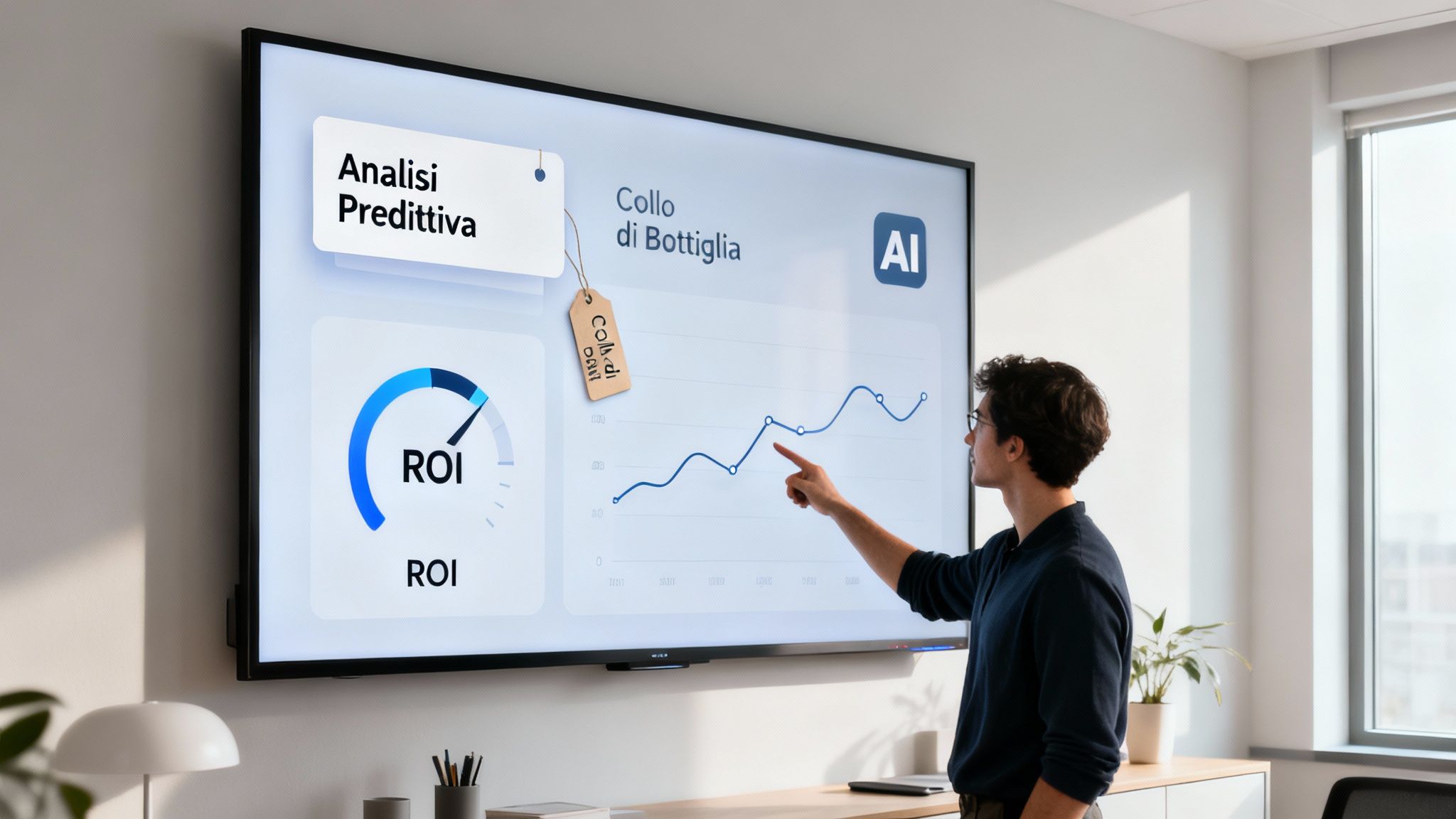
Predictive analytics is the perfect example of how AI can give effectiveness an incredible boost. Instead of launching campaigns based on instinct, you can use algorithms that accurately identify which customer segments are most likely to buy.
This means stopping "shooting in the dark." You can focus your budget, time, and energy exactly where the return is highest, dramatically increasing conversion rates.
At the same time, AI is a formidable ally for efficiency. Think about the time you save by automating weekly reports. Repetitive tasks are performed automatically, freeing up your team for higher-value activities.
In addition, an analytics platform can independently identify bottlenecks or anomalies in processes that consume resources, such as a step in logistics that slows everything down or an advertising campaign that consumes budget without delivering results.
Artificial intelligence transforms data from a simple reporting tool into a proactive strategic partner, capable of suggesting where to improve and how to optimize resources.
This approach is becoming increasingly popular. According to the Anitec-Assinform report, the adoption of AI in Italian companies has doubled, reaching 21.9% of the European target. AI improves operations and reduces errors, but the real challenge remains measuring its economic impact to ensure its efficiency.
With a business intelligence tool like Electe, all this becomes a reality. You can create a unified dashboard that brings together effectiveness KPIs (market share) and efficiency KPIs (campaign ROI), making data-driven decisions a daily practice even for SMEs.
Understanding the difference between effectiveness and efficiency is crucial, but the real value lies in using these concepts to guide everyday choices. Here are three key steps to get started right away:
Operational excellence is not about choosing between doing the right things (effectiveness) or doing them well (efficiency). It is about creating a virtuous circle in which one feeds the other, building a business that is not only profitable, but also solid and ready for the future.
At Electe, our mission is precisely this: to make data analysis accessible and intuitive, enabling you to make smarter decisions and transform your data into a real driver of growth.
Are you ready to turn numbers into strategy? Discover how our AI-powered platform can help you measure and improve both effectiveness and efficiency, transforming raw data into decisions that matter.

.svg)


.svg)
.svg)




.png)