
Financial risk management is the strategic process through which your company learns to identify, analyze, and mitigate uncertainties that could threaten its financial stability. Note that this does not mean avoiding every single risk. It means making informed decisions to protect capital while seizing growth opportunities in a controlled manner.

Every small business, after all, is navigating a sea of uncertainty. Market fluctuations, customers who are slow to pay, and skyrocketing raw material costs—these are all variables beyond your direct control. The real question, then, isn’t how to eliminate risk, but how to manage it so you can continue to grow in a healthy and sustainable way.
Effective financial risk management transforms this discipline from a mere control function into a powerful strategic driver for your business.
Taking a proactive approach to risk management offers very tangible competitive advantages. In fact, companies that master this skill are able to:
In an economy that changes at lightning speed, the ability to anticipate and mitigate financial risks is no longer a luxury. It is a fundamental requirement for the survival and success of every small and medium-sized enterprise.
The modern approach to this field is data-driven. Fortunately, today you no longer need an entire team of data scientists to obtain valuable insights. AI-powered data analytics platforms, such as Electe, finally make predictive analytics accessible, allowing you to automate monitoring and simulate the impact of different variables on your business.
This means turning raw data into accurate forecasts, such as estimating the likelihood of a customer defaulting or the impact of a rise in interest rates on your margins. The goal of this guide is to provide you with practical tools to transition from reactive to proactive financial risk management, turning uncertainty into a strategic advantage. Together, we’ll explore how to identify, measure, and control the risks that truly matter to your business.
To manage financial risk, the first step is to recognize it. You can’t protect yourself from a threat you can’t see. Think of yourself as the captain of a ship: to chart the safest course, you need to know the currents, the storms, and the hidden reefs. In the same way, every small business must identify the financial hazards that could cause it to veer off course.
Although every industry has its own unique characteristics, risks can be grouped into four basic categories. Understanding them will give you a clear framework for analyzing your specific situation and focusing your efforts where they’re truly needed.
Credit risk is perhaps the easiest for an SME to grasp. It arises when a customer or counterparty fails to meet their payment obligations, leaving you with unpaid invoices and a sudden cash flow shortfall.
The problem isn't just the outright loss of revenue. It's the ripple effect on your cash flow, which puts your ability to pay suppliers, employees, and meet deadlines at risk.
A practical example? A construction company that derives 60% of its revenue from a single major client is extremely vulnerable. If that client delays payments, the company finds itself facing a cash flow crisis, even though it has a full order book on paper.
Unlike credit risk, which depends on your counterparties, market risk stems from macroeconomic factors that are entirely beyond your control. These external forces can affect the value of your assets, the cost of your debt, and, ultimately, your profitability.
The main "culprits" are almost always the same:
Liquidity risk is every treasurer’s nightmare. It occurs when a company, despite being profitable on paper, does not have enough cash on hand to meet its short-term obligations. It is the classic case of “rich in assets, poor in cash.”
A healthy business can go bankrupt not because it isn't profitable, but simply because it runs out of cash. Monitoring cash flow is just as vital as monitoring profits.
Imagine an innovative startup that has just secured a major contract, but with a 120-day payment term. In the meantime, it has to cover its monthly research and personnel costs. If it doesn’t manage its cash flow carefully, it might not survive long enough to reap the rewards of its success.
Finally, there is operational risk, which is associated with failures, errors, or fraud occurring within the company. It stems from inadequate internal processes, human error, IT system malfunctions, or unforeseen external events.
This type of risk is often underestimated, but its effects can be devastating. An employee error, a cyberattack that shuts down your e-commerce site during Black Friday, or internal fraud can result in direct financial losses and serious damage to your reputation. A robust financial risk management strategy cannot afford to overlook these issues.
To provide an overview, we have summarized these four categories in the table below.
This table provides a clear overview of the types of risks, their causes, and the potential impacts they can have on an SME.
Credit risk is the risk that a customer will fail to pay a debt. A practical example for an SME: a software provider grants an annual license with payment due in 90 days, but the customer runs into financial difficulties.
Market risk refers to losses resulting from fluctuations in interest rates, exchange rates, or prices. A typical example is that of a winery that exports to the U.S. and sees its margins shrink because the euro is strong against the dollar.
Liquidity risk manifests itself as an inability to meet short-term payment obligations. A concrete example is that of a retailer that grows rapidly by opening new stores but runs out of cash to pay suppliers before collecting payment for sales.
Operational risk stems from inefficient internal processes, human error, or system failures. A typical example is an error in the inventory management system that leads to an overstock of unsold products and resulting financial losses.
As you can see, each risk has its own specific characteristics, but they all boil down to one thing: the need to be identified, assessed, and proactively managed to ensure the company’s stability and growth.
Mapping out the risks is a great starting point, but it’s not enough. True financial risk management begins when you translate uncertainty into numbers. It’s about putting a weight and a measure on what you fear, so you can address it with clarity.
The good news is that the tools once reserved for large investment banks are now much more accessible, integrated into analytics platforms designed specifically for small and medium-sized businesses. They aren’t incomprehensible black boxes, but powerful calculators that answer very concrete questions.
Imagine being able to ask your CFO, "With a 95% probability, what is the maximum loss our loan portfolio could incur in the next quarter?" The answer to this question is, essentially, Value at Risk (VaR).
VaR is a statistical metric that quantifies the potential financial loss over a specific time horizon and at a given confidence level. It doesn’t predict what will happen, but it defines a threshold beyond which losses are unlikely to occur. For an SME, calculating VaR on trade receivables helps assess the maximum impact of potential defaults on cash flow, enabling the company to set aside adequate reserves.
While VaR sets the limits under normal conditions, stress tests simulate the impact of extreme but plausible events. Think of it as a "crash test" for your company's financial health.
What would happen to your business if:
Simulating these scenarios forces you to test the resilience of your processes and prepare contingency plans before it’s too late. An e-commerce manager, for example, could use a forecasting model to see how a doubling of shipping costs would impact cash flow, allowing them to make proactive decisions.
This infographic provides a clear overview of the main types of risk that models such as VaR and stress tests help quantify.
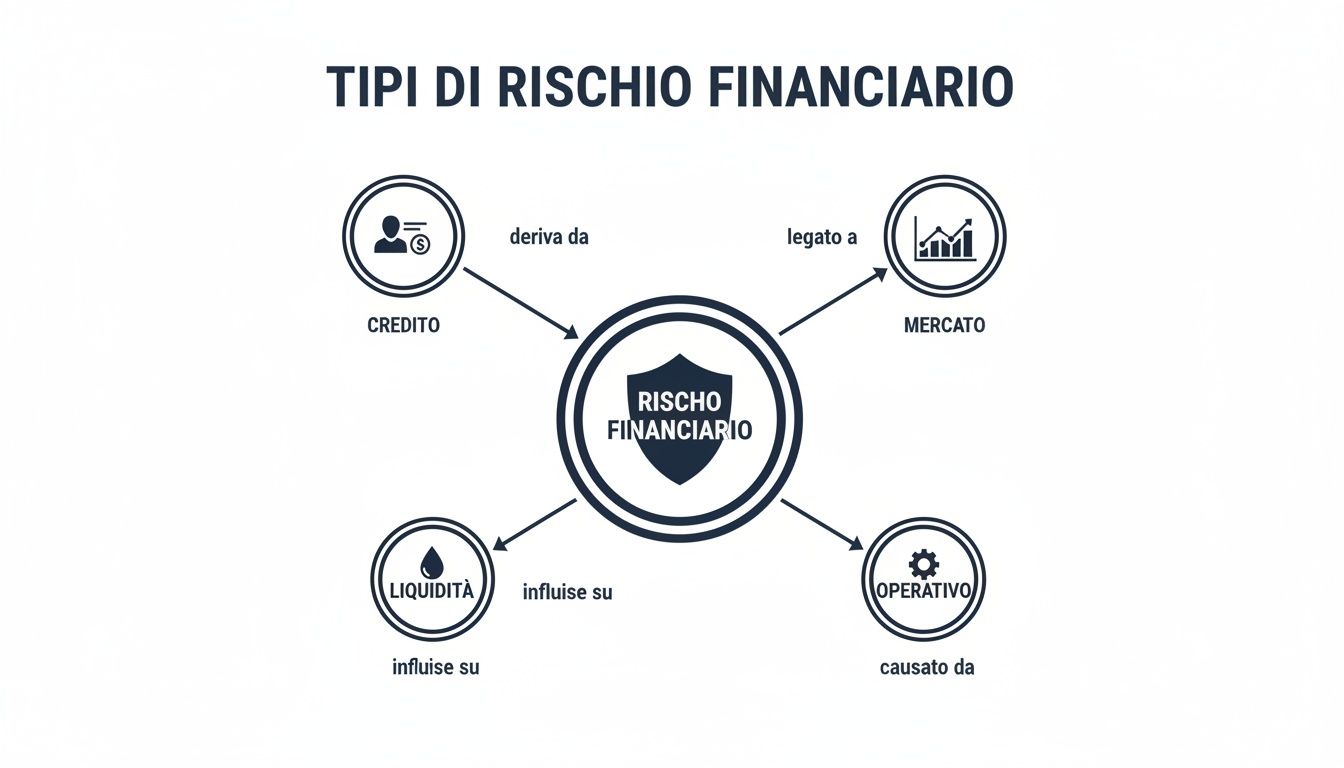
As can be seen, each risk area—from credit to market risk—requires specific metrics to be monitored effectively.
Artificial intelligence takes these models to the next level. AI platforms like Electe just look to the past; they identify complex patterns in the data to generate much more accurate predictions.
For example, an algorithm can analyze financial statement data and payment behavior to assign each customer a predictive risk score. This allows you to identify in advance which customers might become problematic and take appropriate action. For a more detailed analysis, you may want to explore howa financial ratio analysis is conducted.
The true power of predictive analytics isn't in predicting the future with certainty, but in providing a probabilistic map of possible outcomes, allowing you to prepare for the worst-case scenario while working toward the best one.
This monitoring capability is crucial. Recent data show that in the first half of 2025, despite a 13% increase in credit disbursements, the average default rate for Italian companies remained stable at 3.0%. However, specific sectors such as textiles saw a deterioration, underscoring the vital importance of granular analysis. You can explore this data in the full report on corporate credit risk.
Measuring risk, therefore, means equipping oneself with an advanced dashboard to navigate uncertainty, making decisions based not on gut feelings but on concrete data and reliable simulations.

Having the most sophisticated analytical models is only half the battle. Without robust processes and a corporate culture that embraces risk management, even the most precise metrics remain nothing more than numbers on a report. True financial risk management is not a task to be delegated to a single department, but a mindset that must permeate every decision-making process, from the sales team all the way up to the board of directors.
To achieve this, you need a clear and shared governance framework. The starting point is to defineyour risk appetite. Simply put: what is the maximum level of risk the company is willing to take to achieve its goals? It is a concrete threshold that guides day-to-day decisions.
To put this principle into practice, many organizations—including the most dynamic SMEs—rely on the "three lines of defense" model. Think of it as a multi-layered security system.
This collaborative approach ensures that risk is seen as everyone’s responsibility. Of course, a thorough mapping of business processes is essential for clearly assigning roles and tasks.
Embedding risk management into the company’s DNA means integrating it into key decision-making moments, such as the launch of a new product or the decision to enter a foreign market.
An effective governance framework is not a bureaucratic hindrance. On the contrary, it provides the right track to move faster and more safely, leading to more informed decisions and making the entire organization more resilient.
A key issue is the integration of non-financial risks, such as those related to sustainability (ESG). The Ipsos 2025 Observatory found that only 66% of Italian medium-sized companies have already implemented monitoring systems for sustainability goals.
This is an opportunity: combining financial and ESG risk perspectives into a single framework enhances governance across the board.
Building a risk culture requires commitment, training, and the right tools. Platforms like Electe democratize access to data, providing every "line of defense" with the dashboards and alerts needed to monitor their areas in real time. This is how financial risk management transforms from a theoretical exercise into a tangible competitive advantage.
Artificial intelligence is no longer a luxury reserved for multinational corporations. Today, it is a practical tool that is changing the game, making financial risk management more accurate, faster, and more effective—even for small and medium-sized businesses.
AI-powered platforms, such as Electe, give you real analytical "superpowers." They use machine learning algorithms to sift through a vast array of variables—both internal (such as payment history) and external (market indicators)—and uncover patterns and correlations that are invisible to the human eye.
The result? A whole new level of predictive capability, especially when it comes to credit risk.
One of the most powerful benefits of AI is its ability to automate real-time monitoring. Imagine no longer having to analyze reports at the end of the month, when it’s already too late. An AI-powered platform constantly monitors your financial data and alerts you immediately if it detects an anomaly or a concerning trend.
It’s a proactive approach that allows you to take immediate action before a small problem turns into a crisis.
In this context, predictive analysis is everything. Recent data show that, in March 2025, credit risk for Italian companies reached its lowest level since 2020, with an average probability of default (PD) of 5.3%. Forecasts, however, indicate a slight deterioration in the future. It is interesting to note that innovative companies demonstrate greater financial strength, with an average PD of 3.5%. For more details, you can read the full report on credit risk in Italy.
Here’s how an AI platform can transform your approach to risk:
This screenshot from the Electe platform Electe a practical example of a predictive dashboard.
As you can see, the dashboard doesn't just show numbers; it clearly displays sales forecasts and identifies the factors that influence them the most, providing immediate insights.
Consider the finance team at a small manufacturing company. Previously, every month, they spent two days extracting data from different systems and manually creating credit risk reports. It was a slow, repetitive process prone to errors.
By adopting Electe, the team connected the platform directly to their ERP and CRM systems. Now, with a single click, they can generate dynamic reports that show not only historical data but also risk forecasts for each customer. The hours saved are a strategic investment: the team can devote its time to analyzing data, not compiling it. If you want to better understand how these analyses work, read our article on how to use Electe predictive analytics.
Artificial intelligence does not replace your professional judgment. It enhances it by providing you with more accurate data and timely insights for faster and more confident decision-making.
In short, using AI for financial risk management means shifting from a backward-looking approach to one that looks ahead, through the windshield. It is the tool that enables even SMEs to anticipate problems, safeguard liquidity, and turn uncertainty into a competitive advantage.
We’ve seen how financial risk management is essential for sustainable growth. Here are 4 practical steps you can take right away to improve your company’s resilience.
Financial risk management isn’t about avoiding danger, but about understanding it so thoroughly that you can make better, more informed decisions. It’s no longer a reactive exercise, but a proactive strategy for building your business’s resilience.
We’ve explored how to identify risks, measure them using practical tools, and, above all, how artificial intelligence has made these capabilities accessible to all small and medium-sized businesses. Platforms like Electe complex data into clear insights, allowing you to anticipate problems rather than react to them.
The ultimate benefit is the ability to act with confidence, protecting the value you’ve built and seizing growth opportunities in a controlled manner. Sound risk management is the engine that drives safe and sustainable growth for your company.
Ready to turn risk from a threat into an opportunity with data-driven decisions? Discover how Electe, the AI-powered data analytics platform for SMEs, can enhance your financial risk management.
Start your free trial now →

.svg)


.svg)
.svg)