
Is your warehouse disorganized? Think of it as an invisible handbrake slowing down your company's growth. Every day, it generates hidden costs, shipping delays, and, unfortunately, unhappy customers. The solution is not to work harder, but smarter. Discover how warehouse management software, better known as WMS (Warehouse Management System), can transform your operations.
This guide will show you how a WMS is not just software, but a strategic partner for your business. You will learn how to transform chaos into surgical efficiency, drastically reducing those human errors that seem inevitable.
Adopting a management platform means having the right data at the right time to make quick and informed decisions. It's not just about knowing what you have in stock, but understanding how and when each individual item moves.
In a market where speed and precision are everything, equipping yourself with a WMS is no longer a luxury. It is an absolute necessity to ensure your SME's ability to grow and compete.
In this article, we will look at:
Imagine your warehouse as a busy airport. The goods are the planes: they arrive, are sorted, parked, and then depart for their destination. A warehouse management program is the control tower that directs every single movement, ensuring that everything runs smoothly, without delays or hitches.
It is the central nervous system of your logistics. It does not just record inputs and outputs; it acts as a digital conductor, coordinating every element to create a harmonious and efficient workflow.
At the heart of every WMS (Warehouse Management System) are three fundamental pillars that work in synergy to transform chaos into order. Each has a specific role, but is closely interconnected with the others.
The diagram below clearly shows how a disorganized warehouse negatively impacts costs, time, and ultimately customer satisfaction.
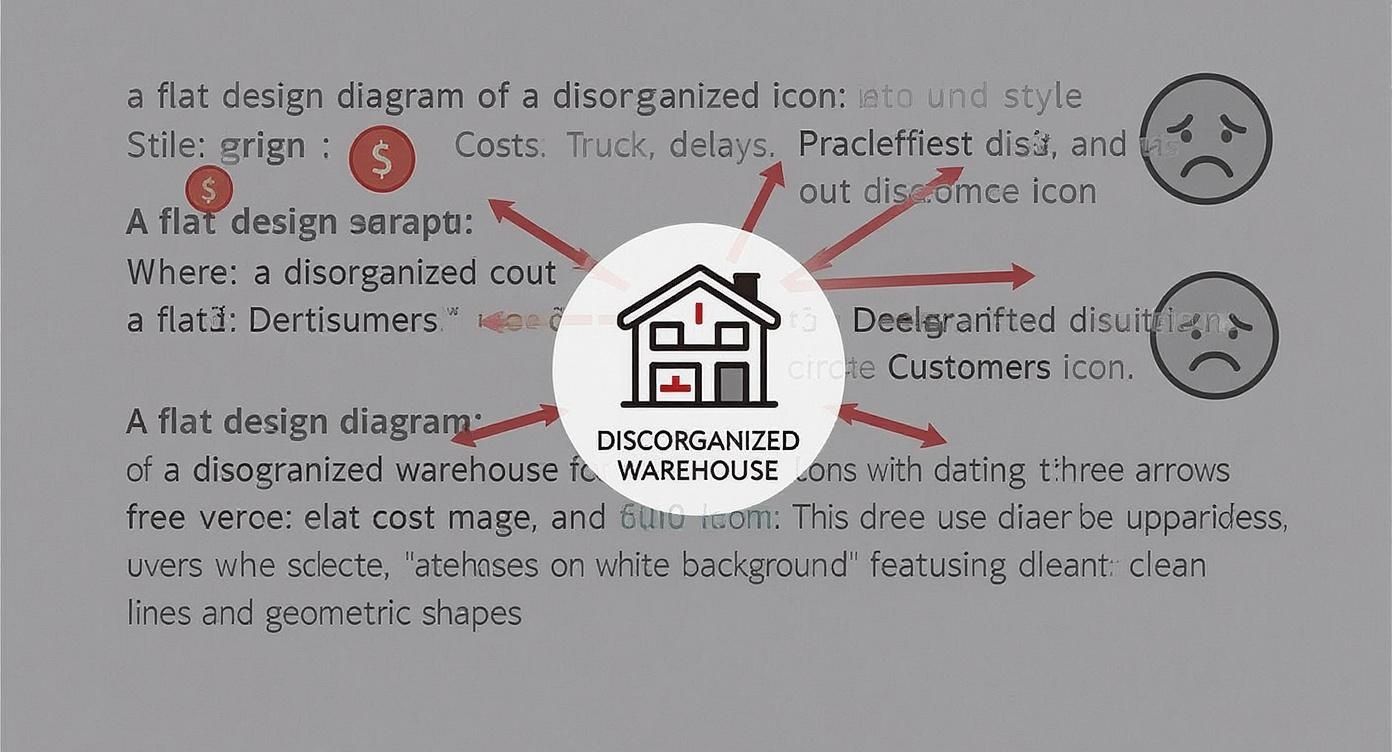
This conceptual map leaves no room for doubt: logistical inefficiency translates directly into economic losses and damage to the company's reputation.
How does the platform "see" and track every movement with near-millimeter precision? The answer lies in automated identification. This process eliminates the need for manual recording, which is not only slow but also the source of over 62% of inventory errors.
Think of your warehouse as a vast library. The management platform is the digital librarian who not only knows where every single book is located, but also knows its history, how many times it has been borrowed, and when it needs to be reordered.
The key technologies that enable this visibility include:
By integrating these technologies, a warehouse management program gains a comprehensive, real-time view of everything that is happening. This visibility is the foundation for optimizing inventory, reducing operating costs, and ultimately delivering the right product to the right customer at the right time.
Basic functions such as loading and unloading are just the starting point. A modern warehouse management program stands out for its advanced capabilities, which transform a simple digital register into a real engine for efficiency. It's not just about automating tasks, but introducing a level of intelligence that can change your logistics performance overnight.
Going beyond simply recording movements means equipping your company with tools that look ahead. Instead of just counting what you have, you start to predict what you will need, optimize every single movement, and ensure error-proof traceability.

The fear of running out of a highly sought-after product often leads you to accumulate excessive stock, tying up valuable capital. On the other hand, astockout results in a lost sale and, worse still, a customer who turns to the competition.
An advanced platform solves this dilemma with inventory management that "thinks." The system doesn't just show you the available quantity, it automatically calculates reorder levels based on sales history, seasonality, and even your suppliers' delivery times.
This data-driven approach allows you to:
Intelligent inventory management transforms your warehouse from a static cost to a dynamic asset. The goal is not to have "more goods," but to have "the right goods at the right time."
If you work in the food, pharmaceutical, or cosmetics industry, managing batches and expiration dates is not optional—it is a legal requirement. Doing so manually is a complex, time-consuming task with a high risk of error.
A specialized management platform automates everything. As soon as goods are received, it assigns each product its batch number and expiration date. This information remains linked to the item throughout its entire life cycle in the warehouse, ensuring complete and effortless traceability.
Consider a product recall: with one click, you can immediately identify which customers received items from a specific batch, acting with a speed and precision that would be unthinkable with a manual system.
This focus on traceability is perfectly in line with logistics trends. In Italy, the centralization of flows is increasingly marked: between 2018 and 2023, the share of direct deliveries from central warehouses rose from 87% to 90%. Concentrating stocks, as highlighted by recent analyses, reduces costs and improves responsiveness, but makes traceability even more vital. For more information on the evolution of logistics flows, see Tendenze Online for further details.
Picking —that is, selecting items to prepare an order—is one of the most time-consuming activities in a warehouse. It is estimated that the time spent by operators moving between shelves can account for up to 50% of the total time required to prepare an order. That is a huge amount.
An advanced platform optimizes this process by acting on two fronts:
These functions transform picking from a manual and disorganized activity into a scientific and optimized process, with a direct impact on order fulfillment speed and end customer satisfaction.
Adopting a warehouse management program is not just a simple technological upgrade. It is a strategic investment, one with a tangible and measurable economic return. Especially for SMEs and in the retail world, where every dollar counts, the benefits translate into a direct increase in margins and a competitive advantage that makes all the difference.
Instead of navigating by sight, relying on intuition or rough estimates, a WMS platform provides you with accurate data. It illuminates those gray areas of inefficiency and allows you to take surgical action. The results are immediately visible on several fronts: from internal productivity to the smile on the end customer's face.
Human error in picking is one of the heaviest hidden costs of all. Every single wrong product that leaves the warehouse triggers a disastrous chain reaction: the cost of the return, the time wasted handling the paperwork, the new shipment and, worst of all, a disappointed customer.
A platform, on the other hand, guides the operator step by step. It shows them the exact location and, with a simple scan, verifies that the item picked is the right one. This system can reduce picking errors by up to 90%, almost completely eliminating returns for incorrect goods and all the costs that come with them.
Think about it: how much time do your operators spend searching for products on the shelves? Or deciphering handwritten orders, perhaps written in a hurry? A WMS eliminates all of this, optimizing routes and automating the creation of picking lists.
The goal is not to make people work "harder," but to enable them to work "better." The platform eliminates downtime, transforming wasted minutes into pure productivity.
This translates into a direct increase in efficiency. A team guided by a computer system can process up to 30-40% more orders in the same amount of time, without increasing stress or workload.
A warehouse managed "by eye" almost always leads to inefficient use of space. A management platform, on the other hand, knows exactly where every single item is located and helps you make the most of every cubic meter you have available, suggesting the smartest storage locations.
But the real masterstroke is in working capital. Precise inventory management allows you to cut excess stock, freeing up liquidity that was previously tied up in unsold products. This analysis becomes even more powerful when linked to business intelligence software. business intelligence software, which helps you understand which products turn over quickly and which ones are just gathering dust.
This strategic approach is the future. It is no coincidence that warehouse management in Italy is expected to be transformed by automation and artificial intelligence by 2025. The use of machine learning will enable real-time data analysis to optimize inventory, making "smart warehouses" no longer a luxury but a competitive standard.
Ultimately, every optimization you make internally has one big goal: to better serve the customer. Speed, accuracy, and reliability are the pillars on which a memorable shopping experience is built.
Put these elements together and you gain customer trust and loyalty. And in today's market, that is the most difficult competitive advantage to copy and the most valuable to retain.
Choosing a warehouse management program is not just a technical purchase, but a strategic decision that will affect your company's efficiency for years to come. The market is flooded with options, but the truth is that there is no such thing as the "best" solution. There is only the right one for your operations and your growth plans.
Before getting lost in demos and brochures, the first step is to look inside yourself. You need to have a clear picture not only of where you are today, but above all of where you want to be tomorrow. The goal is to find an ally, not a new problem to deal with.
To avoid going off course, focus your analysis on three pillars. These are the factors that will determine the success of the investment and its real economic return over time.
One of the first choices to be made is the infrastructure. Should I install the platform on my servers (on-premise) or opt for a subscription-based solution via the internet (Cloud or SaaS)? The answer depends on your budget, the IT resources you have available, and how much flexibility you need.
The choice between a local (on-premise) installation and a subscription service (Cloud/SaaS) is a fundamental crossroads. Each model has specific implications for costs, maintenance, and operational flexibility.
Assessment of the main factors to consider when choosing between a local installation and a subscription service.
FactorWMS On-PremiseWMS Cloud (SaaS)Initial CostVery high. Requires the purchase of licenses, servers, and dedicated hardware.Low or none. Based on a periodic fee (monthly or annual).MaintenancePaid for by the company. Requires IT staff for updates, backups, and security.Included in the service. The provider manages all technical aspects.Flexibility Limited. Access is usually restricted to the company network.Maximum. Accessible anywhere via an internet connection, ideal for remote working.Updates Manual and often expensive. Requires technical intervention to implement.Automatic and continuous. The platform is always updated to the latest version available.Control Total. Full control over data and system customization.Less. Customization is limited to the options offered by the provider.
Today, especially for SMEs, the balance is definitely tipping toward the cloud. The low initial costs and operational agility it offers are advantages that are hard to ignore.
When you start talking to potential suppliers, don't be dazzled by flashy demos. Prepare a list of targeted questions to dig deeper and compare offers objectively.
Choosing the right warehouse management software means giving your growth a new engine. Ask the right questions, evaluate carefully, and take the time you need to make an informed decision. It will be time well spent.
A modern warehouse management program is not just a digital ledger. Think about it: it's a gold mine of raw data. Every movement of goods, every order, every restocking... everything generates information. When analyzed correctly, these insights can transform your warehouse from a simple cost center into a strategic driver for your business.
And this is where artificial intelligence comes into play.
Integrating your WMS with Electe, an AI-powered data analytics platform for SMEs, means moving from reactive to predictive management. Instead of scrambling to fix a problem when it arises—such as a sudden stock shortage—you can anticipate it and take action in advance.
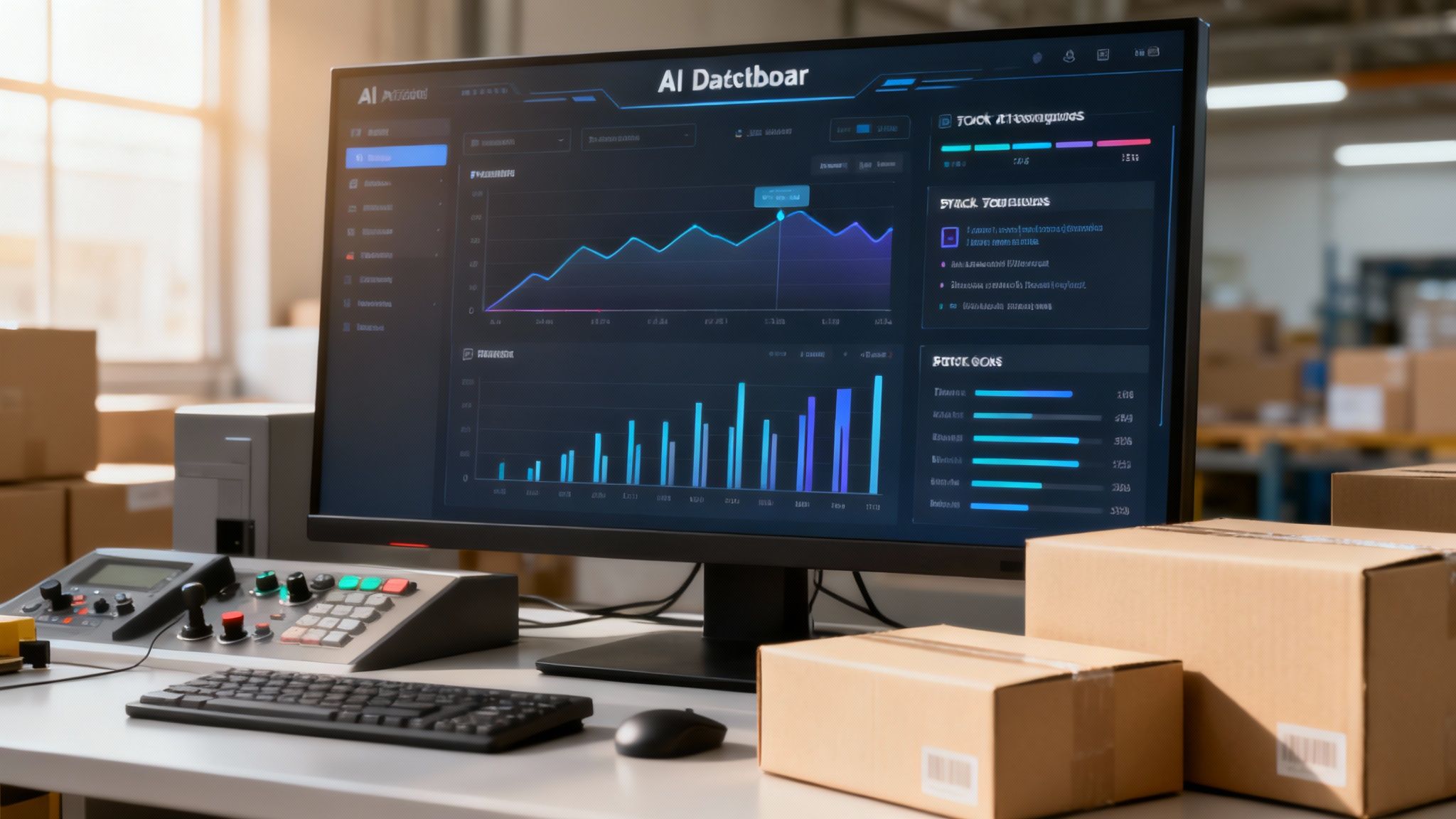
A dashboard like this isn't just nice to look at: it translates complex operational data into immediate visual insights. It finally makes sales trends and inventory performance visible that would otherwise remain buried in numbers.
But how does it work in practice? Artificial intelligence takes historical sales data from your WMS and cross-references it with a world of other variables: seasonality, market trends, even external factors such as holidays or your promotional campaigns. The result is a forecast of future demand with an accuracy that will surprise you.
With AI, you can stop guessing. The platform gives you a mathematical estimate of which products you will sell, in what quantities, and when.
This allows you to optimize your inventory proactively, rather than reactively. For example, the platform could analyze data and suggest that you stock up on a product two weeks before a marketing campaign. The result? You maximize sales and avoid losing customers because you have run out of stock.
The automation of these analyses is essential, especially today. The Italian logistics sector is looking for over 100,000 employees per year, but 32.8% of these profiles are difficult to find. There is a hunger for people with digital skills, but the shortage of personnel risks slowing down innovation. Platforms such as Electe this gap by making advanced analytics available to the entire team, without the need to hire a data scientist.
Connecting a warehouse management program to an analytics platform is not a theoretical exercise. It brings immediate and measurable operational benefits.
In short, integrating artificial intelligence means giving your warehouse a brain. It ceases to be just a place where you store products and becomes the nerve center of your strategy, an asset that actively drives business growth.
When considering such a significant change, it's normal to have doubts. That's why we've compiled the questions we hear most often from companies like yours that are considering adopting a warehouse management program.
This is the first question, and rightly so. However, there is no single answer.
Cloud solutions, known as SaaS, are the most agile. They start at monthly fees ranging from a few dozen to a few hundred euros, with almost no initial costs. They are the perfect choice for SMEs that want to get started right away without a large outlay.
On the other hand, there are on-premise solutions, which are installed on your servers. Here, the initial investment is more substantial, because you purchase licenses and hardware: we are talking about figures that can range from a few thousand to tens of thousands of euros. The important thing is to look at the total cost of ownership (TCO), which includes everything: installation, team training, support, and future updates.
It all depends on how complex your business is. If you have an SME with fairly standard processes, a cloud-based WMS can be up and running in a matter of weeks.
If, on the other hand, your warehouse is a complex machine, with extensive customizations or integrations with existing ERP systems, then it will take a few months. The secret to not taking too long? Good planning and immediately involving the people who will be working with it every day.
The goal is not to disrupt work, but to make it easier. A good implementation plan ensures a smooth transition, minimizing the impact on daily operations.
Yes, without a doubt. If you're juggling spreadsheets, if you occasionally make picking errors, or if you're never completely sure what's on the shelves, a WMS will change your life from day one.
Modern SaaS platforms are also designed for small businesses. They allow you to say goodbye to manual errors, automate repetitive tasks, and immediately gain precision. It's the best way to build the foundations for healthy, controlled growth.
Not only can you, but you must. Today, integration with platforms such as Shopify, Magento, PrestaShop, or WooCommerce is the basis of any self-respecting warehouse management program.
It is a vital link because it allows you to:
Turn your warehouse data into strategic decisions. With Electe, you can integrate your WMS information to forecast demand, optimize inventory, and increase profitability. Find out how it works at electe.

.svg)


.svg)
.svg)