
Imagine you want to teach a child to recognize an apple. You wouldn’t give them a dictionary definition. You’d show them hundreds of pictures: red apples, green apples, big apples, small apples, bruised apples, perfect apples. At some point, almost as if by magic, the child will be able to point to an apple they’ve never seen before and say with confidence, “That’s an apple.”
Training an algorithm works in much the same way. Instead of photos, we feed it a massive amount of data. The goal is the same: to teach it to recognize patterns, make predictions, or make decisions completely on its own. This process is the beating heart of artificial intelligence and machine learning. It is the engine that transforms raw data—often chaotic and seemingly useless—into a strategic tool that generates tangible value for your business. A well-trained algorithm doesn’t just catalog information; it learns from it to answer complex questions, often even before you ask them.
The real breakthrough comes when this power becomes accessible. Today, thanks to AI-powered platforms like Electe, you no longer need a team of data scientists to leverage this technology. Our goal is precisely this: to make algorithm training an intuitive and automated process, providing you with crucial insights directly from the data you already have. In this guide, we’ll explore together what algorithm training really entails, how it works, and how you can use it to make smarter decisions and drive your business’s growth.
Training an algorithm isn’t something you can do with the push of a button. It’s a methodical, almost artisanal process that transforms raw data into strategic insights. Think of it like constructing a building: every brick, every calculation, must be laid with precision so that the final structure is solid and reliable.
To truly understand what training an algorithm entails, we need to break this process down into stages. Each stage has a specific goal and a direct impact on the quality of the predictions you’ll ultimately receive. This logical flow, which starts with data and leads to a concrete result, is the beating heart of artificial intelligence applied to business.
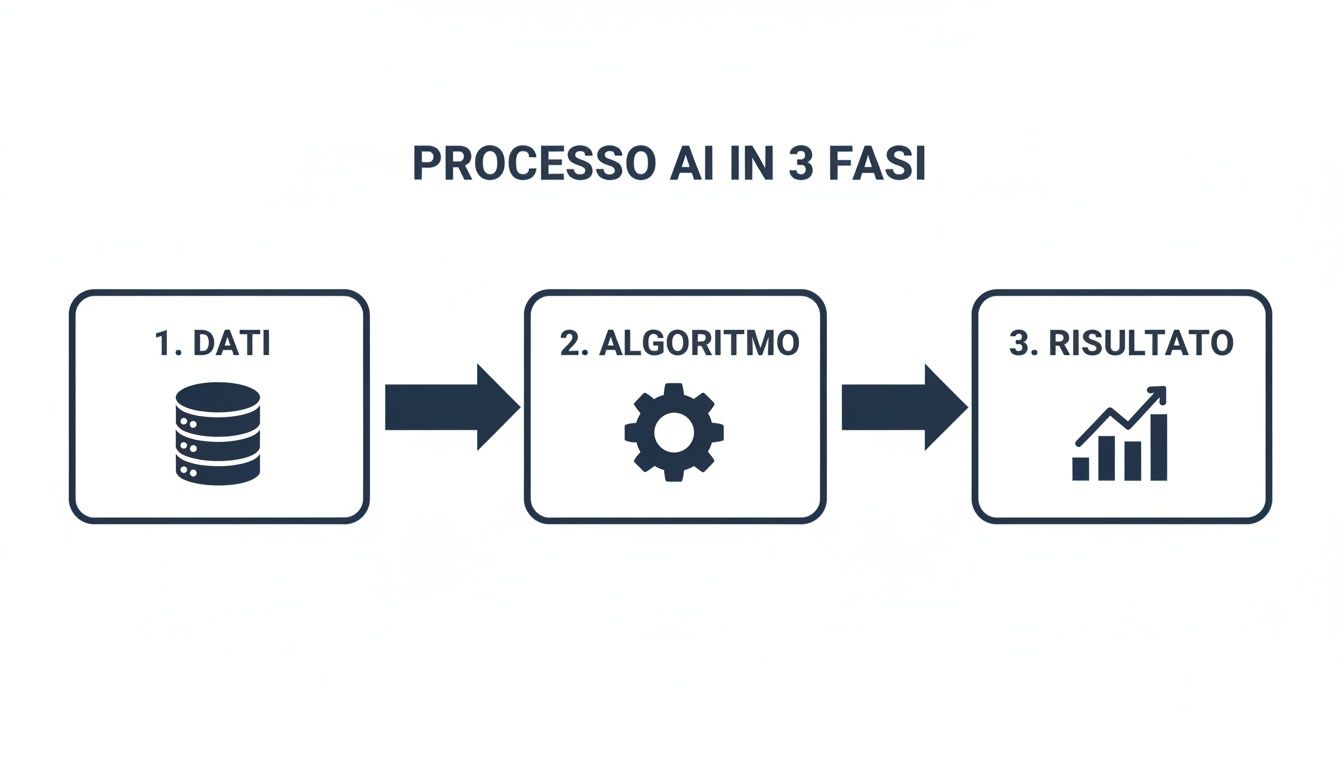
This image sums up the process well: you start with the data, apply an algorithm, and end up with something tangible, such as a graph or a forecast. It sounds simple, but each step presents its own set of challenges.
Everything—absolutely everything—starts with data. The first step is data collection: gathering the necessary information from every possible source (company databases, spreadsheets, sales data, customer interactions). The quality of the final result depends entirely on the quality of this raw material.
Immediately afterward, however, the most challenging work begins: data preparation and cleaning. Raw data is almost always riddled with issues: errors, duplicates, missing values, and inconsistencies. This step is essential to ensure that the algorithm learns from accurate and consistent information. According to the Artificial Intelligence Observatory at the Politecnico di Milano, the AI market in Italy grew by 52% in 2023, but for SMEs, data preparation can take up as much as 60–80% of a project’s total time.
With your data cleaned and ready, it’s time to choose the right tool for the job. The choice of model depends on the problem you want to solve. Do you want to forecast sales for the next quarter? You’ll need a regression model. Do you want to identify which customers are similar to one another? A clustering model is the way to go. There is no single “best” model; there is only the one best suited to the task.
At this point, the actual training begins. The algorithm “studies” the data you’ve provided, looking for connections and hidden patterns that would escape the human eye. This is where the magic happens: the model adjusts its internal parameters to minimize the error between its predictions and the actual results.
This is where theory meets practice. The algorithm isn't simply storing information; it's building a general understanding of phenomena, learning to distinguish the useful signal from the background noise.
How do you know if your algorithm has learned effectively? Through validation and testing. We put the model to the test using a completely new dataset—one it has never seen before. Its performance on this "unknown" data will tell you just how effective it really is in the real world.
If the results aren't what you hoped for, it's time to move on to tuning (or optimization). At this stage, you act like a Formula 1 mechanic, adjusting certain model parameters to squeeze every last drop of accuracy out of it. For those who want to delve deeper into optimization techniques, our article on Design of Experiments is an excellent starting point.
Finally, once the algorithm is deployed and monitored, it’s put to work. But you can’t just forget about it. The world changes, data changes, and so it’s essential to keep monitoring its performance to ensure it remains reliable over time. An algorithm isn’t a “finished” product, but a living system that requires maintenance.
Even the most sophisticated artificial intelligence algorithm cannot learn from scratch. Data is its only textbook, its sole window on the world. Without data, a model is like a powerful engine with not a single drop of gasoline: it simply won’t start.
This brings us to one of the fundamental truths of machine learning, perfectly summed up by the saying "Garbage In, Garbage Out. " If you feed it garbage, it will give you garbage. If you train a model with poor-quality data—full of errors or distorted—its predictions won’t just be inaccurate; they can actually become harmful. Imagine you want to create an algorithm to assist with hiring and you feed it only the profiles of male managers who have advanced within the company. The system will simply learn to favor candidates with those same characteristics, discriminating against women because it has “learned” from a biased dataset.

For SMEs, the problem is often not a lack of data, but rather its quality and fragmentation. Information is scattered everywhere: some in the ERP system, some in dozens of Excel spreadsheets, some in the CRM, and some in the e-commerce platform. Trying to consolidate and clean up this wealth of information manually is a Herculean task.
It is estimated that80% of the time spent on a data science project goes toward data preparation alone. This highlights where the real value lies: not so much in the algorithm itself, but in the meticulous care with which you prepare the raw data that will feed it.
This is where solutions like Electe come into play—an AI-powered data analytics platform designed specifically for SMEs. Our platform handles the most time-consuming and tedious tasks by automating data collection from various sources and data cleaning. In short, we ensure that your algorithm receives only top-quality data.
Relying on a platform like this means transforming what many see as an insurmountable obstacle into a streamlined, automated process. You can learn more about how training data is fueling a billion-dollar business in our dedicated article. Ensuring data quality isn’t an option—it’s the first, indispensable step toward gaining valuable insights and making business decisions that are truly data-driven.
Understanding how to train an algorithm means, first and foremost, realizing that not all models learn in the same way. There are three main categories of machine learning, each with a different approach and designed to solve specific business challenges. Choosing the right one is the first, crucial step toward transforming your raw data into strategic decisions that actually work.
Supervised learning is the most widely used method. Think of it as a student learning from a textbook full of questions and correct answers, with a teacher guiding them. In practice, you provide the algorithm with a "labeled" dataset, where each input is already paired with a correct output. For example, to predict sales, you feed it historical data that includes variables such as advertising spend (the “questions”) along with actual revenue (the “answers”). The algorithm learns the relationship between these factors so it can make reliable predictions.
Unlikesupervised learning, unsupervised learning acts like a detective who is given a box full of clues but no instructions. The algorithm works on unlabeled data, and its task is to uncover patterns, structures, and hidden connections on its own. Here, the goal is not to predict a specific value, but to organize the data in a meaningful way. It is the perfect approach for identifying homogeneous customer segments based on their purchasing behavior.
Unsupervised learning doesn't answer a specific question, but it helps you ask the right questions. It reveals the underlying structure of your data, showing groupings and patterns you didn't even know to look for.
Finally,reinforcement learning is the most dynamic and action-oriented approach. Think of a video game: the algorithm acts as an agent that learns by taking actions in an environment to maximize a reward. No one gives it the right answers in advance; it learns through trial and error. Every action that brings it closer to the goal is rewarded, while every wrong move is penalized. It is the ideal method for real-time optimization problems, such as dynamically setting a product’s price.
According to recent forecasts on AI adoption in Italy, by 2026, SMEs will move from experimentation to a more structured approach focused on automation. Choosing the right approach for your business is the first step.
All the theory we’ve covered translates into a tangible benefit thanks to platforms like Electe, which are tailored specifically for SMEs. The idea of having to manually handle data cleaning, model selection, and tuning may seem like an insurmountable hurdle. And, frankly, for those without a dedicated team of data scientists, it is. But it doesn’t have to be that way.
Electe, an AI-powered data analytics platform, automates these complex steps, acting as a virtual team of data scientists working for you. Instead of investing months and significant resources, you can achieve tangible results in just a few minutes.

Imagine you're the manager of an e-commerce business and you want to predict which products will sell out during the upcoming seasonal peak. Without the right tool, you'd have to rely on intuition or complex spreadsheets—with a very high margin of error.
With Electe, the situation changes completely. All you have to do is connect your data sources (ERP, e-commerce platform, campaign data). It’s a guided and intuitive process—no technical expertise is required.
Since then, the platform has been operating independently:
The end result? Not a complicated file, but a clear dashboard with accurate demand forecasts—product by product—accessible with a single click. This intelligent automation is a cornerstone of AI democratization, a concept that is very important to us.
Our mission is simple: to transform a process that traditionally required specialized teams and large budgets into a "plug-and-play" solution for your business. The algorithm is trained behind the scenes, leaving you with only the strategic insights you need to make decisions.
This is the true meaning of what training an algorithm entails for an SME: not a technical exercise for its own sake, but an automated process for obtaining clear answers to complex business questions. With Electe, you gain access to the power of enterprise-level predictive analytics, but without the associated costs and complexity.
We’ve gone over the training program, but it’s natural to still have a few practical questions. Here are some straightforward answers to the most common questions.
It depends. Processing times can range from a few minutes to several weeks. The two key factors are the complexity of the model and the volume of data. A simple model that analyzes a small set of sales data could be ready in less than an hour. An image recognition algorithm that learns from millions of files will require much more computing power and, consequently, more time. With platforms like Electe, many processes are optimized to give you answers as quickly as possible.
Until recently, cost was a major hurdle. Hiring a team of data scientists and purchasing dedicated hardware meant investing hundreds of thousands of dollars. Today, SaaS (Software as a Service) platforms such as Electe have changed the game.
The subscription-based model has broken down barriers to entry. Instead of a huge upfront investment, you pay a monthly fee for the service you use, giving you access to enterprise-grade technology at a fraction of the cost.
Absolutely not, and that’s the game-changer. Modern AI-powered data analytics platforms are designed with no-code interfaces. You can connect your data sources, run the training, and generate strategic insights without writing a single line of code. All the technical complexity is handled “under the hood” by the platform, making tools accessible that were once the exclusive domain of a select few specialists.
We’ve seen what training an algorithm involves and how this process—once reserved for a select few—is now within reach of small and medium-sized businesses thanks to user-friendly platforms. Here are the key takeaways:
Now you know thattraining an algorithm isn’t some incomprehensible black box, but a concrete process that transforms raw data into a real competitive advantage. Thanks to platforms like Electe, this technology is no longer a privilege reserved for large multinationals, but a tool at your fingertips to solve real problems, optimize resources, and drive the growth of your business.
It’s time to stop letting complexity intimidate you and see AI for what it really is: a strategic ally. Turn the information you already have into decisions that truly make a difference.
Are you ready to turn your data into strategic decisions, without the complexity? With Electe, training algorithms becomes an automated process that anyone can do.
Start your free trial and discover the hidden power of your data →

.svg)


.svg)
.svg)




.png)