
Artificial intelligence for businesses is no longer a futuristic concept reserved for tech giants. Today, it is a concrete strategic tool at your fingertips that is already changing the rules of the game. In a nutshell, AI allows you to transform your business data into valuable insights, automate repetitive tasks, and anticipate the market's next moves. It's like having a super-intelligent co-pilot for your business decisions. This guide will show you how to move from theory to practice, successfully integratingartificial intelligence into your business to gain a real competitive advantage. You'll learn how to set clear goals, prepare your data, and choose the right platform to illuminate the future of your business.
The idea of bringingartificial intelligence into your business may seem complex or intimidating. In reality, its purpose is tremendously practical: to make you more competitive. You shouldn't think of humanoid robots, but rather a system that amplifies the capabilities of your people, allowing them to do more and better with the resources you already have.
It's the algorithm that analyzes sales data and suggests which products to promote this month. It's the platform that optimizes inventory so you never have a warehouse full of unsold goods again. It's the technology that intercepts a customer's needs before they even express them clearly.
And no, you don't need a team of data scientists. Modern platforms such as Electe, an AI-powered data analytics platform for SMEs, are designed to be intuitive and allow managers and analysts to obtain valuable insights with just a few clicks.
The market is moving fast, and those who stand still risk being left behind. Although the adoption of artificial intelligence is growing, we still have a long way to go in Italy. According to recent ISTAT data, the adoption of AI technologies in Italian companies has reached 8.2%, a figure that is increasing but still below the European average.
This is not a negative factor. On the contrary, it represents a huge opportunity for SMEs that are ready to take the leap and innovate before others do.

Once you get past the initial excitement about terms like "machine learning" or "language models," the true value of AI emerges when you integrate it into your daily routine. That's when it really transforms the way you run your business:
For those new to this world, understanding the implications and correct methods of use is the first step. In this regard, an ethical and practical guide to artificial intelligence can offer interesting insights that are also valid in a business context. If you want to get a clearer idea of the possibilities, take a look at our in-depth analysis of the practical applications of large language models.
To understand the real impactof artificial intelligence on businesses, we need to look beyond buzzwords. We're not talking about abstract benefits, but concrete, measurable results that can improve your bottom line. AI is not an expense for its own sake; it's a strategic investment with a tangible return on investment (ROI).
Its true value emerges when you apply it to real problems: optimizing processes that waste your time and money, making smarter decisions based on facts, and creating a customer experience that keeps them coming back. Every single advantage translates into a direct improvement in performance, making your company more agile and competitive.
One of the most immediate benefits of AI is its ability to streamline everyday operations and make them more efficient. Many manual, repetitive tasks that currently consume valuable time can be automated, finally freeing up your people to focus on higher-value tasks.
Take inventory management, for example. Instead of relying on estimates, an AI system can analyze market trends, seasonality, and customer behavior in real time to predict demand with surprising accuracy. This translates into less waste and a reduction in inventory costs that can easily reach 20% or more, depending on the industry.
Here are some practical examples that you could implement right away:
Making decisions based on instinct or incomplete data is one of the biggest risks you can take. Artificial intelligence transforms your raw data into clear, immediately actionable strategic insights. It becomes your personal advisor, always active, capable of finding patterns and correlations that a human being could never see.
A platform such as Electe doesn't just show you graphs. It gives you answers. You can query your data in natural language, just as you would a colleague, and get accurate sales forecasts, identify the most profitable customer segments, or understand why one marketing campaign performed better than another.
"The goal of AI is not to replace human intuition, but to enhance it with objective analysis. It allows you to move from 'I think...' to 'I know...'."
This change of pace allows you to move with greater confidence, allocate your budget where it is truly needed, and anticipate your competitors' moves.
In today's market, customers expect an experience tailored specifically to them. AI gives you the tools to achieve a level of personalization that was previously impossible, creating a much stronger and more lasting bond with your audience.
By analyzing purchase data and browsing behavior, AI-powered systems can:
This ability to understand and anticipate the needs of each individual customer not only increases sales, but also transforms occasional customers into true fans of your brand. This is howartificial intelligence for businesses ceases to be technology and becomes an engine for growth.
To truly understand whatartificial intelligence can dofor businesses, it's best to look at where it's already working. Two key sectors for SMEs, retail and financial services, are undergoing radical transformation thanks to AI. Here, technology ceases to be an abstract concept and becomes a concrete driver for increasing revenue, cutting risk, and better serving customers.
It's not about replacing people, but giving them powerful tools to make smarter, faster, data-driven decisions. Let's see how.
In the retail world, where margins are tight and competition is fierce, artificial intelligence is no longer a luxury, but a necessity. It allows you to move from reactive management to proactive management.
One of the biggest challenges is inventory management. Too much stock means tied-up capital; too little leads to lost sales. AI tackles this problem by analyzing sales data, seasonality, past promotions, and even external factors such as social media trends. The result? Demand forecasts with a level of accuracy that was unthinkable until recently.
But it doesn't stop there. AI is changing commerce in many other ways:
In retail, AI is not just about selling more, but selling better. It transforms every single piece of data into an opportunity to build a stronger and more profitable relationship with each customer.
While AI acts as a sales accelerator in retail, in financial services it acts as a guardian and strategic co-pilot. In an industry where precision and security are everything,artificial intelligence becomes a key allyfor companies in managing risk and planning for the future.
Take credit scoring, for example, which is the assessment of a customer's creditworthiness for a loan. An AI system can process thousands of pieces of data in a matter of seconds, returning a much more accurate and faster risk assessment. This translates into loans being approved in less time and with greater certainty.
Fraud prevention is another area where AI makes a difference. Machine learning algorithms learn to recognize normal transaction patterns and flag any suspicious anomalies in real time. It's a predictive approach: fraud is blocked before it can cause any damage.
Finally, there is financial forecasting. AI can analyze complex historical data to create robust predictive models, giving you a much clearer view of future scenarios. This kind of support is crucial for building solid business strategies.
Introducingartificial intelligence into a business can seem like a daunting task, especially for an SME. But with a clear action plan, the process becomes not only manageable, but even exciting. This roadmap is designed to guide you step by step, transforming an ambitious idea into a concrete project.
The right approach is not to try to revolutionize everything at once, but to proceed methodically. Start with a specific problem, achieve a tangible result, and then scale up.
The first step, often underestimated, is also the most critical: what exactly do you want to achieve? AI is not a magic wand, it is a powerful tool. But to use it well, you need to give it a specific task. Instead of a vague goal such as "improving sales," aim for something specific and measurable.
Some concrete examples:
A clear goal gives you direction and, above all, a way to measure success. If you can't measure it, you can't improve it.
Data is the fuel of artificial intelligence. Without good quality data, even the most sophisticated algorithm will produce unreliable results. The good news is that this phase does not require data scientist skills, but rather a deep understanding of your business.
You just need to ensure that the data is:
Modern platforms such as Electe created precisely to simplify this process, connecting directly to your data sources and automating much of the cleaning and preparation.
This infographic clearly shows the flow: from raw data to strategic insight.
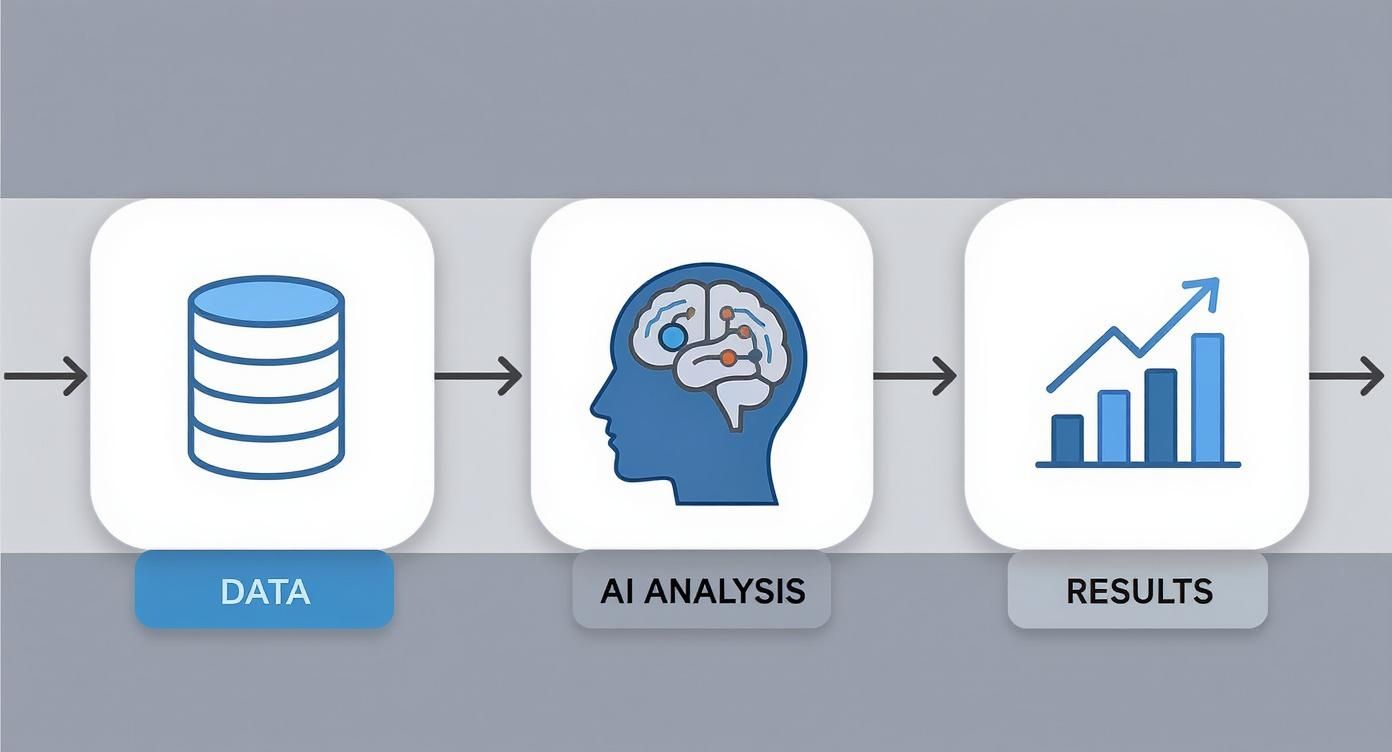
The diagram shows how well-structured data feeds the AI engine, which in turn generates clear and immediately actionable results for your business decisions.
You don't have to bet everything right away. The smartest way to start is with a pilot project: a small-scale experiment with a limited budget and a hyper-defined goal. This allows you to test the effectiveness of AI in your specific context and demonstrate its value with a tangible success story.
A good pilot project has the following characteristics:
For example, you could use a predictive analytics platform to analyze sales data from the last quarter and identify the 100 customers most at risk of churning. Success will be measured by how many of these customers you can retain with targeted action.
A successful pilot project is the best calling card for obtaining the approval and resources needed for large-scale implementation.
Once the pilot project has proven its worth, it's time to extend the use of AI to other areas of the company. Please note: this phase is not only technological, but above all cultural. It is essential that your people understand how to use the new tools and trust the analyses produced.
Large-scale adoption requires:
By following these steps, adoptingartificial intelligence for businesses becomes a structured process rather than a leap in the dark. For an even more detailed plan, you can explore our roadmap for integrating artificial intelligence with a 90-day plan, a practical guide to accelerating the process.
Choosing the right technology is a decisive crossroads. It can make the difference between the success and failure of your artificial intelligence project for businesses. Not all platforms are created equal, and identifying the one that suits the needs of an SME is a step you cannot afford to get wrong. A hasty decision almost always results in unexpected costs and a frustrated team.
The perfect platform for you should be a strategic partner, not yet another complicated piece of software. It should be an accelerator, not a brake. The question to ask yourself is: will this tool really help my people work better?
The first rule is simple: if your team can't use it, the platform is useless. Data analysis is no longer an obscure ritual reserved for a few specialized technicians. A modern solution must be designed for managers, business analysts, and department heads, not just data scientists.
This is particularly true in Italy. An EY study reveals that, although 46% of Italian companies already use AI, a significant 44% complain about a lack of internal expertise. This data highlights the critical need for intuitive platforms that do not require months of training.
Look for "no-code" or "low-code" interfaces and the ability to "query" data using everyday language. The goal should be to transform a mountain of data into clear insights with just a few clicks.
An AI platform cannot exist on a desert island. To be truly effective, it must communicate seamlessly with the systems you already use on a daily basis, such as your CRM (Customer Relationship Management) or ERP (Enterprise Resource Planning) systems.
Seamless integration is the backbone of a consistent and reliable data flow. Without it, you'll find yourself dealing with manual exports and outdated data, negating the benefits of automation.
True power is unleashed when the AI platform becomes the central brain that connects to all your data sources, enriching every decision-making process.
Before choosing, make sure that the provider offers ready-made connectors for the most popular software and flexible APIs for any customizations.
A good platform doesn't just show you what happened yesterday; it helps you understand what will happen tomorrow. Forecasting capabilities are at the heart of this. They must be powerful and reliable to support strategic decisions about inventory, budgets, and sales.
Similarly, automation capabilities are a key selection criterion. The platform you choose should be able to:
When evaluating the ideal AI platform, it can be enlightening to explore comparisons between different AI solutions such as Deepseek and Silicon Valley to gain a broader view of the current technological landscape.
Finally, there is one aspect that does not allow for compromise: the security of your data. You are about to entrust a platform with your company's most valuable information. It is vital that the provider guarantees the highest standards of protection.
Verify that the solution is fully GDPR compliant and uses advanced encryption protocols. Transparency in data management and security certifications are key indicators of a technology partner's reliability. Always ask where the servers are physically located and what the disaster recovery policies are. There can be no gray areas on this point.
An investment in artificial intelligence for businesses must lead to a measurable return. It is not enough to say that it "improves things"; you have to prove it with concrete data. Calculating the return on investment (ROI) is a key step in justifying the expense, gaining internal support, and guiding future decisions.
To do this, you need to focus on Key Performance Indicators (KPIs) that have a real impact on the business. It's not about complex formulas, but about linking investment in AI to tangible business results.

To build a solid business case, you can break down the value generated by AI into four main categories. This approach helps you present a comprehensive picture of the impact.
The ROI of AI is not just about savings. It is an indicator of the competitive advantage you are building by transforming data into faster, smarter, and more profitable decisions.
The adoption of AI is no longer a hypothesis, but a booming economic reality. The artificial intelligence market in Italy has already reached a value of €1.2 billion, with impressive growth of 58% in just one year. Even more significantly, 39% of large companies using GenAI tools have already seen a tangible increase in productivity. For more details, you can explore research on the Italian AI market.
For a more comprehensive guide with practical examples, read our article on how to calculate the ROI of AI implementation in 2025.
Adopting artificial intelligence is not a leap in the dark, but a strategic path that can transform the way you make decisions. Here are the key steps to take:
We have seen howartificial intelligence for businesses has gone from being an abstract concept to a concrete tool for growth, accessible even to SMEs. Integrating it into your business does not mean turning everything upside down, but rather enhancing what you already do, making your operations more efficient, your decisions smarter, and your customers' experience unforgettable.
By starting with clear objectives, launching a pilot project, and choosing the right platform, you can transform your data from a cost to a strategic asset. AI gives you the power to anticipate the future instead of reacting to the present, building a lasting competitive advantage. It's time to take the decisive step.
Are you ready to turn your data into strategic decisions? Find out how Electe can empower your business. Start your free trial →

.svg)


.svg)
.svg)