
Artificial intelligence is no longer science fiction. It has become an incredibly practical tool for growing your business. If you're wondering how artificial intelligence works in practice, the answer is more intuitive than you might think: it uses the data you already have to uncover hidden patterns, make accurate predictions, and automate complex decisions.
Many entrepreneurs and managers know they have a treasure trove of business data at their fingertips, but have no idea how to put it to good use. This guide was created for this very reason: to take artificial intelligence off its technological pedestal and turn it into a real and tangible business opportunity, especially for SMEs.
The Italian AI market has literally exploded. The data from the Artificial Intelligence Observatory at the Politecnico di Milano speaks for itself: in just one year, the sector has grown by +52%, reaching €760 million. If you want to get a more accurate picture, you can take a closer look at the data on the Italian artificial intelligence market. This trend shows that adopting AI is no longer an option, but a necessity in order to remain competitive.

In this guide, we will show you exactly how you can take advantage of this technology.
- Data and Algorithms: The fundamental building blocks: you will understand how your data can "teach" a system to make better decisions.
- Types of Learning: You will discover the difference between "supervised" AI and "autonomous" AI, and which approach is right for your company.
- Neural Networks: We will see , in simple terms, how AI mimics the human brain to solve complex problems.
- Practical Applications: From sales to warehousing: concrete examples of how AI can optimize every department in your company.
- How to get started right away: You will learn practical steps to implement AI, even without a technical team, and see quick results.
By the end of this guide, you will not only know "what" AI is, but more importantly, "how" to use it to make a difference in your industry.
Our goal is simple: to guide you on a journey that will give you the knowledge you need to understand the true potential of AI. We won't stop at textbook definitions, but will show you how each concept translates into a competitive advantage for your business.
Artificial intelligence does not replace your intuition, but enhances it. It provides the insights you need to move from instinct-based decisions to data-driven strategic choices.
In this comprehensive guide, we will look at:
Get ready to transform your data: from a simple archive to the driving force behind your growth.
To understand how artificial intelligence works, imagine you have to teach something to an incredibly diligent assistant who is starting from scratch. It's not enough to give them orders; you have to provide them with a method for learning. This process is based on three pillars: data, algorithms, andtraining.
Data is the fuel of AI. Without data, an algorithm is like a powerful engine without gas: stationary and useless. Think about your company's sales data, customer interactions, and marketing campaign performance. Each of these elements is a lesson your system can learn from.
However, having a mountain of data is not enough. Quality is everything. If you provide incorrect or incomplete information, the AI will learn the wrong things. It's the classic principle of "garbage in, garbage out": if you put in garbage, you'll get garbage out. That's why platforms such as Electe devote meticulous attention to preparing and cleaning data before each analysis, ensuring that the model learns only from reliable information.
If data is fuel, algorithms are the instructions, the "recipe" that the system follows to transform that fuel into intelligence. An algorithm is a set of mathematical rules that guides AI in analyzing information, finding patterns, and making predictions.
There is no universal algorithm. The choice depends on the problem you want to solve. Do you want to predict sales for the next quarter? You need a forecasting algorithm. Do you want to divide your customers into homogeneous groups for targeted campaigns? You will use a clustering algorithm.
An algorithm does not "think" like a human being. Think of it as an extremely sophisticated statistical calculator, capable of identifying correlations in millions of pieces of data in a matter of seconds, a task that would be impossible for a person.
The effectiveness of an AI system depends on the perfect synergy between high-quality data and the right algorithm for the job.
Training is when the algorithm "studies" data to become intelligent. There are two main approaches, each suited to different purposes.
Once you understand the basic mechanisms of learning, it's time to look at the engine that powers today's most powerful AI applications: neural networks. The concept is inspired by something we know very well: our brain.
Imagine a neural network as a team of specialists working together to solve a problem. Each specialist—an artificial neuron —is exceptional at recognizing a single, tiny detail. Alone, its contribution is almost insignificant. But when thousands of neurons work together, organized in hierarchical layers, the results are extraordinary.
It is precisely this structure that makes neural networks formidable at tasks such as image recognition, language comprehension, and complex predictions.
What can a neural network do for your SME? It transforms raw data into decisions that generate value.
Let's look at a couple of concrete examples that show how artificial intelligence works in real-life scenarios.
Neural networks excel at finding the "needle in the haystack" of data. They identify subtle patterns that traditional analysis would never see, giving you a decisive competitive advantage.
Their ability to process unstructured data (text, images) is what makes them so valuable. To better understand how these systems interpret language, read our overview of the evolution of language models, which are a specialized form of neural network.
At this point, you might be thinking, "I'll need a team of data scientists to set something like this up." Fortunately, the answer is no.
AI-powered platforms such as Electe were created precisely for this purpose. They handle all the technical complexity "behind the scenes," from data preparation to network configuration.
You just provide the business objective—such as "forecast next quarter's sales" or "identify customers at risk of churning"—and the platform takes care of selecting, training, and deploying the right model. This way, even SMEs can leverage one of the world's most advanced technologies to make better decisions and accelerate growth.
Creating an effective AI model is not a one-time event, but a cyclical process. To truly understand how artificial intelligence works "behind the scenes," you need to look at the journey that transforms a business idea into a decision-making tool. This process ensures that the model is reliable, accurate, and useful over time.
The journey always begins with data. Without high-quality data, even the most sophisticated algorithm is doomed to fail. This initial phase is crucial to the success of the entire project.
The infographic below shows how raw data is transformed into actionable insights.
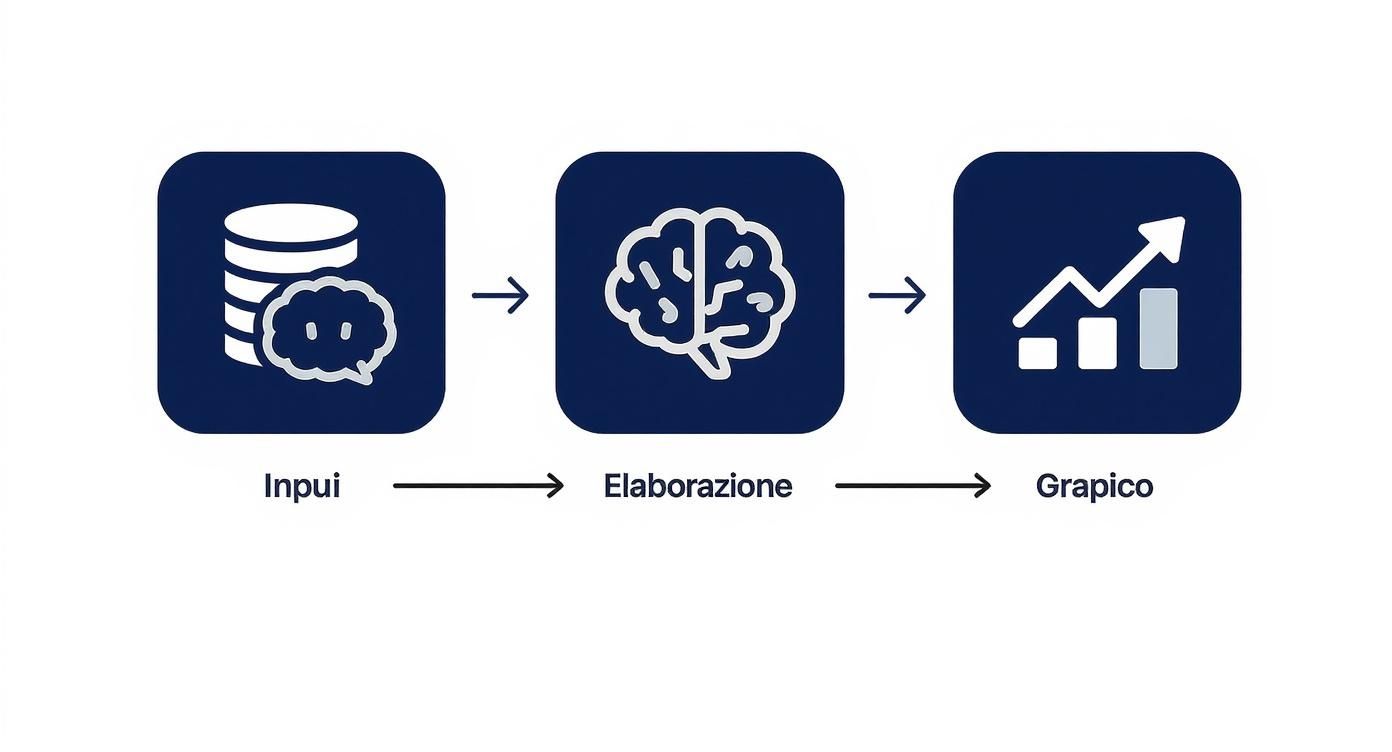
The diagram highlights how incoming data is processed by the AI's "brain" to produce an understandable result, such as a graph showing a prediction.
Every machine learning model follows a specific life cycle. Platforms such as Electe these phases automatically, but understanding them helps you appreciate the value you are getting.
This iterative process is fundamental. For more information, read our article on how artificial intelligence models are trained and refined.
A model that performs well in testing is not yet ready. The last two phases bring AI into your daily workflow.
The true value of an AI-powered platform lies not only in the creation of the model, but in the continuous management of its entire lifecycle. This ensures that the insights on which you base your decisions are always up-to-date and reliable.
Relying on a managed solution such as Electe allows Electe to delegate all this complexity. You can focus not on "how" it works, but on "what" you can do with the insights generated to accelerate your company's growth.
It's time to move from theory to practice. Every manager asks themselves the same question: "What can artificial intelligence really do for my company today?"
This section showcases concrete applications that demonstrate the tangible value of this technology.
According to ISTAT, only 5.3% of Italian SMEs have adopted AI solutions, a figure that highlights enormous potential for growth. Companies that take action now can gain a significant competitive advantage. For those who want a complete picture of the market, a good starting point is the trends and applications of AI in Italy.
Each example below has a measurable goal: increasing revenue, cutting costs, or improving efficiency, showing how artificial intelligence works to generate a real return on investment.
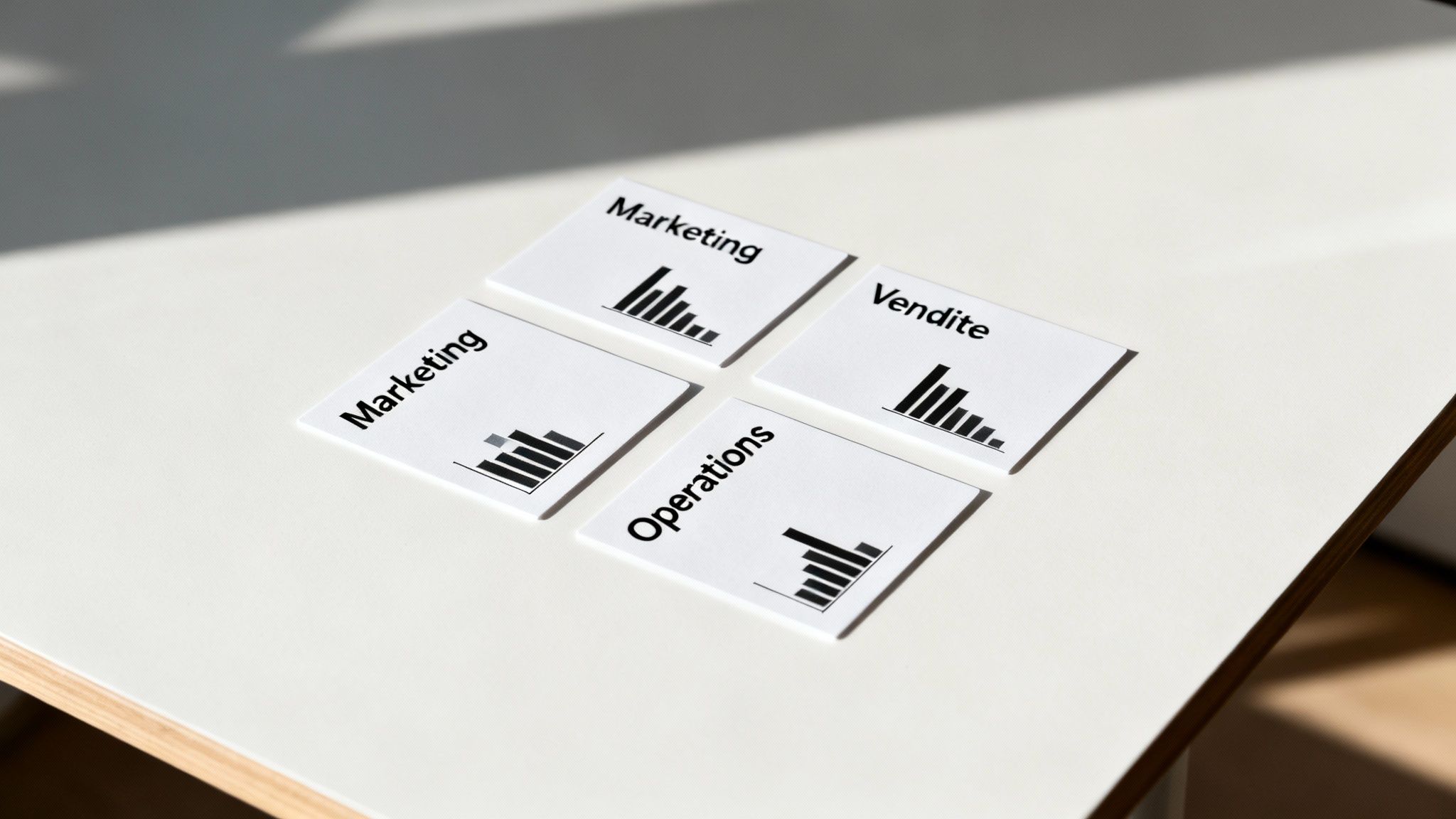
If there is one department where the impact of AI is almost immediate, it is marketing and sales. Machine learning models transform strategies from generic to hyper-personalized.
In finance, accuracy and the ability to identify anomalies are everything. AI offers powerful tools to refine forecasts and secure operations.
AI in the financial sector does more than just crunch numbers. It sees what the human eye cannot: hidden patterns and anomalies in transaction flows. It transforms risk management from reactive to proactive.
Key applications in finance:
Operational efficiency is at the heart of many businesses. AI offers new ways to optimize complex processes such as inventory and supply chain management.
Platforms such as Electe make these capabilities accessible, allowing you to turn your business data into a real competitive advantage, department by department.
It's time to move from theory to action. The first step is not technological, but strategic: identify a clear business problem that artificial intelligence can solve.
Adopting AI just because "everyone else is doing it" is a recipe for wasting time and money. Using it to solve a real challenge, such as reducing inventory costs or understanding why some customers are leaving you, is the real key to success.
Before thinking about algorithms and models, ask yourself the right questions. What is the most cumbersome process in your team? Where are you losing the most money? Which strategic decisions do you currently make based solely on instinct?
The answers to these questions are the perfect candidates for your first AI project.
Once you have focused on your goal, look at your data. You don't need huge amounts of information; what matters is that it is relevant. Sales data, CRM interactions, and website analytics are often an excellent starting point.
At this point, the road splits. To implement AI, you have two main options.
If you want a detailed action plan, check out our roadmap for integrating artificial intelligence, which guides you step by step.
The dashboard of a platform such as Electe, for example, translates complex predictive analytics into clear graphs and numbers. This way, anyone on the team can immediately see sales forecasts, understand which products are performing best, and make fact-based decisions.
The plug-and-play approach of modern platforms has made AI accessible. You no longer need to be a multinational corporation to leverage enterprise-level analytics.
Understanding how artificial intelligence works is the first step. The second, and most important, is to start using it. Experiment with a small but significant problem and discover how your data can become your greatest strategic ally.
We have reached the end of our journey. If I had to take home just a few concepts, they would be these:
Now you know how artificial intelligence works and how it can transform data from a simple archive into a strategic engine for your company's growth. AI is no longer a futuristic technology reserved for large corporations, but a powerful and accessible resource for SMEs that want to compete and win in the market.
Remember, the first step is not to invest in complex technology, but to change your mindset: start seeing your data as your greatest asset. With the right tools, you can illuminate the future of your business and make decisions that will always keep you one step ahead of the competition.
Ready to turn your data into winning decisions?
Discover how Electe works Electe a free demo →

.svg)


.svg)
.svg)




.png)