
A marketing plan sets out in black and white the objectives, strategies, and metrics for reaching your audience. Without one, every campaign is a shot in the dark that wastes budget without producing measurable results. In this article, we will guide you step by step through the creation of a marketing plan that is not based on assumptions, but on concrete data and measurable metrics, transforming your actions into tangible results for your SME.
It often happens, especially in SMEs, that marketing initiatives are launched without a clear direction, burning through budgets and achieving little or nothing. The common mistake is to think that simply being present on social media or activating a few ads is enough to see results. The reality, however, is that in today's hyper-competitive market, a data-driven approach is no longer a luxury, but an absolute necessity for survival and growth.
A marketing plan is not just a formal document to be filled out and put away in a drawer. It is the real driving force behind every action you take towards a concrete and, above all, measurable goal. It transforms instinct into strategy and opinions into decisions based on real data.
Acting without a plan means navigating by sight in a sea of uncertainty, where every choice is a gamble. On the contrary, having a clear strategy allows you to make a difference. How?
This infographic clearly illustrates the transition from aimless marketing to growth driven by a solid plan.
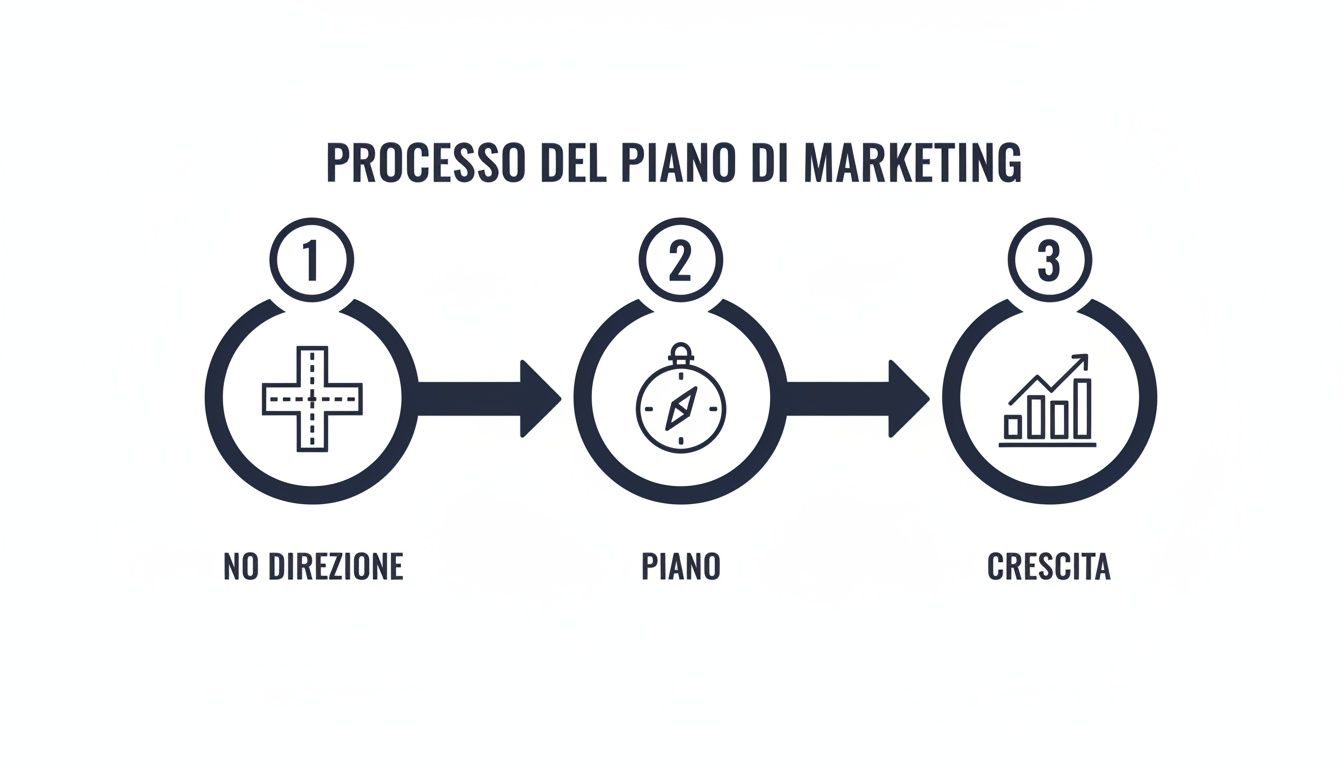
The image clearly shows how a well-designed marketing plan bridges the gap between operational uncertainty and solid, predictable business growth.
Fortunately, today you no longer need teams of data scientists to create a smart plan. Platforms such as ELECTE SMEs to transform business data into strategic insights. Understanding how big data analytics is the first step toward building a lasting competitive advantage. This guide will show you exactly how to do it, step by step, to create a measurable and agile marketing plan that leverages the full power of data.
A marketing plan that works always starts with a blunt and direct question: what exactly do you want to achieve? It's time to forget about generic goals such as "increasing sales" or "improving brand awareness." However valid they may be, these desires are too vague to guide concrete actions and, above all, to measure results.
The real turning point comes when you transform these aspirations into specific, measurable goals with a deadline. This is where a key ally comes into play: the SMART framework.
The SMART method transforms vague desires into measurable goals.
In practice, each objective must be:
Putting the pieces together, the vague "increase sales" turns into something much more powerful: "Increase e-commerce conversion rate by 15% within the next six months by optimizing the checkout process and launching a targeted retargeting campaign." This precision is the foundation of any successful marketing plan.
To make the concept even clearer, let's see how to transform generic ideas into SMART goals ready to be included in your plan.
Once you are clear about where you want to go, you need to look around. Market analysis is not a one-time task; it is an ongoing process that feeds into and refines your marketing plan. You can no longer afford to navigate by sight, relying on feelings or "what has always worked."
The first step is an honest SWOT analysis (Strengths, Weaknesses, Opportunities, Threats). It helps you take stock of the situation: what are your internal strengths? Where are you vulnerable? What external opportunities can you seize? And what threats do you need to keep an eye on?
Next, shift your focus to your competitors. What are they doing well? Where are they making mistakes? Analyze their communication, the channels they use, and the type of content they publish. The goal is not to copy them, but to understand the competitive landscape so you can carve out your own unique space.
The Italian context, for example, shows an unequivocal trend. In Italy, spending on digital advertising reached €5.9 billion (+8.4% year-on-year), with growth forecasts of up to €7.6 billion by 2028. For SMEs, this means one thing: allocating a significant portion of their budget to digital channels is no longer optional.
An effective marketing plan does more than just push a product. It tells the right story to the right person at the right time. To achieve this, you need to stop seeing your audience as a faceless mass and start thinking of them as a group of individuals, each with their own needs, problems, and aspirations.
Going beyond basic demographics—age, gender, origin—is only the first, essential step. The real game is won by digging deeper to understand what really drives your customers to choose you. This is where data becomes your greatest ally.
Buyer personas are nothing more than semi-fictional portraits of your ideal customer. The emphasis, however, is on "semi-fictional": they must be based on concrete data, not pure speculation. Instead of fantasizing about who your customer might be, use the information you already have to give them a face, a name, and a story.
The most valuable sources are often already at your disposal:
By putting these pieces together, you can build profiles based on real data. Your main buyer persona is no longer a generic "SME manager," but becomes Marco: 45 years old, marketing manager of a retail company with 50 employees. Marco spends 5 hours a week on Excel compiling reports manually, struggles to link Google Ads spending to actual sales, and is desperately looking for a tool that will save him time and show him where he is wasting his budget.
With this level of detail, you're no longer "talking about generic optimization"—you're talking directly to Marco about how to eliminate those 5 hours wasted on Excel every week.
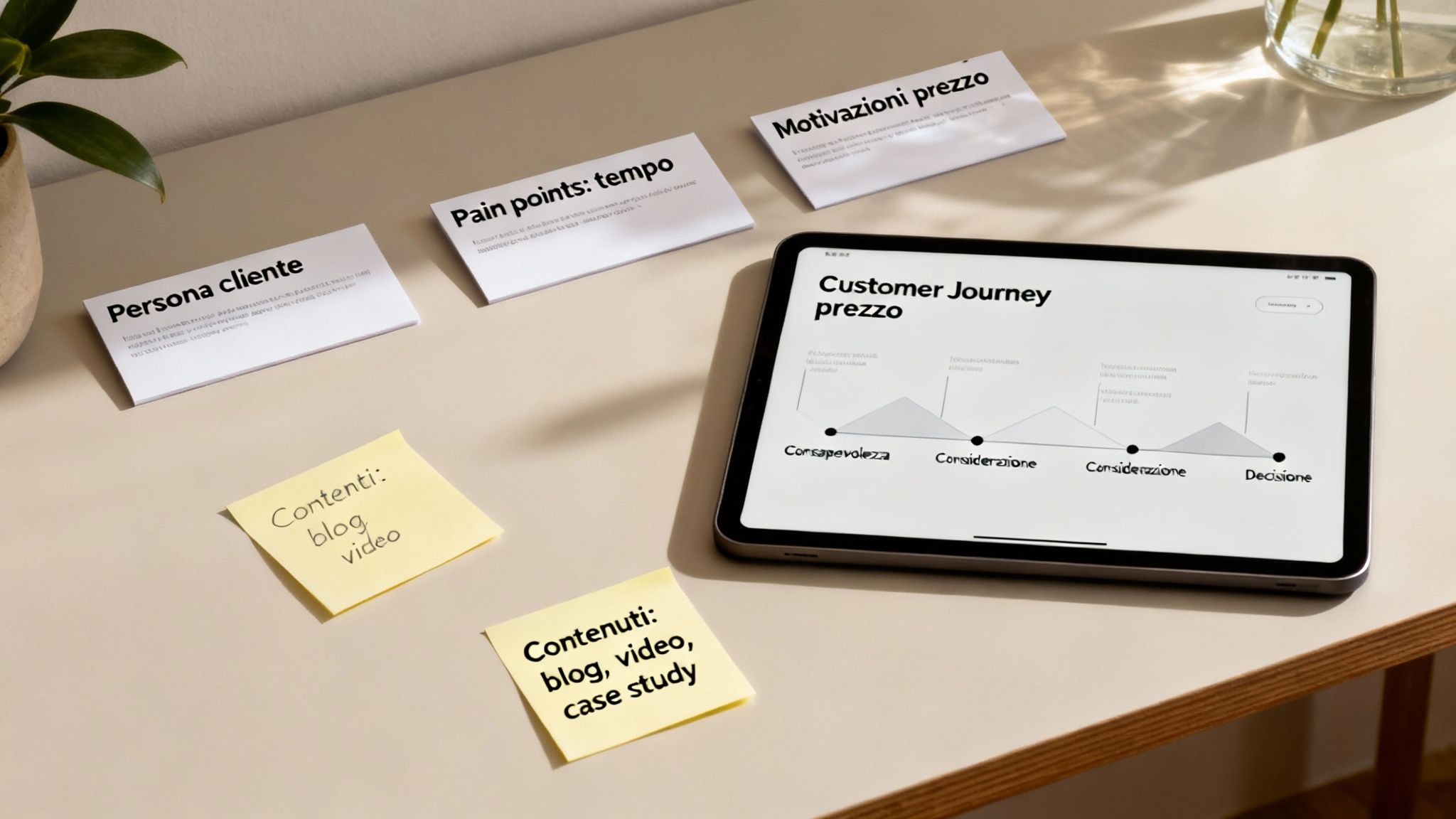
Now that you have a clear idea of who "Marco" is, the next step is to understand the path he takes to get to you. This path is called the customer journey, and it is a real map that tracks every interaction, from the first "hello" until he becomes a loyal customer.
The customer journey is usually divided into three key stages. For each stage, you need to think about specific content.
Data analysis helps you understand which content is performing best at each stage. An analytics platform, for example, might show you that your blog articles attract a lot of traffic (Awareness), but that users then leave the site before downloading the comparison guides (Consideration). This insight is worth its weight in gold: it tells you exactly where you need to intervene to oil the gears of your funnel and guide people toward conversion more smoothly. This is how your marketing plan becomes a living tool that adapts and improves over time.
Choosing where to invest every single euro of your budget is one of the most delicate steps in any marketing plan. Yet I still see too many companies relying on instinct or, worse, on the "fads" of the moment. In today's market, we can no longer afford this luxury.
The starting point must always be the same: a ruthless analysis of past performance.
Just dig a little into your data to understand which channels have delivered the best Cost Per Acquisition (CPA) and the highest Return on Advertising Spend (ROAS). You may find that email marketing, which everyone considers dead, generates leads at a ridiculously low cost compared to social media, or that organic traffic (SEO) brings in customers with the highest lifetime value (LTV).
The truth is that customers no longer follow a linear path. They may discover your brand on Instagram, then do a Google search, read a review, and finally convert only after receiving your newsletter. That's why a multi-channel approach that integrates SEO, SEM, social media, and email is not an option, but a necessity.
But how can you understand the real contribution of each channel in this chaos? This is where attribution models come into play. Instead of giving all the credit to the last click before the purchase, these models distribute the value among the various touchpoints that accompanied the customer in their decision. Understanding this mechanism allows you to allocate your budget in a much smarter way.
Choosing channels without data is like driving at night with your headlights off. You can keep going for a while, but sooner or later, an accident is inevitable. Data analysis turns on those headlights and shows you the way.
The Italian advertising market, after all, speaks for itself. It has reached a value of €11.1 billion with8% growth, and Internet advertising alone takes about 50-51% of the pie. Within this world, the video format is set to exceed €2.4 billion. These figures, availablein the advertising market analysis by Osservatori Digital Innovation, tell us one simple thing: ignoring digital channels, and videos in particular, means giving up a huge slice of the market.
Analyzing the past is essential, but the real breakthrough comes when you can look to the future. This is where artificial intelligence (AI) enters your marketing plan and completely changes the rules of the game.
Imagine finally being able to answer questions such as:
This approach transforms budget planning from an art based on experience to a science based on probabilities. A business analytics software that integrates AI allows you to simulate different spending scenarios and choose the one with the highest probability of success. You may find, for example, that a mix of YouTube video ads and Google Shopping campaigns could generate a 30% higher ROAS than any other combination. And you can find this out before spending a single euro.
This predictive capability is what distinguishes a modern marketing plan from a traditional one. You are no longer just reacting to results, but anticipating them. You gain a huge competitive advantage and maximize the effectiveness of every penny. AI is no longer just an analysis tool, but becomes a true strategic advisor at your side.
Launching campaigns is not the goal, but only the starting point. A truly effective marketing plan is not a static document to be followed to the letter, but a living organism that breathes, adapts, and continuously improves. The real driver of growth, in fact, is a tireless process of monitoring and optimization that feeds on data.
If you don't monitor performance, you're simply hoping for the best. It's time to abandon prayers and turn data into your biggest competitive advantage.
The first step, of course, is to define the right Key Performance Indicators (KPIs) for each individual channel. Not all numbers are equal, and focusing on the wrong metrics is the quickest way to make disastrous decisions.
There are some KPIs that cannot be ignored:
Once you have chosen your KPIs, it's time to say goodbye to manually compiled spreadsheets forever. It's a slow process, full of errors, and by the time you're done, you're left with an outdated and faded snapshot of reality. The solution is to rely on data analytics tools that do the dirty work for you, automatically.
Platforms such as Electe, for example, allow you to create custom analytics dashboards that collect data from all your sources (Google Ads, Facebook Ads, Google Analytics, CRM) and bring it together in one place.
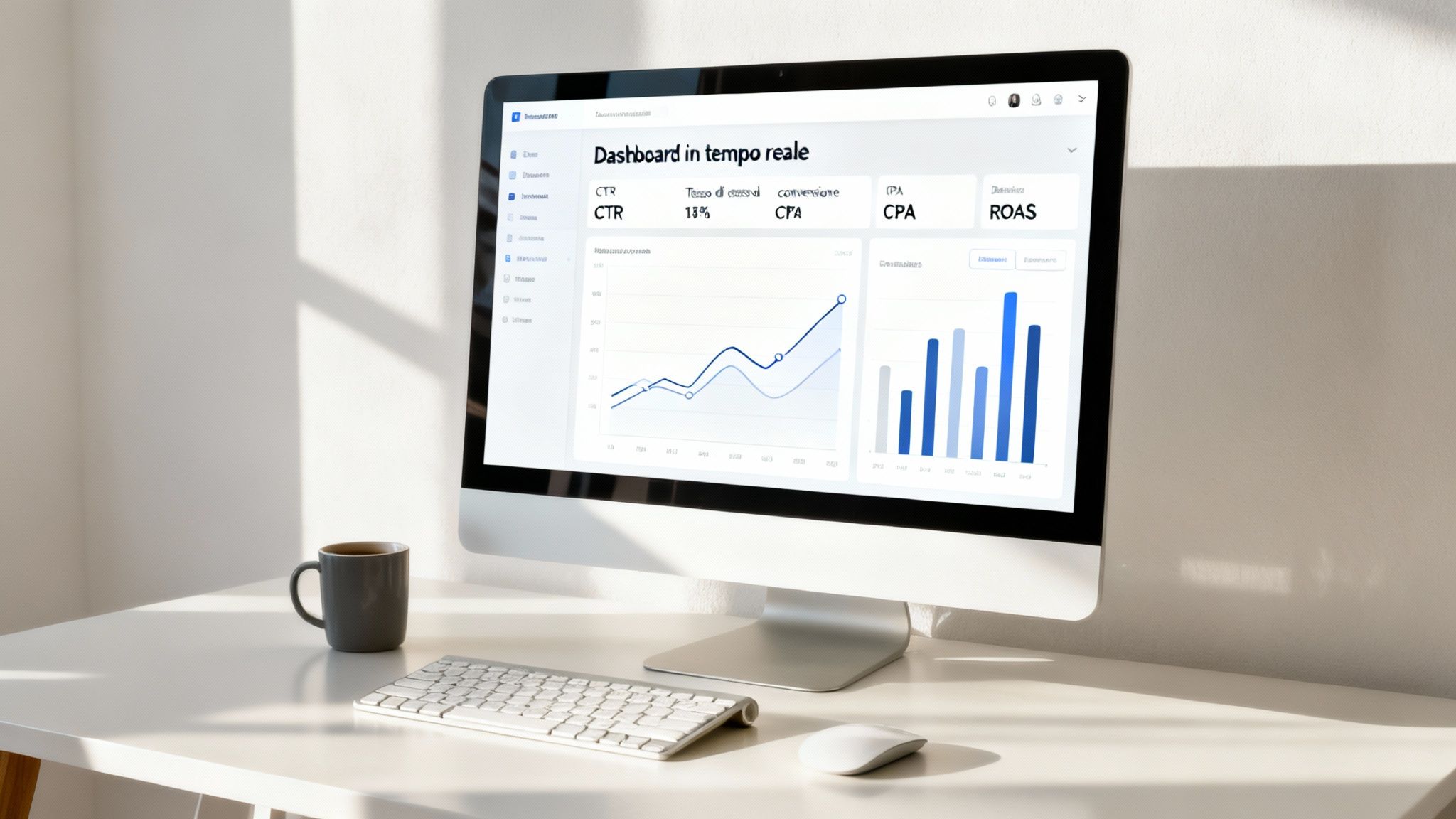
This dashboard becomes your command center, your cockpit, from which you can pilot your campaigns while seeing everything in real time.
This is how an automated dashboard can transform a jumble of data into a clear and immediate overview. At a glance, you can see which campaign is flying high and which one needs urgent attention. Data is thus transformed into quick and informed decisions.
Having a clear view of real-time data is already a giant leap forward. But artificial intelligence (AI) takes your marketing plan to a whole new level: it doesn't just analyze the present, it starts predicting the future.
Instead of reacting to a decline in performance when it's too late, AI helps you prevent it. By analyzing vast amounts of historical data and uncovering patterns that a human could never see, AI-powered platforms can:
And this is not science fiction. In Italy, the adoption of AI is growing at a dizzying pace, signaling a shift in mindset toward smarter marketing. In Italy, the adoption of AI in businesses has doubled (16.4% among companies with 10+ employees), a sign that predictive tools are increasingly accessible even for SMEs. If we add to this the fact that almost80% of companies have achieved a basic level of digitization, we can see that the tools for a data-driven marketing plan are now within everyone's reach. You can find more detailed data in the Istat report on the digitization of Italian businesses.
Optimization, therefore, ceases to be a "once-a-month" activity. It becomes a continuous, intelligent process. Integrating AI into your work means transforming your plan from a static document into a dynamic guidance system that learns, adapts, and shows you the fastest way to achieve your goals.
Ultimately, a modern marketing plan is not a static document to be locked away in a drawer. Think of it instead as a living ecosystem, a continuous cycle of planning, action, and optimization that is constantly fed by data.
The era in which decisions were made based on instinct or past experience is over, forever. Today, knowing how to analyze performance in real time and anticipate future trends is no longer a luxury for large companies, but a necessity for any SME that truly wants to compete and grow.
Linking each action in your marketing plan to specific metrics is the starting point. With the right dashboards, you can see the progress of each campaign in real time, immediately understanding which channels and messages are really driving conversions.
But it's artificial intelligence that really makes the difference. Platforms such as Electe just tell you what happened yesterday. By analyzing historical data, they use predictive analytics to suggest which channels and strategies are most likely to succeed tomorrow. This shifts your approach from reactive to proactive.
An AI-driven marketing plan doesn't just follow the path, it builds it. It allows you to invest your budget where it will have the greatest impact, optimizing ROI before you even launch a campaign.
Every company, no matter how small, already has the data it needs to make smarter decisions. Tools such as Electe, the AI-powered data analytics platform for SMEs, are designed to make this technology accessible.
The next step is up to you. You have the opportunity to stop flying blind and start steering your growth with the precision that only data can give you, transforming every piece of information into a concrete and lasting competitive advantage.
At this point, it's perfectly normal to still have some doubts. A marketing plan is a huge topic, and from experience, I know that certain questions always come up. Let's try to clarify the most common ones once and for all.
These answers will help you see your plan not as a bureaucratic obligation, but as a living, flexible tool, even if you don't have a multinational budget or a team of data scientists. The goal is to turn planning into a habit that drives your business, not weighs it down.
The most common mistake? Thinking of a marketing plan as a document to be written in January and then tucked away in a drawer until the new year. In a market that moves at lightning speed, a static plan is a plan doomed to fail.
Your plan must be a living organism, capable of adapting in real time. The best strategy is a mix of scheduled reviews and a constant eye on the data.
Your plan isn't set in stone. It's more like a GPS that recalculates your route whenever you encounter traffic or discover a shortcut. Real-time dashboards are your eyes on the road.
This is the million-dollar question for SMEs, but the answer is much simpler than you might think: there is no magic number that applies to everyone. The right budget depends on your goals, your industry, and how competitive the channels you want to use are.
The smartest approach is not to guess a figure, but to start with a test budget. Start with a modest investment, just enough to gather solid data on a couple of promising channels. The initial goal is not to conquer the world, but to accurately measure two metrics that really matter: Cost per Acquisition (CPA) and Return on Advertising Spend (ROAS).
Once you have this data in hand, the budget ceases to be an expense and becomes an investment. If you find that every dollar you put into Google Ads brings you five dollars back, the question is no longer "how much should I spend?" but "how much can I afford to invest to scale this result?"
Absolutely. Until a few years ago, data analysis was a luxury for companies with dedicated teams of analysts. Today, things have changed dramatically.
Platforms such as Electe precisely for this reason: to make data analysis accessible to everyone, not just technicians. The goal of these tools is to democratize data-driven insight.
Here's how they simplify your life by automating the most tedious and complex parts:
You no longer need to be an Excel wizard to understand what works and what doesn't. You just need to be curious enough to ask the right questions and willing to listen to the answers that the data gives you. Your entrepreneurial intuition remains the driving force, but now you have a dashboard full of indicators to help you steer better.
You have the foundation to build a data-driven marketing plan. Now you need the right tool to put it into practice.
ELECTE the analysis of your marketing data:

.svg)


.svg)
.svg)



.png)