
Let’s be clear:business automation is simply the use of technology to have machines perform those repetitive and tedious tasks that used to be done by people. It’s a powerful tool that allows you to cut costs, eliminate errors, and, most importantly, free people from manual tasks so they can focus on what really matters: growth.
Imagine being able to say goodbye to all those manual tasks that slow you down: endless data management, manual order entry, and month-end reconciliations. Business automation isn’t just the stuff of science fiction for multinational corporations—it’s now an essential strategic choice for competing and growing, especially for small and medium-sized businesses.
This approach doesn't just speed up processes—it transforms them. It turns tedious tasks into smooth, efficient workflows, freeing up your team to focus on growing the business.

The true goalof business automation isn't just to get things done faster, but to do them smarter. It means building a system where different software applications communicate with each other, data flows seamlessly, and decisions are based on accurate, up-to-date information.
The benefits are tangible and immediate:
Automation doesn't replace people; it empowers them. It's a tool that allows teams to work more effectively by focusing on innovation and customer relationships rather than on compiling reports.
For SMEs, automation is the key to becoming more agile and responsive in the marketplace. While large companies are often held back by bureaucracy and complex processes, a small or medium-sized enterprise can quickly implement targeted solutions, optimizing one area of the business at a time.
Platforms like Electe, for example, make this process even easier. They allow you to turn raw data into predictive analytics and strategic decisions without needing an in-house team of data scientists. This way, even the smallest businesses can harness the power of data to anticipate trends and respond before their competitors.
Of course, before you get started, it’s essential to identify which processes have the greatest potential. If you’d like to learn more, you can read our guide to mapping business processes.
Simply put, automation is the bridge that connects where your company is today with where it can be tomorrow.
To truly understand what automation means for a business, it helps to think of the various technologies as a team of digital “specialists,” each with a specific role. There is no one-size-fits-all solution; the choice always depends on the goal you want to achieve. Understanding these differences is the first step toward equipping your SME with the right tool at the right time.

Robotic Process Automation (RPA) is the classic tireless digital employee. It is a software “bot” that perfectly mimics the repetitive actions of a human being to perform structured tasks based on strict rules. It doesn’t think or learn, but it executes exactly what it is told to do.
Think of RPA as that assistant you entrust with all the tedious tasks—the ones that require neither judgment nor creativity, but only great precision.
When should you use RPA? Examples of workflows:
RPA is the ideal tool for stable processes with predictable inputs and outputs. Its main advantage is that it integrates easily with the systems your company already uses.
When a process requires more than just mechanical execution,intelligent automation—powered by Artificial Intelligence (AI) and Machine Learning (ML)—comes into play. It doesn’t just follow rules; it’s capable of analyzing data, interpreting unstructured contexts, and even making complex decisions.
If RPA is the arm, AI is the strategic brain that learns and adapts. Platforms like Electe these very AI engines to transform raw data into predictive analytics. The adoption of these tools is now well established: about 60% of companies actively use automation solutions, and as many as88% of organizations employ AI in at least one business function. You can learn more by reading these statistics on business automation.
When should you use AI? Examples of workflows:
Smart automation doesn't just ask, "What should I do now?", but "What's the best thing to do?" It analyzes historical and real-time data to optimize the outcome.
To help you decide, here's a handy comparison.
For many SMEs, the best solution is often a hybrid approach, where RPA handles routine tasks and AI steps in for activities that require analysis, interpretation, and a touch of intelligence. To determine which processes to automate first, we recommend learning more about business process management.
Talking about automation in business isn’t just about saving time. It’s a real driver of growth. The benefits are tangible, measurable, and spread like wildfire across every department, transforming what are currently operating costs into investment opportunities.

When you automate a process, you’re essentially building a more robust and reliable system that can handle much higher workloads without compromising quality. Let’s take a closer look at the key benefits.
Any manual task, from simple data entry to accounting, carries an inherent risk of error. All it takes is an oversight, a couple of transposed digits, or a botched copy-and-paste to trigger costly consequences. Automation, on the other hand, performs tasks with nearly 99.99% accuracy, ensuring cleaner data and compliance with regulations.
In other words: less time spent correcting errors and much greater confidence in the numbers you use to make your decisions. For a finance department, this means faster month-ends and audits without the headaches.
Perhaps the greatest benefit is precisely this: the impact on people. When you free your employees from tedious, repetitive tasks, you’re not just saving hours of work—you’re finally unlocking their true potential.
People can devote themselves to everything a machine will never be able to do:
This shift creates a more stimulating and dynamic work environment. People feel valued for their intelligence, not for their ability to perform routine tasks.
Increased efficiency and fewer errors lead to a near-mathematical result: a significant reduction in operating costs. Automation allows you to handle more work with the same resources—if not fewer.
The savings, however, aren’t limited to labor costs. Consider more accurate inventory management thanks to automated inventory tracking, which reduces waste and warehousing costs. Or automated invoice management, which prevents late payments and potential penalties.
Automation transforms processes from mere cost centers into drivers of efficiency. Every single optimized activity directly contributes to improving profit margins.
Finally, automation—especially when integrated with an analytics platform such as Electe — radically changes the way you make decisions. Having access to data that is always up-to-date, clean, and analyzed in real time means you can act more quickly and with greater insight.
You no longer have to wait for the end-of-month report to see how sales are performing. With Electe access predictive insights at the click of a button, anticipating market trends and acting before your competitors. In a fast-paced market, this advantage is invaluable.Business automation thus becomes the cornerstone for building a truly data-driven corporate culture.
Enough with the theory. Automation only proves its true value when it solves a real-world problem. So let’s look at some practical examples you can start implementing right away in your company, to see how automation isn’t just an abstract concept, but a tangible solution for streamlining your daily work.
These use cases cover critical areas such as finance and order management, where efficiency and accuracy are everything.
Managing supplier invoices is a classic bottleneck. It requires manual data entry, cross-checks, and endless approval steps. An automation system can literally transform this process.
Imagine this scenario:
This process not only reduces processing time from days to minutes, but also minimizes the risk of data entry errors or duplicate payments.
Another essential but terribly repetitive task: bank reconciliation. With automation, it can become almost invisible.
A software bot can be programmed to connect to your online banking account, download your account statements at regular intervals, and compare each transaction with the entries in your accounting software. It automatically matches amounts and descriptions, doing the legwork for you.
The goal here is to highlight only the exceptions. Instead of reviewing hundreds of lines, your finance team will only need to check the few discrepancies that the system couldn’t reconcile, freeing up valuable time.
For an e-commerce business, speed and accuracy in order management are everything. Automation enables a seamless, integrated workflow from sale to delivery.
Here's how a fully automated order management workflow works:
Integration is the key here. These processes work best when your systems (CRM, ERP, e-commerce platform) communicate with each other. Using connectors like Zapier can greatly simplify this communication, as we explain in our article on how to integrate Electe hundreds of apps.
The Italian industrial automation sector, among other things, has shown remarkable resilience, closing out 2023 with a 4% increase in revenue . This indicates that Italian companies are making strategic investments, focusing on quality and process efficiency. If you’d like to learn more, you can check out these analyses on industrial automation in Italy.
Finally, a data analytics platform like Electe serve as the "brain" that monitors the performance of these automated workflows, providing you with real-time dashboards so you can immediately identify bottlenecks and areas for further improvement.
Implementing automation in a company isn’t as simple as flipping a switch. It’s more of a strategic process—a journey that requires a clear roadmap. The goal isn’t to turn everything upside down overnight, but to build a competitive advantage one step at a time, starting with the areas where the impact is felt most strongly.
Following a methodical approach not only ensures the project’s success, but also ensures that the team is on board and that the return on investment is clear and tangible.
The first, crucial step is to figure out what to automate. Not all processes are ideal candidates. You should start by identifying those with specific characteristics:
Once you’ve identified the candidates, it’s time to map out their workflow. Who does what? What software is used? How long does it take? This analysis will give you a clear picture of the bottlenecks and the real opportunities for optimization.
Without a clear goal, automation is nothing more than a fancy display of technological prowess. The question we need to ask is: "What exactly do we want to achieve?" This is where KPIs (Key Performance Indicators) come into play; they must be specific, measurable, and realistic.
Here are a few concrete examples of well-defined goals:
These KPIs are not only used to measure success, but also to justify the investment and motivate the team. After all, enthusiasm for automation is growing in Italy as well. Although the machine tool and robotics industry is showing modest signs of growth, domestic consumption has risen by 20.5% and deliveries to the domestic market have increased by 32%. You can learn more in these analyses of the Italian automation market.
With clear objectives in mind, choosing the right tool becomes much easier. As we’ve seen, not all automation technologies are the same.
If your goal is to speed up a task based on fixed rules (such as copying data from one spreadsheet to another), Robotic Process Automation (RPA) is likely the right choice. If, on the other hand, you need to analyze unstructured data or make complex decisions (such as forecasting sales), then you’ll needintelligent automation (AI).
The question you should ask isn't "What is the absolute best technology?", but "What is the best technology for solving this specific problem?". The answer will guide your choice.
This infographic, for example, shows how automation can handle a typical workflow—such as e-commerce orders—by combining the various steps into a single, seamless process.
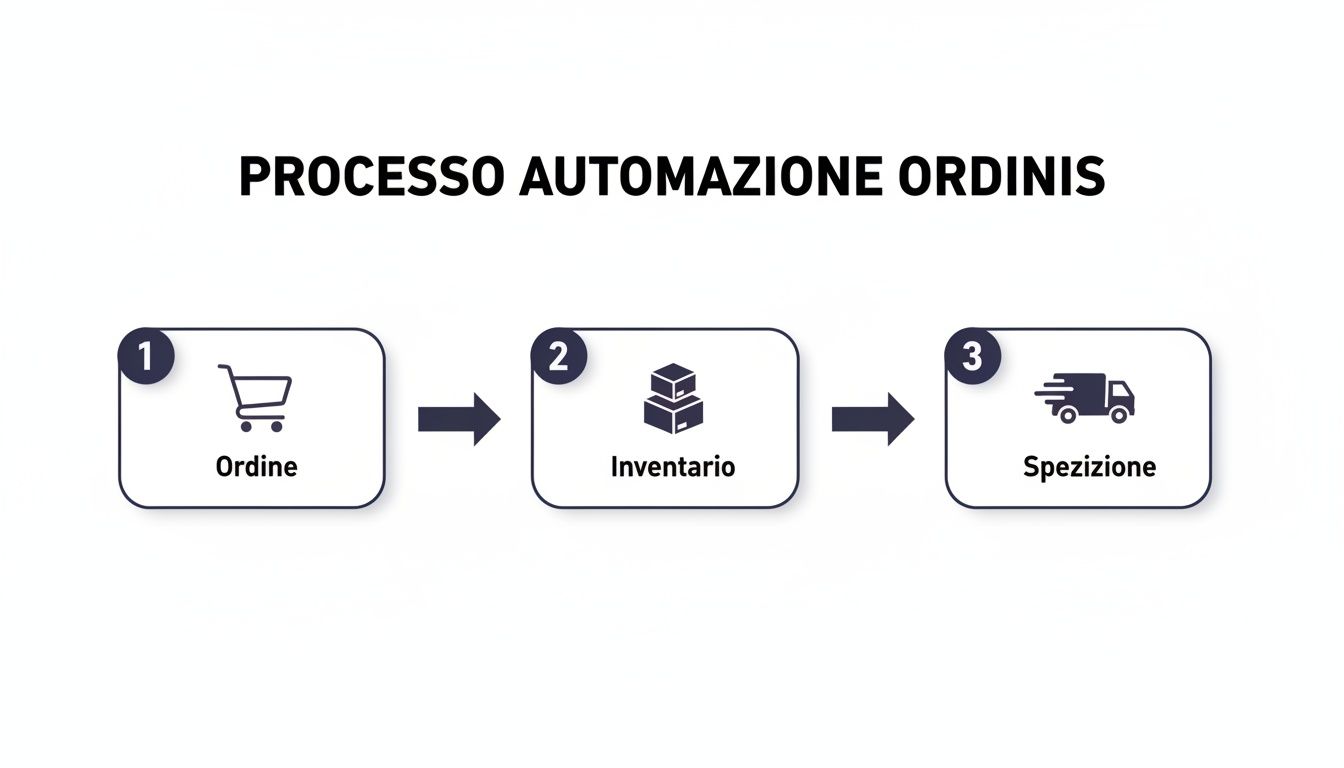
It is clear to see how automation links order receipt, inventory verification, and the initiation of shipping, instantly eliminating delays and manual errors.
Resist the temptation to automate everything right away. The best strategy is to start with a pilot project: a low-risk, high-impact initiative. This approach allows you to:
A great pilot project could be automating the sending of standard reports or managing vacation requests. Its success will build the confidence needed to tackle more ambitious projects.
Now that the pilot project has proven successful, it’s time to think big. How can we extend this automation to other departments and processes?
This is where continuous monitoring becomes crucial. Using a data analytics platform such as Electe allows you to analyze the performance of your automated processes. Always keep an eye on the KPIs defined at the outset and never stop looking for new areas of improvement.Automation in business is not a destination, but a continuous cycle of optimization.
Introducing automation into your business is a major step. It’s normal to have doubts and questions. In fact, it’s a good sign: it means you’re taking this seriously. Let’s try to shed some light on the most common concerns we hear every day when talking to small and medium-sized businesses, debunking a few myths with clear and straightforward answers.
This is the number one concern—the one that always comes up first. Fortunately, the reality is much more encouraging than you might think. The goalof automation in the workplace has never been to replace people, but to empower them. It’s a matter of upskilling, not downskilling.
When software takes over mechanical and repetitive tasks, such as data entry or invoice reconciliation, people are finally free to focus on more strategic, creative, and human activities: improving customer relationships, analyzing new markets, and developing innovative products. Automation doesn’t take away jobs; it transforms them for the better.
Automation handles the tasks; people run the business. The result is a team that is more motivated and focused on growth, not on routine.
Another myth to dispel: the idea that automation requires prohibitively high upfront investments. This may have been true ten years ago, but it is no longer the case today. This is thanks to flexible business models such as Software-as-a-Service (SaaS).
These solutions don’t require you to purchase expensive licenses or build an infrastructure from scratch. They operate on a monthly subscription basis, scalable to meet your actual needs. You can start small by automating a single process—such as purchase invoice management—to demonstrate ROI with minimal investment. Only then, if the numbers support it, do you decide whether and how to expand your use of the solution.
The thought of having to wait months, if not years, to see a return on investment can be discouraging for anyone. Fortunately, for many well-defined processes, the benefits come much sooner.
For tasks such as order management or bank reconciliation, the first tangible results—time savings, operational efficiency, and a drastic reduction in errors—become apparent within a few weeks. The key is to start with a targeted pilot project with clear objectives. Initial success generates the enthusiasm (and the budget) to take the next step.
This is perhaps the biggest misconception of all. Automation is not a luxury reserved for large corporations; on the contrary, in many ways, it is SMEs that reap the most immediate and significant benefits.
While large companies are often held back by complex processes and internal bureaucracy, an SME can implement automation solutions in a much more agile and targeted manner. This allows them to immediately become more competitive, responsive, and flexible, closing the gap with larger but less dynamic competitors. Automation is the lever that enables an SME to operate with the efficiency of a large company while maintaining its agility.
Do you want to turn your data into strategic decisions with the help of automation? With Electe, you can start seeing the benefits of AI-powered analytics right away.
Start your free trial now →

.svg)


.svg)
.svg)