
Let’s be honest: raw data, on its own, is a mess. An entity-relationship diagram (ERD) is the strategic roadmap that brings order to the chaos, transforming confusing information into a logical and understandable structure. It works like a floor plan that shows you exactly where your most valuable business insights are located and how they’re connected. Why is this so important? Because in a market that moves at the speed of light, you can’t afford to search for information blindly. Having a clear map of your data is the first step toward making quick and smart decisions. In this guide, you’ll learn not only how to read these diagrams but also how to create them from scratch to gain a real competitive advantage.
Imagine walking into a vast library without a catalog. Finding a specific book would be nearly impossible. Similarly, without a clear structure, your company’s data is like thousands of books scattered haphazardly: it holds enormous potential, but is effectively inaccessible.

Think ofthe entity-relationship diagram as the catalog for your data “library.” It’s not just a diagram for experts—it’s a strategic visualization that anyone on your team can understand. It shows you the key components of your business (customers, products, orders) and, most importantly, how they interact with one another, enabling you to make better decisions faster.
An ERD allows you to answer complex questions simply by looking at a diagram. This diagram translates business concepts into a structure that a database can understand and use. The ROI benefits are immediately apparent:
This approach has proven so effective that it laid the foundation for modern data modeling. In 1976, Peter Chen published "The Entity-Relationship Model—Toward a Unified View of Data," a groundbreaking paper. Although the concept is not new, its application is more relevant than ever. Today, in 2026, AI-powered platforms like ELECTE, an AI-powered data analytics platform for SMEs, can even accelerate this process. One of our case studies recorded a 40% reduction in the time required to design a new database for a retail client.
To learn more about the impact of this model, you can explore the origins of ERDs on Lucidchart.
An entity-relationship diagram isn't just a technical drawing. It's a visual representation of your business logic. If data is the new oil, the ERD is the map that shows you where to drill to get the highest ROI.
Understanding the structure of your data is the first step toward mastering it. This visual logic is closely tied to how business processes work. Organizing data using an ERD is very similar to optimizing workflows. You can learn more by reading our article on business process mapping.
In the following sections, we’ll show you how to turn the hidden potential in your data into a real competitive advantage.
Understanding an entity-relationship diagram (ERD) isn’t just an academic exercise. It’s like learning to read the strategic roadmap of your business. Every ERD has its own syntax—a precise set of rules—that, once understood, reveals the logic behind every business process.
You don't need complicated lessons. All you have to do is break it down into its three basic components, using an analogy that anyone can understand: language.

Think of an ERD as a series of sentences that describe how your company works. To construct these sentences, you need three fundamental elements: nouns, adjectives, and verbs. These correspond exactly to the pillars of any entity-relationship diagram.
Entities are the "nouns" of your business universe. They represent the key concepts, objects, or people that your organization needs to track. They are the main players on your data stage.
In a diagram, you can spot them right away: they’re the rectangles that contain the names of the things that matter. Think of an e-commerce site:
Identifying the right entities is the first and most crucial step. It means deciding who the main characters are in the story your data is meant to tell. If you get this wrong, the entire narrative loses its meaning.
If entities are nouns, attributes are the "adjectives" that describe them. They are the properties and characteristics that give each entity its concreteness and detail.
Without attributes, an entity like "Customer" is just an empty box, an abstract concept. It is the attributes that make it a useful representation of a real person. For the Customer entity, you might have attributes such as:
For the entity Product, on the other hand, attributes such as SKU (Stock Keeping Unit), Price and Weight are essential for any logistics or sales analysis.
A well-designed set of attributes transforms a vague idea into a concrete source of information. It’s the difference between saying “we have customers” and knowing exactly who they are, where they live, and how to reach them for the next marketing campaign.
Finally, there are the relationships—the "verbs" of your diagram. They are what drive the action, describing how different entities interact with one another. They are the engine that connects the various pieces of the business puzzle.
A report transforms a collection of isolated lists into an integrated and coherent system. It’s the glue that allows you to answer complex business questions. For example:
Without these connections, you would never know which products a particular customer has purchased or how many units of an item are available in a specific warehouse. The data would remain in silos, unusable for strategic analysis.
To provide an overview, we have summarized these three pillars in a table.
| Component | Grammatical Analogy | Simple Description | Practical Example (E-commerce) |
|---|---|---|---|
| Entity | Noun | An object, concept, or person of interest to the business. | Customer, Product, Order |
| Attribute | Adjective | A characteristic or property that describes an entity. | Name (the Customer’s), Price (Product) |
| Report | Verb | The action or connection that links two or more entities. | A Customer perform a Order. |
Mastering this basic "grammar" is the first step toward understanding any data model. But relationships have more specific rules—nuances that define their numerical logic. This is the concept of cardinality, and we’ll look at it right away.
If entities, attributes, and relationships are the grammar of your data model, cardinality is the syntax. It consists of the rules that dictate how sentences are connected to make sense. Simply put, cardinality defines how many instances of one entity can be linked to how many instances of another.
This isn’t an abstract concept, but a reflection of real-world rules. If a customer can have multiple shipping addresses, the diagram must reflect that. If a product has a single, unique barcode, that must also be clear. Defining cardinality means forcing the database to adhere to your business logic, without exception.
In most business scenarios, you’ll encounter three basic types of cardinality. Understanding them is the first step toward building data models that don’t fall apart at the first sign of trouble.
One-to-one (1:1): The simplest and most exclusive relationship. An instance of entity A can be linked to one and only one instance of entity B, and vice versa.
Employee has only one Tax ID Number. And, of course, a Tax ID Number is associated with only one Employee.One-to-many (1:N): The most common relationship of all. An instance of entity A is linked to many instances of entity B, but each instance of B can be linked to only one instance of A.
Manager can supervise many Projects, but every Project has only one Manager manager.Many-to-many (N:M): Here, things get a little more complicated. Many instances of A can be linked to many instances of B. To make this relationship work in a database, you almost always need a third table—called a "join table" or "association table"—to act as a bridge.
Customers can buy many Products. At the same time, every Product can be purchased by many Customers.An ASSINT survey conducted in 2026 revealed a concerning finding: for82% of Italian data analysts, cardinality errors are the direct cause of nearly half of all failures in database projects. Platforms like ELECTE precisely to automate this type of validation. In a case study of an Italian retail company, our platform identified and corrected 92% of the cardinality anomalies in their models, leading to a 37% improvement in forecasting efficiency. For those who want to go to the source, the approach is still based on the principles described in Peter Chen’s original paper.
Once you've defined the rules, you need to draw them. There are several graphic notations, but two have become the industry standard: Chen notation and "Crow's Foot" notation.
The choice of notation is not just a matter of style. Good notation makes the diagram immediately readable, reducing ambiguity and facilitating communication between technical and non-technical teams.
Chen Notation
Created by Peter Chen, the father of ERDs, this notation uses precise symbols. Relationships are represented by a diamond, and the cardinality (1, N, M) is written next to the lines connecting the entities. It is academically rigorous and highly expressive, but can be a bit difficult for non-experts to understand.
Crow's Foot Notation (
) This is, without a doubt, the most widely used notation today, the one you'll find in most modeling tools. Its success is due to its visual clarity. Instead of numbers, it uses graphical symbols at the end of lines to indicate cardinality:
|) means "one".O) means "zero".<) means "many".By combining these symbols, you can intuitively represent every possible relationship. A line ending with a dash on one end and a zigzag on the other, for example, clearly indicates a "one-to-many" relationship. It has become the de facto standard precisely because of its remarkable clarity.
It’s time to take action. Creating your first entity-relationship diagram may seem like a daunting task, but if you break the process down into logical, concrete steps, you’ll see that it’s entirely doable. I’ll guide you step by step, turning an abstract concept into a solid data model—even if you’ve never done this before.
Think of this process as a five-step journey. We’ll start with an idea and end up with a clear overview of your data.
Before you even draw a single line, stop for a moment. The key question is: "What is the purpose of this diagram?" An ERD without a specific purpose risks becoming an exercise in futility.
Maybe you want to design a database for a new app, document an existing system so you can analyze it, or simply understand how sales data relates to marketing data.
Write a single sentence that clearly defines your goal. For example: "I want to map out the order management process for an e-commerce site, from the moment a customer adds a product to their cart until shipment." This will serve as your guiding light.
Once you’ve clarified your goal, it’s time to identify the “key players” in your system: the entities. Think about the concepts, objects, and people that take center stage.
If you're designing a hotel reservation system, the entities immediately stand out: Customer, Reservation, Room. At this stage, don't get bogged down in the details. The only thing that matters is identifying the key players. Make a list of them; if you're using a visual tool, each entity becomes a rectangle.
Now that you have your characters, it’s time to describe them. Attributes are the characteristics and qualities that define each character. They are what give them substance.
For the entity Customer, you might have Customer ID, Name, Email. For the Room, Room Number, Type and Price_Per Night. It is essential that every entity have at least one attribute that uniquely identifies it: the primary key. TheCustomer ID, for example, is perfect because there will never be two customers with the same ID.
This is where the diagram really starts to come to life. It’s time to connect the entities using the “verbs” of your system: the relationships. A Customer perform one Reservation. A Reservation concerns one Room. These verbs are the glue that holds the structure together.
But that's not all. For each relationship, you must define the cardinality. Ask yourself: "Can a customer make multiple reservations?" The answer is yes. So, among Customer and Reservation there is a connection one-to-many. Repeat this process for each link.
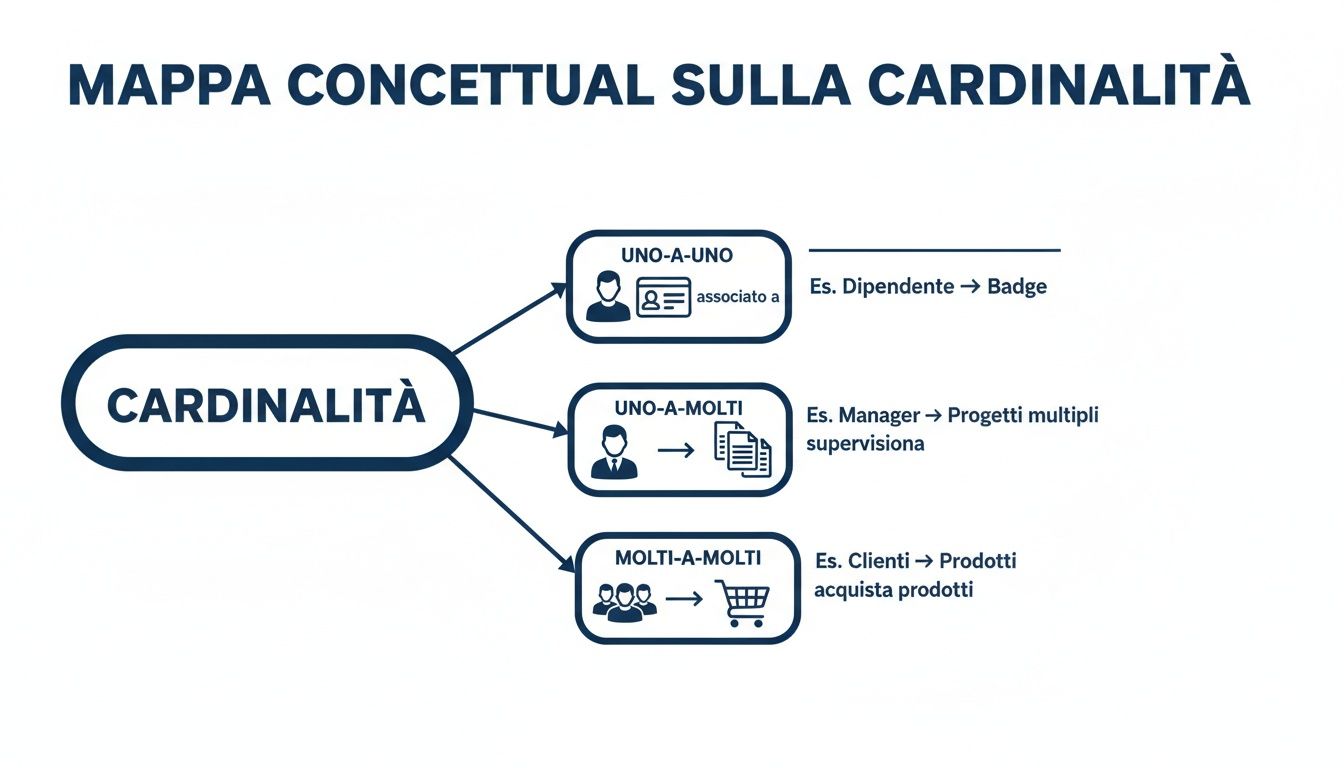
This visual map is crucial because it translates your business rules into a logical, universal diagram. Choosing the right notation (such as the Chicken Foot diagram) makes the model immediately understandable. If you want to see how these concepts apply in a real-world context, our article on a sample database for a website offers practical insights.
The first draft is ready. Now, take a step back and look at it with a critical eye. Does the diagram truly serve the purpose you defined at the beginning? Are any key entities or attributes missing? Do the relationships and their cardinalities accurately reflect the business reality?
An entity-relationship diagram isn't set in stone. It's a living tool, a tool for dialogue and analysis that must be able to evolve.
Share it with your colleagues and anyone else familiar with the subject matter. Their feedback is invaluable, because it will help you make the model not only accurate, but also clear and useful for everyone.
To get started, free tools like draw.io are perfect. However, as things get more complex, platforms like ELECTE can make all the difference: they use AI to automatically uncover relationships based on the data you already have, reducing manual errors and saving you valuable time.
As your business grows, so does the complexity of your data. There comes a point when a simple entity-relationship diagram (ERD), as useful as it is, begins to show its limitations. It can no longer capture all the nuances of a modern ecosystem.
When you're dealing with big data, complex business scenarios, or NoSQL databases, you need an upgrade. You needthe Enhanced Entity-Relationship Diagram (EERD).
Think of the basic ERD as a good street map of a city. But what if you also need to show subway lines, bike paths, and restricted-traffic zones? You need a more detailed map with multiple layers. The EERD is exactly that: an enhanced model that introduces more sophisticated concepts to describe reality more accurately.
The two pillars of the EERD are generalization and specialization. These may sound like academic terms, but the underlying concept is very practical.
Let's take a generic entity such as Vehicle. This is our superclass. Within your business, however, you may need to track very different information for specific types of vehicles. This is where specialization comes into play:
Vehicle "specializes in" Car and Motorcycles, which become his subclasses.Car will have features that don't make sense for a motorcycle, such as Number of Doors and Type: Power Supply.Motorcycles will have its own specific features, such as Displacement and Type: Easel.Generalization is simply the reverse process. It’s when you realize that Car and Motorcycles they do, however, share some common characteristics (such as Nameplate and Year of Production) and decide to group them into a superclass Vehicle so I don't have to repeat the same information over and over again.
This hierarchy of supertypes and subtypes is a powerful tool for combating complexity. It allows you to avoid duplicate data and build cleaner, more logical, and easier-to-maintain models. It becomes indispensable when your data sources become diverse and chaos is just around the corner.
This advanced approach, developed in the 1980s to overcome the limitations of Chen’s original model, is no longer just an option but a necessity. According to the Digital Innovation Observatory at the Politecnico di Milano, 71% of Italian companies already use EER models to manage complex databases such as NoSQL and graph databases.
The benefits are tangible. A case study in the financial sector showed that monitoring risk using entity subtypes improved the accuracy of predictive models to 96%, cutting operating costs by 32%. If you want to better understand how these models have evolved, this article on the history and future of data modeling offers an interesting perspective.
AI-powered platforms like ELECTE this concept to the next level. Instead of forcing you to manually draw these complex hierarchies, our platform can analyze your data and automatically generate an EERD, identifying the relationships between superclasses and subclasses on its own. It’s a way to unlock a level of business analysis and understanding that would be nearly impossible to achieve with a manual approach.
Now that we’ve explored the basics of entity-relationship diagrams, it’s time to address the questions that almost always arise when we move from theory to practice.
We've compiled the most common questions to provide you with clear, straightforward, and immediately useful answers.
This is one of the key distinctions, but it’s actually simpler than it seems. Think of the logical model as an architect’s blueprint: it defines the structure, the rooms (the entities), and the hallways connecting them (the relationships). It’s an overview that focuses on the “what,” without yet deciding on the type of bricks or the color of the walls. Our entity-relationship diagram is almost always a logical model.
The physical model, on the other hand, is the engineer's implementation design. It takes the architect's blueprint and translates it into technical specifications for construction: the type of database (MySQL, PostgreSQL, etc.), the exact names of the tables, the data types for each column (VARCHAR(255), INT) and the metrics for optimizing performance.
In short, the logical model describes the business, while the physical model describes the technology.
Absolutely not. In fact, it’s a common misconception to think so. Creating an entity-relationship diagram is a business analysis task, not a programming one. The most important skill isn’t writing code, but having a deep understanding of your company’s processes.
Your task is to figure out which data matters, how it’s generated, and how it’s connected. Modern tools, including our platform ELECTE, are designed specifically to let you visualize these relationships without writing a single line of code, allowing you to focus solely on the business context. Many technical steps, such as managing complex logic in SQL, can be automated. If you’re interested in this topic, you can learn more in our article on how to use CASE WHEN in SQL.
An entity-relationship diagram isn’t something you hang on the wall and forget about. It’s a living navigation tool. The golden rule is simple: it should be updated whenever business processes or collected data change significantly.
Think of your ERD as a map: if the city expands and new roads are built, the map needs to be updated to remain useful and keep you from getting lost.
If the company launches a new loyalty program, opens a new sales channel, or introduces a new product category, the diagram must reflect these changes. An up-to-date ERD is a strategic asset; an outdated one is merely a source of confusion.
We’ve taken an in-depth look at the world of entity-relationship diagrams. Here are the key concepts you need to keep in mind:
Understanding and using an entity-relationship diagram means moving beyond flying by the seat of your pants in the sea of data and starting to chart a clear course toward your business goals. It’s the foundation for unlocking the true potential of data analysis and making decisions that lead to real growth.
Are you ready to put theory into practice and leverage the power of AI to analyze your company’s data? ELECTE helps you automatically uncover hidden relationships in your data, effortlessly generating clear models.

.svg)


.svg)
.svg)