
We often hear about Industry 4.0, but in simple terms, what is it really? It is the combination of three key elements: the Internet of Things (IoT), Artificial Intelligence (AI), and data analytics applied to manufacturing. Imagine your factory no longer as a collection of isolated machines, but as an intelligent organism where every component communicates, anticipates problems before they occur, and self-adjusts to maximize efficiency.
This isn’t science fiction, but the fourth major industrial revolution that is transforming traditional factories into smart factories. The fundamental shift is the transition from a reactive approach (“I fix it when it breaks”) to a proactive and predictive one (“I prevent the failure because the data tells me it’s about to happen”). For you, as the manager of an SME, this means fewer machine downtimes, less waste, and an unprecedented ability to make decisions based on real data, not just intuition. It’s the way to make your production more agile, flexible, and, above all, more profitable.
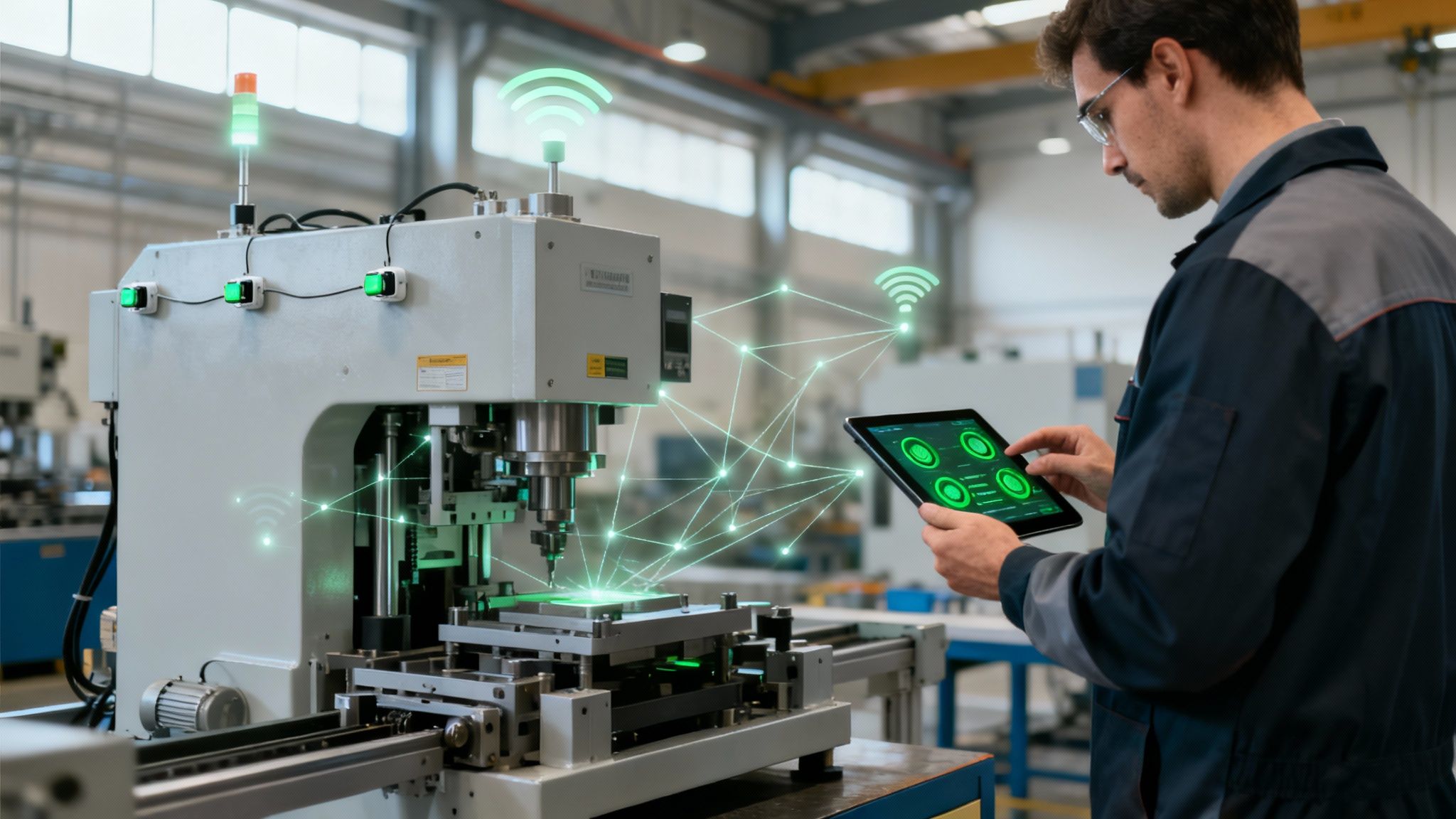
Although the term "Industry 4.0" may sound complex, the underlying concept is very concrete. It represents a major evolutionary leap that is transforming traditional factories into smart factories.
The biggest change lies in how problems are addressed: we’re shifting from a reactive to a proactive approach. Instead of intervening only when something breaks—such as a sudden machine shutdown that halts an entire production line—Industry 4.0 takes a proactive approach. It uses a combination of technologies to predict and prevent critical issues, ensuring a workflow that never stops and is always optimized.
But it’s not just a matter of efficiency. This transformation opens the door to entirely new business models and a level of production flexibility that was once unimaginable. Companies can respond much more quickly to market demands, customize products on a large scale, and, above all, make decisions based on real data updated in real time.
To truly grasp the scope of this change, it’s worth taking a step back. Industry 4.0 is merely the latest chapter in a long history of technological evolution. Each industrial revolution has marked a watershed moment in the way we manufacture, driven by a key technology.
To put things in perspective, here’s a quick comparison.
As you can see, the common thread is a journey toward ever-greater automation and intelligence, culminating in today’s factories that “think” for themselves.
The true magic of Industry 4.0 lies not in any single technology, but in their combination. It is the synergy between different tools that creates a connected and intelligent ecosystem. There are three main pillars that support the entire structure:
Essentially, Industry 4.0 uses sensors (IoT) to "sense" what is happening on the factory floor, data to "understand" processes in detail, and artificial intelligence to "decide" on the best course of action.
To truly understandIndustry 4.0, we need to look at its beating heart: technology. These aren’t isolated tools, but a fully interconnected ecosystem that works in perfect harmony to make your production more agile, precise, and responsive.
The goal is clear: to create a continuous flow of information that transforms raw data into strategic decisions. In practice, this means making production more agile, precise, and responsive. While each technology plays a specific role, it is their collaboration that generates true added value.
It all starts withthe Internet of Things (IoT). Think of it as your factory’s nervous system: a vast network of sensors installed on machinery, production lines, and even finished products.
These sensors continuously collect vital data on every aspect of operations: engine temperature, component vibrations, assembly line speed, or energy consumption. This constant and comprehensive data collection is essential because it provides the “raw material” for all subsequent analyses.
The Italian market has clearly recognized this. Industry 4.0 reached a value of 4.1 billion euros in Italy in 2020, representing an 8% increase over the previous year. Of this total, Industrial IoT technologies accounted for a full 60% of spending. You can explore the details of this growth in the Italian Industry 4.0 market by reading the full report here.
If the IoT is the nervous system, Big Data and Analytics are the brain. All the data collected by sensors—often in enormous quantities and at an impressive speed—ends up here to be processed and analyzed.
This technology makes it possible to manage and interpret vast amounts of information that would be impossible for a human to decipher. Its job is to uncover patterns, correlations, and anomalies hidden within the data, transforming a chaotic stream of numbers into insights that are understandable and useful for your business.
For example, an analytics system can link a slight increase in machine vibrations to a rise in energy consumption, flagging a potential problem days before it turns into an actual breakdown.
This is the key point: data is no longer collected just for the sake of it, but to turn it into insights that inform business decisions.
Artificial Intelligence (AI) and its subset, machine learning, are the neurons of this digital brain. They don’t just analyze the present; they look to the future, answering the crucial question: “What’s going to happen?”
Machine learning algorithms learn from historical data to make increasingly accurate predictions. The practical applications for a manufacturing SME are vast and offer a huge competitive advantage:
Rounding out the picture are other essential technologies that work in tandem with the main ones to keep the entire system running.
Working together, these technologies transform a traditional factory into a smart, proactive system, ready to tackle the challenges of the modern market.
Talking about Industry 4.0 is not simply a matter of modernization. For an SME, it is a strategic investment with a tangible and measurable return on investment (ROI). The basic idea is simple: stop managing production based on gut instinct and start doing so with the support of data. This approach is not a cost, but a genuine driver of growth.
This concept map captures the essence of the process: it starts with raw data and leads to artificial intelligence, which becomes the beating heart of Decision-Making 4.0.
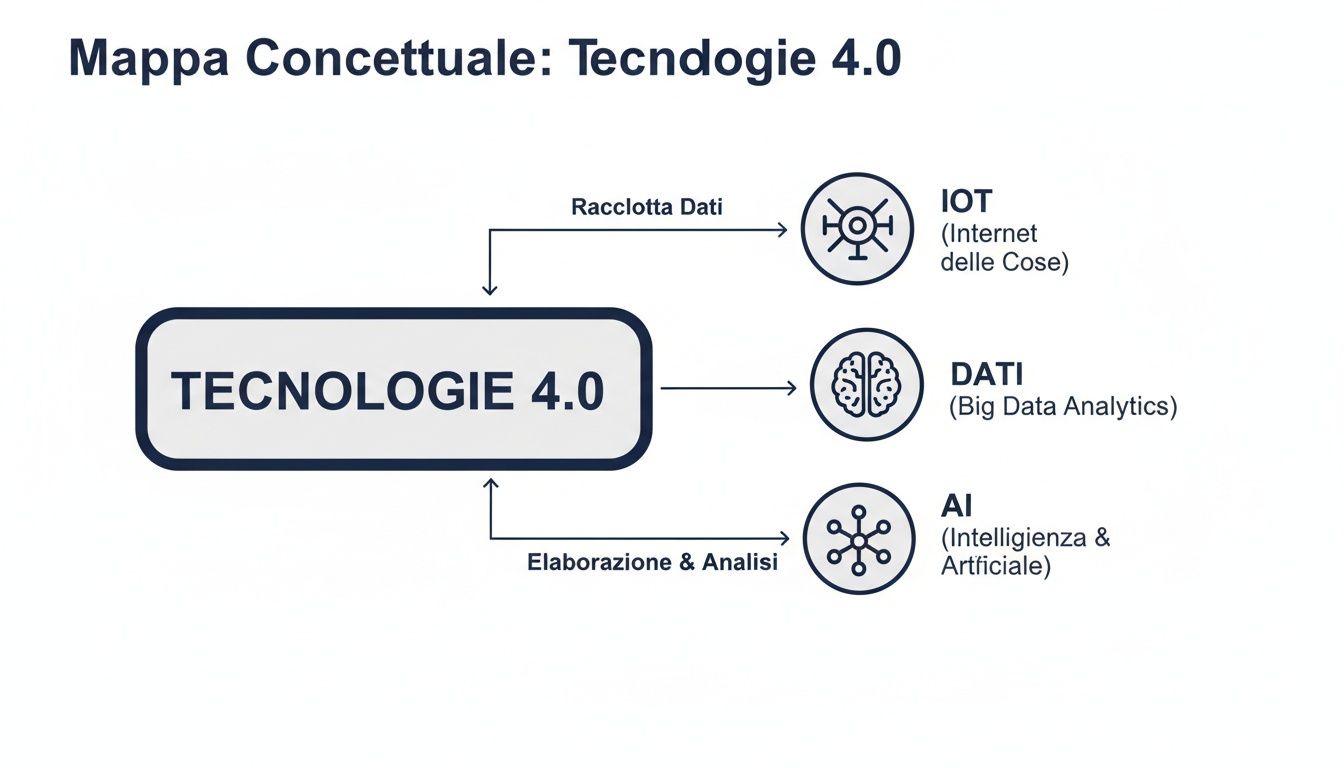
As you can see, it’s a virtuous cycle: IoT sensors collect a flood of data, analytics systems transform it into useful insights, and artificial intelligence uses these insights to suggest or carry out concrete actions. Let’s look at some realistic ROI examples for a manufacturing SME.
One of the fastest ways to see a return on investment is through predictive maintenance. Until recently, there were two options: repairing a machine only after it had broken down, or performing maintenance at fixed intervals without knowing whether it was actually necessary.
Today, thanks to IoT sensors and AI analytics, you can monitor a machine’s “health” in real time. The algorithm learns to recognize those nearly imperceptible signs that foreshadow a failure, such as a slight increase in vibrations or abnormal energy consumption.
This changes everything, because it allows you to:
Another area where the impact is immediate is automated quality control. Imagine using AI-powered machine vision systems to inspect 100% of your production in real time. These systems detect defects that the human eye could never spot, with unmatched speed and precision.
The result? A drastic reduction in waste. Some companies have seen production defects drop by as much as 90% after implementing these solutions . It’s not just about cutting costs associated with wasted materials and labor; it’s also about increasing customer satisfaction and strengthening your brand’s reputation.
Industry 4.0 shifts the focus: it’s no longer about “finding defects,” but about “preventing them.” By analyzing process data, AI identifies the root causes of quality issues and suggests ways to eliminate them at the source.
Understanding what Industry 4.0 is also means realizing how real-time data analysis can revolutionize the entire value chain. Having a clear picture of market demand, order status, and production capacity enables you to make much more effective decisions.
Analytics platforms, for example, allow you to create optimized production plans to maximize efficiency and reduce lead times. Not only that: by analyzing data across the entire supply chain, you can reduce inventory by 20–30%, freeing up valuable capital to reinvest where it’s needed most. If you’d like a practical example of how to calculate these benefits, check out our guide to the ROI of AI implementation.
In short, investing in Industry 4.0 means equipping yourself with the tools to compete in a market that rewards those who are more efficient, flexible, and quality-conscious. It means transforming data from a mere cost into a strategic resource.
Embarking on the journey towardIndustry 4.0 may seem like a Herculean task, almost out of reach for a small or medium-sized business. The truth is, it doesn’t have to be. The winning approach isn’t an overnight revolution, but a gradual evolution made up of concrete, measurable steps.
The secret? Start with strategy, not technology. Instead of asking yourself, “What Industry 4.0 machine should I buy?”, the right question is: “What is the biggest problem or the most costly inefficiency that I want to solve?” The answer to this question will serve as the guiding principle for the entire project.

The first step is purely strategic. Take a critical look at your company and identify the single process that, if improved, would have the greatest impact. It could be a production line with too many downtime issues, an area with an excessively high scrap rate, or a warehouse where inventory management is a nightmare.
This analysis phase is crucial. A clear process map helps you identify bottlenecks and areas where collecting and analyzing data can really make a difference. For more information on how to do this effectively, check out our guide to mapping business processes.
Once you’ve chosen the battlefield, the goal must be crystal clear and measurable. “Reduce downtime on Line X by 20% in six months” is a specific target. “We want to be more efficient” is just a vague aspiration.
Don’t try to digitize the entire company all at once. That’s a recipe for disaster. Instead, choose a small, focused pilot project with a clearly defined goal. This approach, often called a “quick win,” has enormous advantages.
A good pilot project could be:
The idea is to achieve tangible results quickly. This not only demonstrates the concrete value of the investment, but also builds enthusiasm and confidence within your team, paving the way for the next steps.
Industry 4.0 isn't just about technology; it's primarily about people. Even the smartest machines in the world are useless if the people who are supposed to use them don't know how to do so—or, worse, see them as a threat.
It is crucial to involve your employees from the very beginning. Clearly explain the objectives and the expected benefits (including for their day-to-day work), and listen to their concerns. Invest in their training to build the digital skills needed to use the new tools and, above all, to interpret the data they generate.
True digital transformation succeeds when it becomes part of the corporate culture. The goal is to create an environment where decisions are no longer based solely on experience, but are informed and validated by data.
Once the pilot project is complete, it’s time for the moment of truth: analyzing the results. Was the goal achieved? What were the actual benefits? What did you learn along the way?
Use this data to build a compelling internal case. Use the numbers to demonstrate how the investment has generated a tangible return. This will give you the momentum—and the resources—to move on to the next phase: scaling the solution.
Scaling doesn’t mean applying the same solution across the board, but rather replicating the method: identify a new problem, set a goal, launch another pilot project, and measure the results. It’s a cycle of continuous improvement that, step by step, will make your SME stronger, more agile, and more competitive in the market.
Collecting data is just the first step. The true valueof Industry 4.0 only becomes apparent when that flood of information is transformed into smart decisions. But how do you turn thousands of pieces of raw data into concrete action that improves your business?
This is where an AI-powered data analytics platform like Electe plays a crucial role.
Think of Electe an expert "translator" for your company. It takes the complex language of data—numbers, codes, measurements—and translates it into clear, understandable insights for decision-makers. Whether you're a production manager or an analyst.
Data, on its own, is just noise. A sensor that records an engine’s temperature every second generates a flood of information, but this data only becomes useful when a system analyzes it to identify a trend, such as abnormal overheating that typically precedes a failure.
This is where artificial intelligence and advanced analytics come in. A modern platform doesn’t just collect data from various sources, such as ERP systems or IoT sensors. It brings them together, cross-references them, and analyzes them to uncover the correlations that really matter, transforming background noise into clear, strong signals. If you want to get a better idea of how this process works, you can learn more about the fundamentals of Big Data Analytics in our article.
Let’s see how a platform like Electe in practice, enabling the decisions that are at the heart of Industry 4.0.
Performance reports, hassle-free. Instead of spending hours cross-referencing data in spreadsheets, the platform automatically generates charts and dashboards showing line efficiency (OEE), scrap rates, and energy consumption. You can finally focus on taking action, not on collecting data.
Predictive maintenance for everyone. Built-in machine learning models analyze equipment history to predict failures before they occur. When the probability of a problem exceeds a certain threshold, an alert is triggered. This allows for timely intervention, avoiding downtime and the associated costs.
Inventory and demand under control. By analyzing sales data, seasonality, and dozens of other factors, algorithms can predict future demand with surprising accuracy. This allows you to optimize your inventory, avoiding both tying up capital and disappointing customers with out-of-stock items.
The true power of these tools lies in making them accessible. We designed Electe managers and analysts Electe —people who need complex answers without having to become data scientists. Our mission is to democratize data analysis.
Electe, therefore, is not just a platform. It is a strategic partner that provides the insights needed to navigate the complexities of Industry 4.0, enabling even SMEs to compete on equal footing in a market increasingly driven by data.
Here’s what you need to know about Industry 4.0:
Industry 4.0 isn’t the future—it’s the present. For an SME, embracing this change is no longer a choice, but the key to staying competitive and thriving. By taking a strategic and gradual approach, you can transform your data from a simple repository into a driver of growth.
With user-friendly tools like Electe AI-powered data analytics platform, you can harness the power of predictive analytics without the complexity. Start making smarter decisions, reducing waste, and building your factory of the future, one step at a time.
Ready to turn your data into decisions that make a difference? Find out how it works with a free trial.

.svg)


.svg)
.svg)