
Every day, as an SME manager, you face a crossroads: should you trust your instincts or data when making crucial decisions? In a market where speed is everything, intuition alone is no longer enough. This is where an AI startup comes in. Not just a software provider, but an agile partner that finally makes predictive analytics and automated insights accessible to your business.
Startups developing artificial intelligence are filling a huge strategic gap, offering targeted solutions that transform complex tangles of data into clear, straightforward, and almost immediate business decisions. Unlike the platforms of tech giants—which are often expensive, rigid, and oversized—an AI startup focuses on the specific problems of your SME with a flexible, results-oriented approach.
An AI startup doesn't just sell a product; it offers a growth accelerator. It makes advanced analytics, once reserved only for large corporations, an everyday tool for SMEs that want to scale intelligently.
In this comprehensive guide, we will explore how to navigate the Italian and European AI startup ecosystem to unlock the efficiency and profitability hidden in your data. Here's what you will learn:

Talking about innovation in Italy and Europe is no longer a theoretical exercise. It is a concrete and vibrant economic reality, with artificial intelligence as its growth engine. AI startups are not a phenomenon for the select few, but a strategic and accessible response to the hunger for digitalization that every SME faces today.
This ecosystem is fueled by a continuous flow of investment and talent, concentrated in increasingly robust technology hubs. It is a market that finally offers businesses reliable and agile technology partners, ready to tackle tomorrow's challenges, with European excellence as their trademark.
The vitality of this sector is not an opinion, but a fact supported by numbers. The innovative ICT startup sector in Italy is experiencing impressive growth. A report by Anitec-Assinform and InfoCamere has put this trend in black and white: in October 2022, there were already 8,416 innovative startups and SMEs in the sector, with an8.6% jump in just one year. Even more significant is their economic impact: for every euro of production, these companies generate 32.3 cents of added value, clearly outperforming the 22.5 cents generated by the non-ICT sector. You can read the full report on ICT startups in Italy for more information.
These figures tell you one simple thing: investing in an AI startup is not just a technological gamble, but a smart business decision. It means choosing a partner with a more efficient operating model, capable of translating innovation into concrete and measurable results.
What does all this mean, in practical terms, for your company? It means that today you have access to a mature market of specialized solutions, designed to solve specific problems with a speed that was unthinkable just a few years ago. Unlike large corporations, an AI startup moves at your speed and adapts to your needs.
The European AI startup ecosystem offers SMEs much more than technology. It offers access to flexibility, specialization, and a partnership model that large tech players cannot replicate.
The areas where these companies are already making a difference are those that directly impact your profitability:
Collaborating with one of these innovative companies means giving your business a competitive advantage that lasts over time. It means leveraging the best of artificial intelligence not for experimentation, but for faster and more informed growth.
When it comes to choosing a technology partner for data analysis, SMEs find themselves at a crossroads. On the one hand, there are industry giants such as Google and Microsoft, with their immense and powerful ecosystems. On the other, there is a universe of specialized AI startups that are fast-moving and incredibly focused on specific problems.
The decision is by no means trivial, because this choice determines how quickly you can transform data into decisions and, ultimately, into profit. While big tech solutions are designed to be universal, those of an AI startup are built to solve the specific problems of your SME with an almost tailor-made approach.
Tech giants offer robust, integrated platforms capable of handling staggering volumes of data. However, all this power comes at a hidden cost: rigidity. Very often, their solutions require highly advanced technical skills and configuration times measured in months, not weeks. An analytics project thus risks becoming a colossal undertaking.
Startups, on the other hand, are the exact opposite. They are agile by definition, built to adapt quickly to your needs and deliver value in the shortest possible time. They don't offer a "one-size-fits-all" package, but a targeted solution that speaks the same language as your business.
Choosing an AI startup means investing in a partner that grows with you, not a platform that forces you to grow according to its rules. The goal is to achieve a quick ROI, not an oversized infrastructure.
To clarify these differences, we have compared the two approaches. Examining these factors will help you understand why specialization is often a much more powerful weapon than size alone. For further insight, you can read more about navigating the world of big data analytics for SMEs.
As the comparison shows, for an SME that needs quick results without disrupting its structure, a specialized startup offers a much more direct and sustainable path to transforming data into a real competitive advantage.
Artificial intelligence is not an abstract concept. It is a practical tool that you can use to solve everyday operational challenges. The true value of an AI startup emerges precisely here: in its ability to translate complex mathematical models into immediate solutions for real problems. The goal is not to disrupt your business, but to empower it from within, making processes smarter, faster, and more profitable.
A classic challenge for anyone who runs an e-commerce or brick-and-mortar store is the inventory puzzle. Too much stock ties up valuable capital; too little causes stockouts and customers going to the competition. AI turns this dilemma into a strategic opportunity.
An AI-powered analytics platform such as Electe can dig into historical sales data, cross-referencing it with external variables such as seasonality, past promotions, and emerging market trends. The result is an incredibly accurate demand forecast.
For SMEs in the financial services industry, managing risk and regulatory compliance is a crucial activity that, when done manually, consumes a huge amount of time and resources.
Here, artificial intelligence automates surveillance, analyzing thousands of transactions in real time to detect anomalies or suspicious behavior that a human being could never detect at the same speed. This not only improves security, but also frees up your team to focus on higher-value activities.
AI does not replace human judgment in the financial sector, but rather enhances it. It provides it with an analytical "superpower" that allows risks to be identified before they become problems.
This capacity for intelligent automation is one of the major advantages offered by a specialized AI startup.
Launching generic marketing campaigns is like shooting in the dark: expensive and ineffective. Today's customers expect tailored communications. AI finally makes this kind of large-scale personalization a reality.
By analyzing user behavior, purchase history, and interactions with the site, algorithms can segment audiences into micro-groups with previously unthinkable precision. This allows you to create perfect offers and messages for each cluster, maximizing your return on advertising investment.
The idea of bringing artificial intelligence into your business can be intimidating, but it doesn't have to be a daunting task. For an SME, the secret is to start small, one step at a time, measuring results and then growing with confidence. This roadmap is designed for those who, like you, are looking for a clear path with a tangible return on investment (ROI).
The process is based on three concrete pillars: starting with a real problem, applying a targeted solution, and achieving a measurable result.
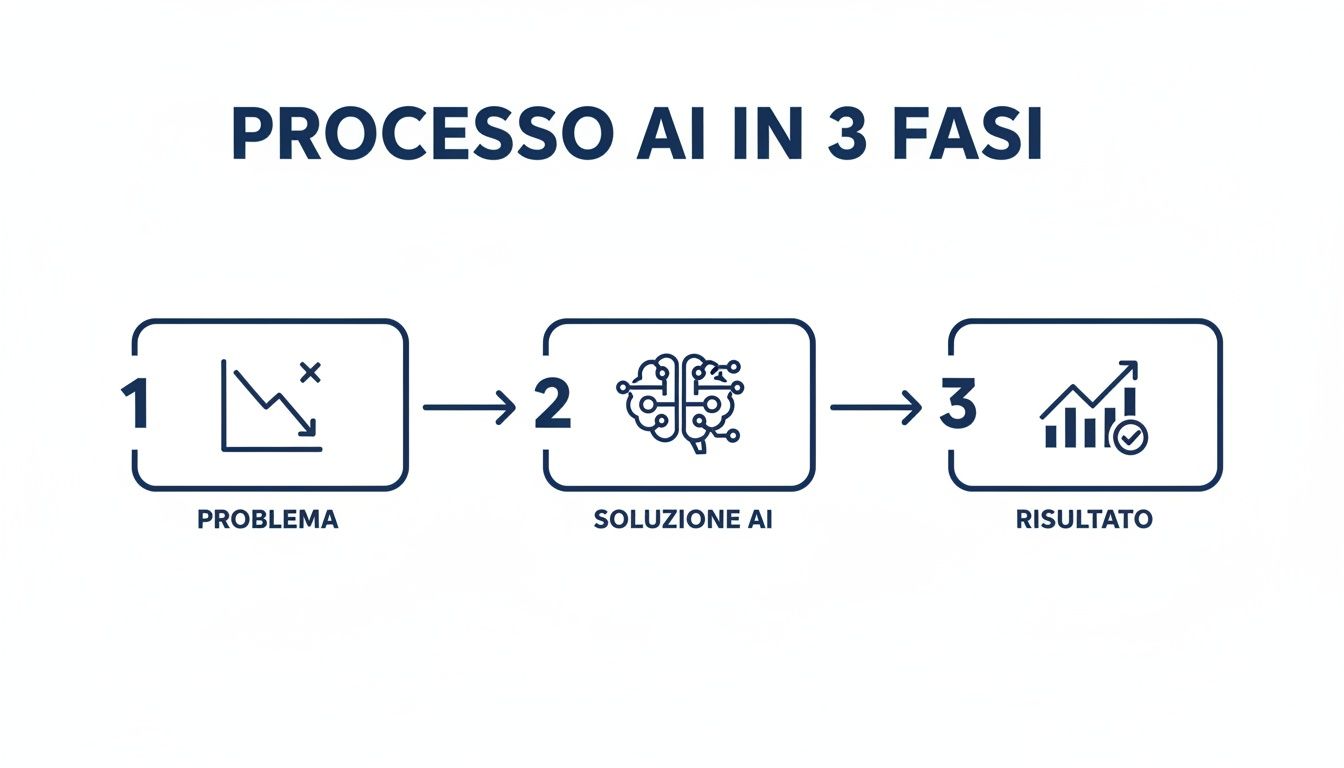
It all starts with a business need (a decline in sales), continues with the application of a specific AI solution, and ends with a tangible improvement (an increase in profitability).
The first step is to look at what you already have in-house. What data do you collect? Where is it stored? Often, you don't need huge data lakes; sales data, social media interactions, or marketing campaign results are a great place to start.
Once you have a clear idea of the raw material, define a pilot project. It must have three key characteristics:
The goal of a pilot project is not to revolutionize the company. It is to create an internal success story, a concrete victory that justifies wider adoption and convinces even the most skeptical.
A well-executed pilot is your best ally. To help you plan it, we have developed a roadmap for AI integration that guides you through each phase.
Choosing a technology partner is a crucial moment. You're not just buying software; you're choosing a travel companion that will help you grow.
When evaluating an AI startup, keep these practical criteria in mind:
By following these steps, AI adoption transforms from an unknown quantity into a structured process that can give you an almost immediate competitive advantage.
We have seen how an AI startup can become a growth accelerator for your SME. Here are the key points to take away with you:
Unlike enterprise solutions, many AI startups offer flexible subscription-based pricing models (SaaS). This lowers the initial investment and makes the technology accessible, with a return on investment (ROI) visible much more quickly.
Absolutely not. Modern platforms such as Electe are designed to be intuitive and "no-code. " This means that you or your team of business analysts can use them directly, without writing a single line of code.
Data security is the number one priority for any serious AI startup. Before choosing, always check compliance with regulations such as GDPR, the use of encryption protocols, and clear policies on information management. Consider security a non-negotiable requirement.
Ready to turn your data into decisions that make a difference? With Electe, you can get clear, actionable predictive analytics in just a few clicks. Start your free trial now →

.svg)


.svg)
.svg)